Impedyme
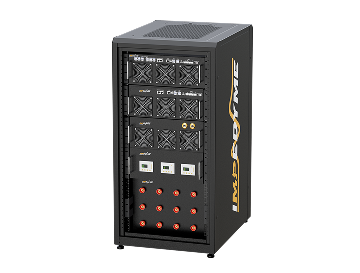
Battery Emulator
Experience precise, real-time battery simulation and testing with the advanced Impedyme Battery Emulator.

What Is a Battery Emulator?
A battery emulator is a programmable, bidirectional power system designed to replicate the electrical behavior of a real battery with precision and flexibility. It electronically reproduces essential characteristics such as voltage, current, internal resistance, power limits, and dynamic response during both charging and discharging cycles—without the need for physical battery cells.
Functionally, a battery emulator behaves like a genuine battery connected to a system under test (SUT). It can source power during discharge and sink power during charge, enabling safe and repeatable testing of chargers, battery management systems (BMS), and battery-powered devices. This bidirectional capability allows engineers to evaluate system performance under normal, boundary, and fault conditions with greater control.
In modern applications, battery emulators play a vital role in EV battery testing, power electronics validation, and battery simulation research. By eliminating safety risks, cell degradation, and long charge-discharge cycles, they provide faster, safer, and more consistent results for battery emulation tests and EIS tests for batteries.

Bidirectional Generative

Fast Parameter Changes

Safe Testing
Battery Emulator vs Battery Simulator
In practice, the terms are often used interchangeably, but there is a technical distinction:
Battery Emulator
- Focuses on real-time electrical behavior
- Interacts directly with power hardware
- Requires fast control loops and high bandwidth
- Used in Power-HIL and closed-loop testing
Battery Simulator
- Often includes higher-level electrochemical or thermal models
- May run offline or slower-than-real-time
- Common in early-stage algorithm development
Why Electrochemical Impedance Spectroscopy (EIS) Is Critical for Battery Pack Validation
As battery systems grow in voltage, power, and complexity, traditional DC charge–discharge testing can’t fully capture performance or degradation behavior. Many key battery characteristics—like aging, internal resistance growth, and dynamic instability—are frequency-dependent and can’t be seen in time-domain tests.
Electrochemical Impedance Spectroscopy (EIS) fills this gap by analyzing a battery’s impedance across different frequencies, revealing detailed insights into electrochemical, thermal, and structural processes within cells, modules, and complete packs.
Today, EIS testing for batteries is a core diagnostic method in battery validation and EV development, helping engineers optimize performance and longevity.

Electrochemical Impedance Spectroscopy (EIS)
EIS characterizes battery complex impedance over frequency, providing deep insight into electrochemical, thermal, and structural processes invisible to time-domain measurements.
EIS + DC Testing
- Frequency-domain insight
- Physically separable processes
- Early aging detection
- Electrochemical fingerprints
- Time-domain performance metrics
- Fast and well-understood diagnostics
- Ideal for baseline health checks
- Industry-standard measurements
Extra Features
High-Fidelity EIS for Battery Packs
Perform precise, scalable EIS tests for batteries in EV and energy storage systems. Wideband (sub-Hz–20 kHz), micro-ohm accuracy, and safe 1,000 V+ operation enable synchronized, multi-channel analysis.
Fast EIS Without Accuracy Loss
Use multisine and PRBS excitation for fast, accurate EIS testing. Analyze multiple frequencies at once and track battery charge, discharge, and aging in real time.
Multi-Channel EIS for Scalable Validation
Speed up battery validation with synchronized multi-channel EIS. Run parallel tests, catch outliers early, and automate state-of-health insights.
Real-Time Battery Emulation with HIL and Power-HIL
Modern batteries interact with BMS firmware, chargers, inverters, and the grid — creating fast, complex control loops that offline testing can’t fully capture. Hardware-in-the-Loop (HIL) and Power-Hardware-in-the-Loop (Power-HIL) systems enable safe, realistic, real-time testing without using live batteries.
Power-HIL Battery Emulation
Power-HIL battery emulation extends simulation into the power domain, linking real-time models with physical converters to recreate realistic energy flow.
This setup enables full-scale testing of:
-
DC-link and current loop dynamics
-
PLL and synchronization behavior
-
Nonlinear impedance and regenerative effects

HIL Battery Emulation
In HIL testing, a real-time battery model runs on deterministic hardware and connects to the DUT (e.g., BMS or inverter) via real I/O.
This battery emulator setup validates:
-
-
SOC-dependent voltage and impedance
-
Protection logic (OV, UV, OC, OT)
-
Fault detection and recovery
-
Core Capabilities
Industry-leading real-time battery emulation platform for Hardware-in-the-Loop and Power-HIL testing.

Real-Time Battery Modeling
FPGA-based real-time emulation with nanosecond time steps. Deploy MATLAB® Simulink® battery models directly for high-power testing reaching multi-megawatt scales with bandwidths up to 20kHz.
ns-level
Time Step
20 kHz
Bandwidth
12.5 Gbps
Optical Link


Impedyme Battery Emulator Software
-
Real Battery Emulation – Simulates Li-ion, NMC, LFP, NCA and other chemistries for advanced battery emulator testing.
-
EIS Analysis – Perform EIS tests for batteries and generate Nyquist and Bode plots instantly.
-
Instant Fault Detection – Flags impedance and stability issues.
-
Custom Test Profiles – Control voltage, current, and frequency for precise battery emulation.
-
Model Fitting – ECM tools for SOH and SOC estimation.
-
Easy Integration – Works with BMS, EV, and ESS systems.
-
Smart Interface – Live diagnostics and auto reports.
Impedyme’s battery emulator speeds up testing and ensures accurate, safe battery research.

Advanced Battery Emulation and EIS Testing for Next-Generation Energy Systems
Battery emulation and EIS testing are transforming how engineers design, validate, and scale advanced energy systems. These technologies deliver precision, repeatability, and deep insight into real-world battery performance.
High-Resolution Measurement and Control in Battery Emulation
Accurate battery emulation demands high-resolution voltage and current measurement. Even µA-level deviations can affect battery-powered systems near cutoff thresholds or during transient states.
To achieve stable and realistic results, a battery emulator must deliver:
-
Wide dynamic range (µA to high-current transients)
-
Low-noise acquisition and deterministic timing
-
Precision measurement fidelity for EIS tests for battery and Power-HIL setups
Precision measurement isn’t optional—it defines model accuracy, loop stability, and test reliability.
Fast Feedback Loops with Battery Emulation
Physical battery testing slows innovation with charge/discharge cycles and degradation effects. Modern battery emulation enables software-driven testing, helping teams:
-
Simulate realistic SOC and impedance profiles
-
Accelerate validation before hardware is ready
-
Automate regression and firmware testing
With battery emulator technology, engineers replace time-consuming manual testing with fast, repeatable digital iteration—cutting development time and boosting product reliability.
Usability and Integration for Engineers
Advanced testing doesn’t have to be complex. A usable battery emulator integrates directly with existing HIL or PHIL setups, offering:
-
Intuitive GUI for setup and monitoring
-
Scriptable automation for repeatability
-
Compatibility with existing test frameworks
-
Real-time insight into SOC, voltage, and impedance
Battery emulation should empower engineers to focus on system behavior—not infrastructure management.
Flexibility in Custom Battery Model Emulation
No single battery emulator fits all chemistries or use cases. Engineers need flexible battery emulation that supports:
-
Li-ion, LFP, NMC, and solid-state chemistries
-
Real-time parameter tuning for SOC and resistance
-
Scalable models from single cell to full pack
-
Aging, temperature, and degradation behavior
Custom model creation ensures every EIS test for battery scenario reflects real-world operation, not assumptions.
Integrated and Accurate System-Level Battery Testing
As systems grow in complexity, disconnected testing creates errors and instability. Integrated battery emulation unifies:
-
Real-time simulation with power hardware interaction
-
Automated test execution
-
High-resolution control and synchronization
This holistic approach minimizes human error and ensures accurate EIS test for battery results across converter-coupled, impedance-sensitive environments.
Scalable, Automated Battery Emulation for Industry
Industrial testing demands throughput and parallelism. A scalable battery emulator architecture enables:
-
Multi-channel, multi-module testing
-
Parallel validation and automated data handling
-
CI/CD workflow integration for continuous testing
By merging automation with battery emulation, organizations cut labor, improve safety, and achieve repeatable, high-quality validation at scale.
Frequently Asked Questions
Ready to Transform Your Battery Testing?
Join leading automotive OEMs, energy companies, and research institutions using Impedyme's real-time battery emulation platform for safe, accurate, and efficient testing.
Ready to Replace Your NHR Battery Emulator?
Already running an NH Research battery test system? See how the Impedyme CHP Series battery emulator compares as a replacement, model for model, then partner with Impedyme to match channel count, power level, and cell emulation fidelity to your BMS, module, and pack validation program.