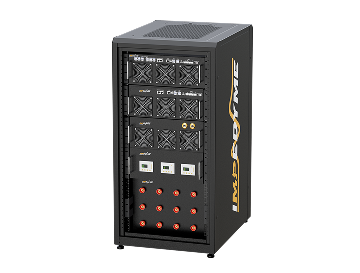

Real-time HIL/ RCP-Box
The Impedyme HIL/RCP-Box is a high-performance modular platform purpose-built for Rapid Control Prototyping (RCP) in power electronics and embedded control systems. Featuring a user-programmable Ultrascale+ FPGA and seamless Hardware-in-the-Loop (HIL) integration, it enables engineers to execute real-time controller testing, accelerate development cycles, and validate advanced converter algorithms with unmatched speed and precision.
What Sets HIL/RCP-Box Apart?
Unlike conventional RCP hardware, the Impedyme HIL/RCP-Box includes industry-grade signal conditioning and next-gen PWM control that meet the demands of today’s fastest power electronic systems:
- Fully Programmable Analog Front-End, allowing precise signal conditioning and adaptation.
- Advanced Pulse-Width Modulation (PWM) Capabilities, supporting high-resolution, high-speed control strategies.
- Comprehensive and Specialized I/Os, catering to the needs of complex power electronics applications.
High-Performance Architecture & Scalability
- Built for demanding applications, the HIL/RCP-Box is equipped with a dual-core ARM processor and an Ultrascale+ FPGA, offering:
- Closed-loop control frequencies up to 250 kHz, enabling real-time execution of advanced control algorithms.
- Scalability up to 64 stacked units, creating a networked system with thousands of I/Os.
- RealSync Technology, a proprietary synchronization system delivering sub-μs transfer latency and ns-level precision, allowing seamless integration of multiple units as if they functioned as a single controller.
- With its real-time processing capabilities, stackable design, and FPGA precision, the Impedyme HIL/RCP-Box is the ultimate hardware-in-the-loop solution for modern RCP workflows.

Model-Based Design Workflow for Ultra-Fast FPGA-Accelerated HIL and RCP
Model-based design is the core of the Impedyme HIL/RCP-Box workflow, enabling engineers to develop, validate, and deploy complex control systems with a unified toolchain. Instead of writing firmware manually, engineers construct high-fidelity plant and controller models in graphical environments such as MATLAB/Simulink, then compile them directly onto the RCP-Box’s multi-core FPGA and ARM-based architecture. This methodology allows seamless transition from offline simulations to real-time Hardware-in-the-Loop (HIL) tests, with the HIL/RCP-Box executing models at sub-microsecond time steps.
Seamless MATLAB/Simulink Integration
The HIL/RCP-Box is natively optimized for MATLAB/Simulink workflows, enabling:
-
Direct compilation of plant and control models onto the FPGA fabric
High-frequency PWM logic, motor models, switching dynamics, and control loops are synthesized in hardware without manual HDL coding. -
Closed-loop real-time execution with fixed sub-µs simulation steps
Essential for wide-bandgap converter testing, high-speed motor control, and nonlinear multi-domain systems. -
End-to-end workflow continuity
Engineers can migrate from simulation → Data acquistion → HIL → PHIL without redesigning or rewriting models.

1. Simulation
Offline Model
High-level Simulink models for plant and control design.

2. Data Acquisition
System Identification
Measured signals refine models before HIL/PHIL.

3. HIL/RCP-Box
Hardware-in-the-Loop
FPGA executes real-time models with sub-µs steps.

4. Power-HIL
PHIL
Models driven into real physical power stages with hardware feedback.
High-Fidelity HIL Through FPGA-Accelerated Architecture
The Impedyme HIL/RCP-Box leverages a multi-core FPGA architecture to overcome the limitations of traditional CPU-based HIL systems, delivering ultra-fast, high-fidelity real-time simulation for power electronics, motor drives, and grid models.
Key advantages:
-
Eliminates bus-transfer latency by co-locating computation and I/O
-
Parallel execution of inverter, motor, and grid simulations
-
Sub-microsecond time steps for high-bandwidth control loops
-
Nanosecond-edge capture for fast switching events
-
Stable simulation of high-order, nonlinear plants including saturation phenomena
Automatic Code Generation and Rapid Deployment
-
Fully automated HDL and C/C++ code generation directly from Simulink control, plant, and FPGA-accelerated models.
-
Converts high-level models into FPGA bitstreams and ARM executables, eliminating manual firmware work.
-
Deterministic model-to-hardware equivalence ensured across the entire toolchain.
-
Unified workflow enables single-click deployment to both FPGA fabric and heterogeneous embedded processors.
-
Rapid build times allow quick iteration when modifying controller logic, regenerating FPGA modules, or updating fixed-point pipelines.
-
Ideal for high-frequency power electronics and converter designs requiring ultra-fast control.
Advanced Real-Time Experimentation and Automation
-
Automated real-time testing via MATLAB, Simulink Test, and external scripting frameworks.
-
Parameter-sweep automation for key control variables (PLL bandwidth, PWM frequency, dead-time, observer gains, FOC tuning).
-
Deterministic, sample-by-sample execution during all experiments.
-
Regression testing and stability validation across firmware revisions.
-
Real-time injection of nonlinear and fault behaviors (saturation, hysteresis, harmonics, short circuits, phase loss, overcurrent/thermal events).
-
High-throughput workflows that accelerate validation and expand test coverage for PHIL, motor-drive RCP, and converter prototyping.
| Feature | Technical Benefit |
|---|---|
| Direct Simulink-to-FPGA Compilation | Hardware-accelerated execution without manual HDL |
| Sub-µs Real-Time Closed Loop | Essential for SiC/GaN inverter and high-speed motor control |
| Automatic Code Generation | Eliminates manual coding and reduces integration errors |
| Rapid Deployment | Fast model updates and tight iteration cycles |
| Advanced Fault/Nonlinearity Injection | High-fidelity testing of corner cases and protection logic |
| Unified Simulation → HIL → PHIL Workflow | Consistent model behavior across all development phases |
Advanced Turnkey I/O and Connectivity Architecture
The Impedyme HIL/RCP-Box features a high-performance I/O and connectivity architecture engineered for real-time control, power electronics testing, motor drive development, and HIL/PHIL applications. Its deterministic, low-latency design enables seamless integration with sensors, actuators, inverters, and communication networks in demanding environments such as EV powertrains, industrial automation, and grid-tied systems.
By combining precision signal conditioning with high-speed digital and optical interfaces, the HIL/RCP-Box delivers noise-resistant, high-bandwidth data flow for advanced closed-loop control and validation.
Precision Sensor & Analog Signal Interface
The HIL/RCP-Box supports high-accuracy, EMI-resistant signal acquisition for real-time control and monitoring.
-
Differential analog inputs/outputs for voltage and current sensing
-
High CMRR front-end for harsh electrical environments
-
Direct connection to temperature, pressure, and Hall-effect sensors
High-Resolution Feedback for Motor & Drive Control
An integrated resolver and encoder interface provides precise rotor position and speed feedback for PMSM, BLDC, and induction motor control. Programmable excitation and accurate angle reconstruction make the HIL/RCP-Box ideal for traction drives, robotics, and aerospace actuation systems.
Real-Time Actuator & Power Stage Control
The HIL/RCP-Box delivers ultra-low-latency digital control and high-speed PWM generation, enabling deterministic control of:
-
Motor drives and servos
-
Power converters and inverters
-
Robotic and automotive actuators
Industrial & High-Speed Communication Interfaces
To support modern control and HIL architectures, the HIL/RCP-Box includes:
-
CAN / CAN-FD for automotive and industrial subsystems
-
High-speed Ethernet for data streaming and SCADA integration
-
UART, SPI, I²C for peripheral and sensor communication
Synchronization I/O for multi-unit HIL and PHIL setups
Ultra-High-Speed Interfaces for Power Electronics
For next-generation inverter and HV systems, the HIL/RCP-Box integrates:
-
SFP+ (up to 12.5 Gbps) for real-time data and multi-node synchronization
-
Fiber-optic I/O for EMI-immune, high-voltage environments
These interfaces are ideal for SiC/GaN inverter testing, microgrids, and PHIL configurations.
High-Speed Digital I/O for Inverter Testing
Advanced digital channels support:
-
Nanosecond-level signal capture
-
High-frequency PWM generation
-
Fault detection and trigger inputs
-
Encoder (ABZ) support
Configurable Front-Panel Expansion Options
To accommodate diverse project requirements, the HIL/RCP-Box is offered in two front-panel expansion configurations. Both variants share the same processing architecture, real-time performance, and model-based design workflow; the only difference is the available expansion module located on the front panel. Users can select the configuration that best aligns with their I/O density, sensor/actuator interfacing needs, or system-level integration requirements. This modularity ensures that each engineering team can choose the optimal connectivity layout without compromising the platform’s core capabilities.

Modular I/O card with configurable analog or digital channels.

Anlog High Resolution Inputs Channels
High-speed 10Gb optical communication links.
Fiber-optic interface with galvanic isolation.
Hardware Architecture and Technical Specifications
The HIL/RCP-Box is built for high-performance rapid control prototyping and real-time HIL/PHIL applications in power electronics and embedded systems. Its optimized hardware architecture delivers the speed, stability, and flexibility required for advanced control algorithm execution.
The system features a high-performance processor for fast real-time computation and precise control, along with expandable memory and storage to support complex models and large datasets. Its compact, industrial-grade design allows easy deployment in lab and field environments.
Advanced power management and thermal control ensure reliable operation under continuous and high-load conditions — making the HIL/RCP-Box ideal for long-duration testing and mission-critical development.
Key technical highlights:
- High-speed, real-time processor
- Expandable memory and storage
- Compact, rugged form factor
- Efficient thermal and power management
Advanced Software Ecosystem and Development Tools
The HIL/RCP-Box is powered by an integrated software ecosystem designed for rapid control prototyping and real-time HIL/PHIL execution in power electronics and embedded control systems. It streamlines the entire workflow—from model development and automatic code generation to deployment, debugging, and live monitoring.
Engineers can work inside a familiar, intuitive environment, staying focused on control algorithms instead of complex configurations. The result is faster validation, fewer errors, and a shorter path from concept to prototype.
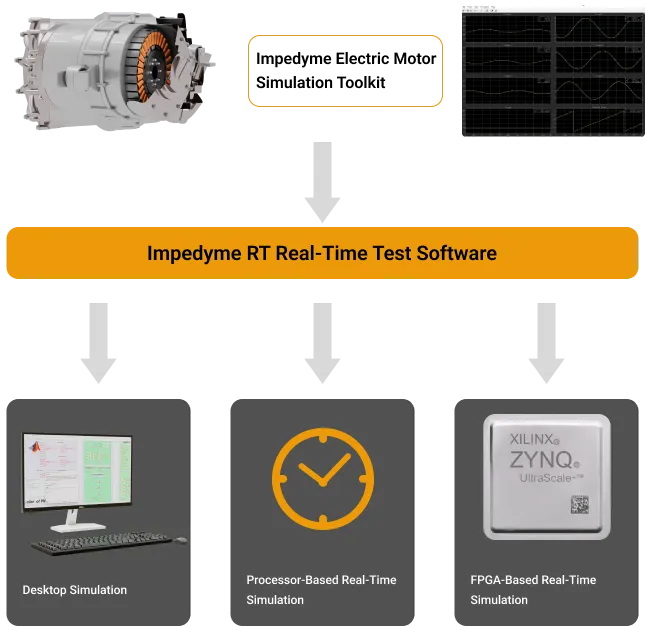
Impedyme-RT (MATLAB/Simulink Integration)
Impedyme-RT connects MATLAB/Simulink directly to the HIL/RCP-Box hardware, allowing models to be deployed to the CPU, FPGA, or a hybrid co-execution setup without manual coding.
It enables:
- Automatic code and HDL generation
- CPU + FPGA co-execution
- Real-time parameter tuning and signal streaming
- One-click deployment to HIL and PHIL environments
With Impedyme-RT, teams can move seamlessly from desktop simulation to real-time HIL and PHIL testing, ensuring consistency, speed, and reliability throughout the development cycle.
Debugging, Monitoring, and Real-Time Analysis Tools
The HIL/RCP-Box gives engineers deep, real-time visibility into internal signals, control loops, and FPGA-level behavior while the system is running. Instead of waiting for offline results, you can monitor performance live, make adjustments instantly, and identify issues at the exact moment they occur.
Engineers can tune parameters on the fly, stream internal variables, and evaluate system performance in real time, making troubleshooting faster and significantly more accurate. This accelerates validation while reducing development risk and rework.
For deeper analysis, the HIL/RCP-Box also provides step-by-step execution tracing, detailed signal logging, and FPGA event visualization, enabling thorough post-processing and root-cause investigation when needed.
Specialized Test and Emulation Applications
The ecosystem comprises domain-specific tools meticulously designed for power electronics and motor drive engineers.
MotorSim Studio
A dedicated motor and drive emulation environment supporting PMSM, BLDC, and induction machines.
Features include:
Real-time nonlinear motor behavior (hysteresis, saturation)
Torque ripple and demagnetization stress tests
Controller robustness and fault injection scenarios
Real-time waveform visualization
GridSim Studio
A high-performance grid emulation and inverter validation tool providing:
Real-time impedance emulation
Voltage ride-through sequences
Harmonic and fault injection
Scalable multi-phase and microgrid emulation
Risk Reduction in Development Projects
The HIL/RCP-Box (Rapid Control Prototyping Box) reduces development risk by enabling early-stage, real-time testing and validation. Teams can identify issues faster, prevent costly redesigns, and maintain smoother project execution in high-pressure development environments.
Key benefits:
- Early error detection
- Real-time validation and verification
- Compliance testing support with industry standards
By integrating advanced simulation and control testing, the HIL/RCP-Box ensures systems meet performance and regulatory requirements—minimizing the risk of failure.
Cost & Time Savings with the HIL/RCP-Box
The HIL/RCP-Box accelerates development cycles through rapid prototyping and real-time testing, significantly reducing time-to-market. It optimizes engineering resources by minimizing physical prototype iterations and maximizing simulation efficiency.
Core advantages:
- Faster development cycles
- Reduced hardware costs
- Higher return on investment (ROI)
This makes the HIL/RCP-Box a cost-effective solution for modern, fast-moving engineering projects.
Real-World Application
The HIL/RCP-Box's versatility is showcased through its extensive real-world applications. It has been successfully integrated into various sectors, revolutionizing complex control systems and prototyping methodologies.
1
Grid-Connected Systems
Inverters, microgrids, and power distribution networks for stable and efficient energy delivery.
2
Electric Drive Systems
High-speed motor control, traction inverters, and industrial automation applications.
3
Energy Storage & Hybrid Systems
Battery management systems, hybrid power applications, and energy balancing solutions.
4
Renewable Energy Technologies
Solar PV inverters, wind power converters, and fuel-cell controllers.
5
Automotive & Electric Mobility
EV powertrains, charging systems, ADAS prototyping, and autonomous vehicle control.
6
Aerospace, Defense & Research
Flight control systems, missile guidance, robotics, academic research, and real-time simulation.
Frequently Asked Questions
Products