
Impedyme Solutions for Academia & Research Centers
Impedyme partners with leading academic institutions, national laboratories, and research teams to drive advancements in power electronics, electric machines, microgrids, and energy conversion systems. By combining high-performance Real-Time HIL, Modular CHP Series PHIL/HIL platforms, Rapid Control Prototyping (RCP) solutions, and MATLAB/Simulink modeling toolchains, we provide researchers with scalable, precise, and open workflows that accelerate innovation and experimentation.
Academic Partnership Program Overview
Impedyme’s Academic Partnership Program collaborates with leading research groups through co-developed research projects, enabling advanced power electronics, microgrid, and electric machine studies from high-fidelity simulation to real-world hardware validation.
Research Groups We Work With
-
Power electronics & wide-bandgap semiconductor research labs
-
Microgrid control and distributed energy resource (DER) centers
-
Electric machine, motor drive, and EV/HEV research teams
-
Undergraduate and graduate experimental laboratories
Co-Developed Research Projects
-
Custom FPGA models and high-fidelity simulation development
-
HIL and PHIL test scenario design and implementation
-
Experimental support for converters, motors, and microgrids
-
Joint research on advanced and novel power electronics concepts
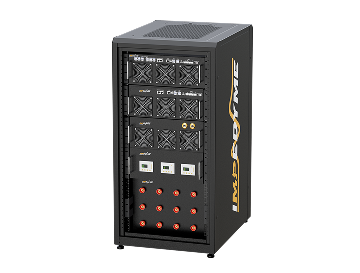
Modular CHP Series — Combined HIL & Power Hardware-in-the-Loop
The CHP Series is a modular, liquid-cooled, FPGA-powered platform for high-dynamic PHIL/HIL research. Its flexible chassis supports converter, motor, grid, and storage emulation in a single reconfigurable system.
Research Applications
-
Advanced motor drives (PMSM, BLDC, induction, nonlinear motor emulation)
-
Wide-bandgap (SiC/GaN) converter prototyping
-
Microgrid control & system-level studies (grid-forming/following, DER emulation)
-
Power quality analysis (harmonics, impedance, multi-physics experiments)

100%
Compatible
<1 µs
Control Loop
<100 ns
FPGA Rate

Real-Time RCP/HIL Box — Rapid Control Prototyping for Research
The Impedyme RCP/HIL Box is a compact real-time platform for fast controller development, algorithm testing, and experimental validation in power electronics and motor drive research.
Key Capabilities
-
FPGA + ARM real-time control architecture
-
High-speed analog, PWM, encoder, and CAN I/O
-
Safe HV/HC sensing via Impedyme Sensor Box
-
Real-time control of converters, motors, and grids
-
Cost-effective platform for research labs
MATLAB/Simulink Blocksets — Impedyme-RT
A native MATLAB/Simulink library enabling seamless progression from modeling to real-time, HIL, and PHIL, with FPGA-optimized blocks for high-fidelity, reproducible research.


Impedyme Open-Source Power HIL
1
hardware drivers & FPGA reference models
2
converter, motor, and grid simulation libraries
3
communication stacks, experiments, and automation
What Is Open-Source Power HIL?
-
Open access to core software, models, and interfaces
-
Customization of FPGA-based motor and converter models
-
Support for custom switching, modulation, and control algorithms
-
Easy integration of third-party or student-developed solutions
-
Enables community contributions and reproducible research workflows
Benefits for Active Power Electronics Research Groups
Impedyme’s Open-Source Power HIL ecosystem is engineered to support advanced, publication-grade research across power electronics, motor drives, microgrids, and energy conversion systems. By providing an open, modifiable, and transparent real-time environment, research teams gain capabilities that are rarely available in traditional proprietary HIL platforms.
Full Customization for Research
Researchers retain full control of real-time models and the FPGA execution layer to enable novel work, including:
-
Custom switching models for SiC and GaN devices
-
Advanced motor models with nonlinear or high-speed behavior
-
Multilevel, resonant, matrix, and MMC converter topologies
-
New modulation schemes, digital filters, and control algorithms
Open Validation Workflow
Transparent model access and solver settings enable rigorous HIL and PHIL studies:
-
Fully visible PHIL timing and parameter paths
-
Reproducible experiments across institutions
-
Publishable research with open reference models
This improves scientific credibility and simplifies multi-university collaboration.
Collaboration & Knowledge Sharing
Open-source Power HIL accelerates innovation through shared development, including:
-
Converter and motor model libraries
-
IEEE 1547 and V2G test scenarios
-
Harmonic, stability, and protection algorithms
The result is a scalable, collaborative research ecosystem for the global power electronics community.
Open-Source Components Provided by Impedyme
The Open-Source Power HIL Initiative includes a comprehensive suite of models, drivers, and reference scripts designed to support advanced academic and industrial research:

Research Domains We Support
1
Power Converter Design & Prototyping
Covers digital control architecture, advanced PWM strategies, and SiC/GaN switching validation. Includes EMI, dv/dt, and transient response analysis.
2
Wide-Bandgap Semiconductor Innovation
Focuses on custom switching models, high-frequency control loops, and system-level impacts on microgrids and motor drives.
3
Microgrid & DER Research
Supports grid-forming/following algorithms, IEEE 1547 ride-through, weak-grid emulation, and harmonic/stability studies.
4
Electric Machine Drive Systems
Includes high-speed PMSM/BLDC/IM control, torque ripple analysis, nonlinear EMF profiling, and fault detection strategies.
5
Energy Storage & Battery Emulation
Enables Li-ion cell, module and pack emulation, ECM characterization, and Hybrid Energy Storage System (HESS) research.
6
System-Level Integration & Testing
Combines converter, machine, and storage models for realistic simulations, reproducible testing, and control strategy validation.
Ready to Advance Your Research?
Partner with Impedyme to accelerate your power electronics research with our cutting-edge platforms and collaborative support.