Battery Simulation Software for EIS Testing — BatterySim Studio
BatterySim Studio is Impedyme's flagship battery simulation software for engineers who design, validate, and certify lithium-ion cells, modules, and packs for electric vehicles, stationary energy storage, and high-performance power electronics. It is a battery simulation software platform that combines 实时硬件在环(HIL) 与 Power-Hardware-in-the-Loop (Power-HIL) emulation with integrated Electrochemical Impedance Spectroscopy (EIS), automated equivalent circuit model (ECM) fitting, and live fault diagnostics inside a single application. Built on Impedyme's FPGA-based CHP (Combined HIL and Power) platform and Power HIL Studio environment, BatterySim Studio replaces a fragmented toolchain — one tool for cell modeling, another for impedance measurement, another for BMS testing — with one MATLAB/Simulink-native battery simulation software workspace that scales from a benchtop coin-cell study to a megawatt traction pack.
What Is BatterySim Studio Battery Simulation Software?
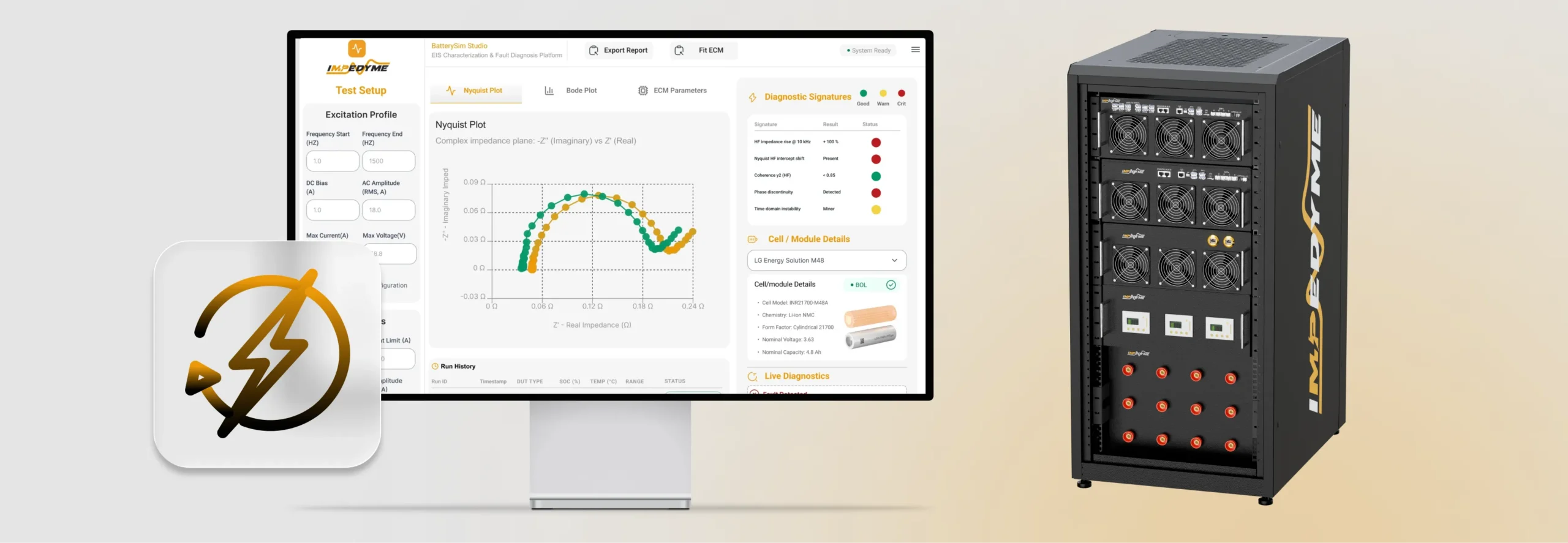
BatterySim Studio is a Windows-based battery simulation software and battery emulation application that runs on Impedyme's Power HIL Studio and CHP hardware. As a complete battery simulation software environment, it lets engineers run physics-aware, real-time simulations of lithium-ion, LFP, NMC, NCA, and emerging solid-state battery chemistries at the cell, module, and pack level; perform high-fidelity EIS measurements over a sub-Hz to 20 kHz frequency range with automatic Nyquist and Bode plotting; automatically fit equivalent circuit models — Randles, Thevenin, dual-polarization, and higher-order RC networks, including fractional-order ECMs with Constant Phase Elements and Warburg diffusion — with SOC, SOH, and temperature-dependent parameterization; emulate a real battery to a BMS, inverter, on-board charger, or DC-DC converter under closed-loop power conditions; and inject faults such as cell imbalance, micro-shorts, sensor failures, over-voltage, and over-temperature while capturing the response of the device under test in real time.
Most battery simulation software occupies a single niche: either offline physics-based design simulation, or simple power-supply control with a lumped cell model. BatterySim Studio is built instead for the validation and emulation phase of the workflow — bringing characterization, modeling, emulation, and diagnostics together so engineers no longer need to move data between separate tools.
Why Battery Simulation Software Is Critical for EV, ESS, and Power Electronics
Faster development
A digital twin in battery simulation software runs in minutes what takes days on a real pack.
Safe fault coverage
Battery simulation software simulates shorts and abuse cases without destroying cells.
BMS validation
Emulated packs test BMS firmware before silicon, meeting ISO 26262 fault-injection needs.
Lower project risk
Power-HIL tests inverters and chargers at full power without staging real batteries.
Core Capabilities of Battery Simulation Software
Real-Time Battery Emulation
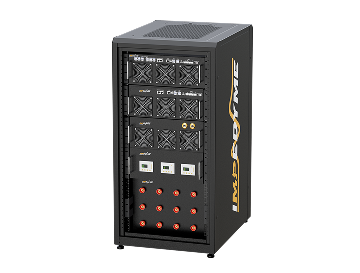
This battery simulation software runs a battery model on Impedyme's FPGA-based CHP platform, with steps as low as 90 ns. A CHP cabinet delivers up to 50 kW of Power-HIL, scaling to 550 kVA/kW paralleled. The virtual battery connects directly to a BMS, inverter, charger, or motor drive.
Control and Protection Validation
Engineers drive the emulated battery through any duty cycle and watch how the BMS reacts to over-voltage, over-current, cell imbalance, and thermal runaway. The battery simulation software re-runs scripted fault catalogs and captures pass/fail signatures on every test.
Integrated EIS Testing and Analysis
This battery simulation software performs EIS from sub-Hz to 20 kHz with micro-ohm accuracy, supports 1,000 V+ full-pack measurements, and uses multisine excitation to capture a full spectrum in seconds — keeping measurement and model in one tool.
Equivalent Circuit Model (ECM) Fitting
The battery simulation software automatically fits an ECM — Rint, Thevenin, RC, Randles, and fractional-order models — parameterized by SOC and temperature, ready for Simulink or a BMS algorithm, with no manual data transfer.
Diagnostics and Fault Detection
Built-in diagnostics translate impedance data into clear health indicators, detecting issues such as internal resistance growth, contact loss, and measurement instability, with real-time pass/fail feedback.
Custom Test Profiles and Automation
Users can define voltage, current, frequency sweeps, and protection limits, then automate testing via MATLAB/Simulink integration. This supports batch testing, SOC-based sweeps, automated logging, and report generation.

What Makes BatterySim Studio Stand Out as Battery Simulation Software?
1
Fusion of real‑time emulation and EIS
2
Automation and openness
3
Tight hardware integration
BatterySim Studio and Hardware-in-the-Loop Testing
BatterySim Studio operates within a Hardware-in-the-Loop (HIL) and Power-Hardware-in-the-Loop (PHIL) environment.
These testing environments connect real hardware devices (such as inverters, controllers, or BMS systems) to simulated battery models.
The result is a closed-loop testing system where engineers can evaluate:
- Battery behavior
- Power electronics interaction
- Control system performance
In conventional HIL, a simulated battery delivers signal-level sensor values to a BMS ECU. BatterySim Studio supports this out of the box. Where this battery simulation software goes further is Power-HIL: by routing the real-time model through a bidirectional regenerative converter, the emulated pack delivers real current and voltage to the device under test — letting engineers validate BMS logic alongside contactor, pre-charge, on-board charger, DC-DC converter, and motor-inverter behavior under production electrical conditions.
Applications and Use Cases

EV Battery Pack Validation

Energy Storage Systems

Academic and Industrial Research

Safety Testing
Battery Modeling Approaches BatterySim Studio Supports
Good battery simulation software should not lock engineers into a single model fidelity. BatterySim Studio works across the full modeling pyramid: empirical and lookup models for the fastest real-time loops; Equivalent Circuit Models — Thevenin, dual-polarization, n-th order RC, Randles, and fractional-order ECMs — fitted directly from EIS data; physics-based reduced-order models including the Single Particle Model and SPMe; Doyle-Fuller-Newman (DFN / P2D) models for offline parameterization, with reduced-order outputs deployed to the real-time engine; and coupled electro-thermal models so heat generation evolves consistently with the electrical state.
Frequently Asked Questions
Make Battery Testing More Intelligent
Explore a complete battery simulation software platform for emulation, impedance analysis, and diagnostic validation.