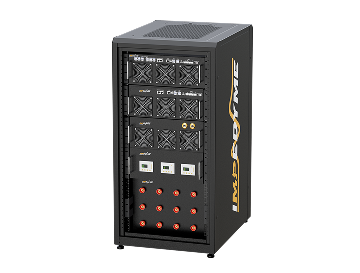

Impedyme Sensor Box
If you work with real-time simulation, hardware-in-the-loop (HIL)还 power-hardware-in-the-loop (PHIL) test benches, you already know how critical reliable signal conditioning is. Even the most advanced real-time simulators can deliver inaccurate results when the measurement interface between the simulator and the device under test (DUT) is noisy, poorly scaled, or insufficiently protected.
That’s where the Impedyme Sensor Box steps in — a precision-engineered sensor box built to solve these exact challenges.
Why a Sensor Box Matters
A sensor box acts as the essential link between high-voltage/current systems and the limited-voltage inputs of real-time simulators. Without proper signal conditioning and isolation, labs risk:
- Ground loops and measurement errors
- Equipment damage from transients
- Noisy or distorted feedback impacting control loops
- Increased setup time for iterative testing
The Impedyme Sensor Box resolves these challenges by scaling, isolating, filtering, and digitizing signals, maintaining speed and accuracy required for PHIL/HIL systems.

Advanced Sensor Interface Themes for Modern PHIL/HIL Power Electronics
High-Power Application Themes
Impedyme 的 传感器盒 is engineered for laboratories pushing the limits of modern power electronics. Its precision signal conditioning, high-speed analog processing, and fully isolated measurement front-end make it the ideal interface for Power HIL, inverter development, microgrid research, motor-drive testing, and protection systems.
Below is a refined, ready-to-publish content section:
Power HIL / Inverter Testing
The Sensor Box provides a clean, stable measurement interface for high-fidelity Power Hardware-in-the-Loop (PHIL) testing.
-
Accurate scaling of L–L / L–N voltages and AC/DC phase currents
-
Stable closed-loop operation under faults, voltage sags, grid disturbances, and high di/dt switching
-
Safe isolation and signal conditioning between high-power inverters and FPGA-based real-time systems
This ensures deterministic PHIL stability for validating converters, grid interfaces, and advanced control algorithms.
Motor Emulation & Drive Testing
Designed for high-performance motor control research, the Sensor Box ensures uncompromised measurement accuracy.
-
High-bandwidth feedback for FOC, torque, flux, and current control loops
-
Precision conditioning of resolver, encoder, Hall, and back-EMF signals
-
Accurate phase voltage and current scaling for realistic drive testing
It enables reliable validation of drive algorithms and extreme transient scenarios.
Microgrid / DER Research
For microgrids and distributed energy resources (DER), the Sensor Box acts as a universal measurement hub.
-
High-fidelity capture of multi-source voltage and current signals
-
Precise PCC measurement for stability, harmonic, and power-quality analysis
-
Support for hybrid systems including battery inverters, PV emulators, wind converters, and generators
Its wide dynamic range and EMI-immune design make it suitable for academic research and industrial DER validation.
Productivity & Workflow Optimization
Impedyme’s Sensor Box is not just a measurement interface—it’s a productivity accelerator designed to help engineering teams work faster, cleaner, and with less downtime.
Reduce Wiring Time — Focus More on Testing, Less on Setup
Banana plug terminals, labeled channels, configurable scaling, and a unified interface dramatically reduce wiring complexity. Engineers spend less time troubleshooting cables and more time running experiments, accelerating daily workflow.
Consistent Measurements Across Multiple Experiments
The Sensor Box ensures you get consistent, predictable measurement behavior from one experiment to the next.
- Same scaling
- Same noise performance
- Same isolation
- Same channel mapping
This consistency is critical for multi-day testing campaigns, regression studies, and verification of iterative control changes.
A Standardized Sensor Front-End for Collaborative Lab Teams
In large labs with multiple researchers, inconsistent wiring or ad-hoc sensor conditioning can lead to wasted time, incorrect data, and repeat mistakes. The Sensor Box becomes a shared, standardized front-end that ensures:
- Unified configuration across teams
- Minimal training time for new users
- Clear documentation and traceability
- Fewer wiring errors and measurement discrepancies
By standardizing sensor interfacing, the Sensor Box keeps teams aligned and productive, even during complex multi-domain projects.