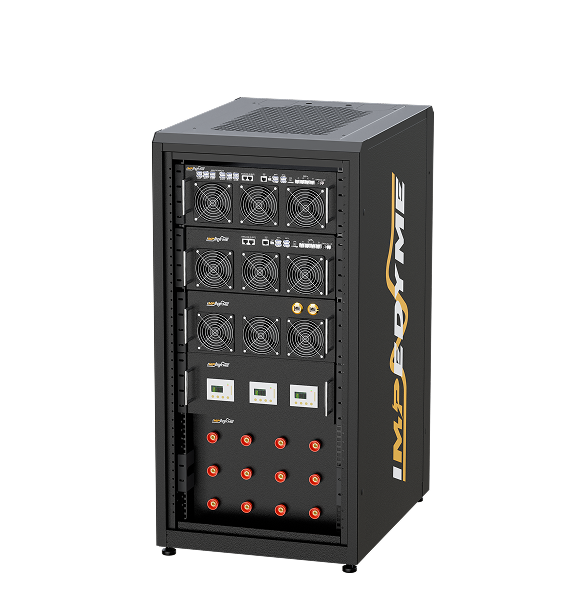

power hardware in the loop

Purpose and Role of Power Hardware in the Loop (PHIL) Simulation

Power Hardware in the Loop (PHIL) simulations are a cornerstone of modern power systems engineering, providing real-time, closed-loop testing of physical hardware within a simulated environment. Their purpose is to let engineers explore the interaction between real devices and virtual models without having to build or risk the entire system in the field. PHIL simulations are particularly valuable in the following scenarios:

  • Early-Stage Design and Development: PHIL should be employed as early as feasible in the design cycle—whether for a new system or an upgrade—once surrogate hardware or functional prototypes become available. This allows iterative testing, fault injection, and performance evaluation under safe and repeatable conditions.
  • Risk, Cost, and Schedule Optimization: Full-system physical testing may be impractical due to high costs, potential safety risks, or time constraints. PHIL simulations provide a powerful alternative, offering repeatability and scalability without compromising data accuracy.
  • Closed-Loop Validation: Unlike software-only simulations, PHIL facilitates interaction between a Hardware of Interest (DUT) and a Model of Interest (MOI) using real electrical signals and power exchange. This closed-loop setup preserves natural coupling, enabling high-fidelity representation of real-world behavior.

It is important to note that PHIL simulations are not intended to fully replace final system-level testing unless physical testing is impractical. Rather, they complement traditional approaches by reducing prototype iterations, enabling early integration validation, and supporting edge-case analysis in a controlled environment.

Technology Development Path with PHIL

  • Principles defined → fundamental concepts identified.
  • Concept created → initial idea or framework developed.
  • Proof of concept shown → early experimental evidence established.
  • Lab validation → technology confirmed under controlled conditions.
  • System tested in real use → early hardware evaluated in practical contexts.
  • Technology proven in relevant setting → demonstrated where conditions resemble operational use.
  • Prototype tested in operation → near-final system trialed in real environments.
  • System finalized and qualified → completed solution verified against requirements.
  • System verified in real operation → full deployment validated in actual field use.
PHIL_Cost

PHIL aligns naturally with these stages, bridging the gap between lab validation and operational deployment. It provides the fidelity of real-power exchange while preserving the flexibility and repeatability of simulation, making it an indispensable tool in the journey from concept to proven system.

Recommended PHIL Simulation Architecture

A robust PHIL simulation environment should incorporate the following principles and components:

  1. System Partitioning
    • Clearly define which parts of the System of Interest (SOI) are real hardware (DUT) and which are modeled virtually (MOI).
    • The combined DUT + MOI should together represent the complete SOI, enabling system-level validation within a PHIL simulation setup.
  2. Real-Time Simulation Environment
    • The MOI must be executed on a Real-Time Simulator (RTS) capable of deterministic, high-speed computation.
    • Simulation time steps should be appropriately small (e.g., microseconds) to capture fast transients and switching events in power electronic systems, which is essential for accurate power hardware in the loop 的测试,该仿真能够帮助识别系统效率低下的问题、改善负载分配,并实现车辆能量性能优化。
  3. Synchronization and Latency Control
    • Time-dependent variables within the MOI must be updated in real time, in lockstep with the physical world, to ensure accuracy.
    • Any interface delays (from power amplifiers, sensors, or controllers) must be accounted for or compensated in the simulation.
  4. Power Interface and Amplifier
    • A power interface, typically via a bidirectional amplifier or grid/motor emulator, is used to exchange power between the MOI and the DUT.

This amplifier should preserve voltage and current waveforms accurately while allowing real-time fault injection, waveform distortion, or grid behavior emulation.

InterfaceDeley

    5. Interface Effects and Compensation

    • Although ideal coupling is desired, practical limitations (e.g., time delays, measurement noise, amplifier bandwidth) introduce interface artifacts.
    • These effects must be:
      • Minimized through proper interface algorithm design (e.g., damping injection, time delay compensation),
      • Characterized through sensitivity analysis and frequency-domain modeling,
      • Documented alongside test results to ensure transparency in interpretation.

Power hardware in the loop simulation is a transformative methodology for real-time testing and validation of power electronic systems, enabling safer, faster, and more cost-effective product development. It bridges the gap between theoretical modeling and full-system prototyping by providing high-fidelity interaction between hardware and virtual models under dynamic and programmable conditions.

A well-designed Power hardware in the loop setup ensures:

  • Realistic power exchange,
  • Full system-level observability,
  • Accelerated development cycles, and
  • Improved reliability through rigorous scenario-based testing.

As the complexity of modern power systems grows—from 自适应控制。 to electric vehicles and AI datacenters—PHIL simulation offer a critical foundation for innovation and certification-ready validation.


 PHIL Key Design Factors: Time Step Selection Guidelines

 One of the most critical design considerations in Power Hardware in the Loop (PHIL) simulation is the selection of an appropriate simulation time step (ΔtRTS) for the Model of Interest (MOI) running on the real-time simulator. The time step determines the temporal resolution of the simulation and directly affects the system’s ability to accurately model dynamic behavior, maintain numerical stability, and synchronize with the Hardware of Interest (DUT).

FPGA-CPU_Timestep

1. Time Step Definition and Role

The simulation time step ΔtRTS defines how often the simulation state is updated. It is the time interval between consecutive simulation points. A smaller time step allows for better resolution of fast transients, switching events, and high-speed dynamics but increases the computational load. Conversely, a larger time step reduces simulation complexity but risks omitting critical behaviors and destabilizing the PHIL loop.

ΔtRTS should be selected based on the fastest dynamics that need to be captured in the system of interest, rather than the system’s fundamental frequency.

2. General Time Step Selection Criteria

To ensure model fidelity and interface stability:

  • The time step must be at least 10 × smaller than the period of the fastest signal to be resolved.
  • ΔtRTS must allow sufficient computation, communication, and actuation delay margin to avoid loop instability.
  • Time step selection should account for:
    • The dynamics of switching devices,
    • Control bandwidths,
    • Sensor and amplifier delay compensation,
    • Numerical solver convergence (especially for stiff systems).

3. Application-Based Time Step Examples

A. AC Power System Applications (e.g., 电网仿真环境, harmonic analysis)
  • Target behavior: Capturing harmonic distortion and waveform anomalies.
  • Design consideration: Instead of selecting a maximum frequency (e.g., 3,000 Hz), determine the shortest time-scale waveform that needs to be resolved.
  • Typical requirement:
    • To resolve harmonics up to the 50th order of a 60 Hz waveform (≈0.33 ms period),
      → desired time step:
      ΔtRTS ≤ (1 / (50 × 60)) ÷ 10 = ~333 µs ÷ 10 = 33 µs
B. Impedance Measurement and Small-Signal Perturbation
  • Target behavior: Apply and resolve fast perturbations to identify impedance profiles during power hardware in the loop 的测试,该仿真能够帮助识别系统效率低下的问题、改善负载分配,并实现车辆能量性能优化。
  • Design consideration: If the shortest injected waveform is 200 µs in period (5 kHz), then:
    • ΔtRTS ≤ 200 µs ÷ 10 = ~20 µs
  • Note: Finer steps improve frequency resolution in impedance sweep results.
C. Electric Machine Simulation
  • Target behavior: Accurate simulation of machine dynamics, torque ripple, and inverter ripple effects.
  • Design consideration:
    • For a high-speed motor with ripple effects occurring on a 50 µs timescale:
      → ΔtRTS ≤ 5 µs
    • For back-EMF waveforms with steep slopes (e.g., 1 kHz back-EMF harmonics), resolve with ΔtRTS ≤ 10 µs.
  • Switching device ripple simulation: If the inverter operates at 20 kHz (50 µs period),
    → ΔtRTS ≤ 5 µs
D. DC-DC Converter and Switching Power Electronics
  • Target behavior: Capturing high-speed switching transients and inductor/capacitor behavior.
  • Design consideration:
    • For a 100 kHz converter (10 µs period), simulation must resolve sub-µs scale events.
    • Recommended ΔtRTS: 5 µs to 1 µs
E. Microgrid and Inverter-Based Resource Simulation
  • Target behavior: Simulating control loops and grid synchronization behavior for power hardware in the loop microgrid studies.
  • Design consideration:
    • For inverter control loops with 2 kHz bandwidth (500 µs period),
      → ΔtRTS ≤ 50 µs
    • To also resolve harmonics up to the 25th order of 60 Hz (0.67 ms / 25 = 26.7 µs),
      → ΔtRTS ≤ 2–5 µs for full fidelity.

4. Practical Guidelines for Implementing ΔtRTS

  • Simulation Tools: Use fixed-step solvers in real-time environments to ensure deterministic and repeatable execution of time-critical simulations. All Impedyme-RT platforms support adjustable simulation time steps (ΔtRTS), enabling users to tailor the temporal resolution based on the dynamics of their system under test, from microsecond-level switching transients to slower electromechanical responses.
  • Interface Compatibility: Match ΔtRTS with interface loop delay budgets (from power amplifiers, A/D, D/A converters, fiber optics, etc.). Include delay compensation mechanisms if needed.
  • Hardware Constraints: Ensure that the selected time step is sustainable by the real-time simulation hardware, considering model complexity, solver type, and I/O overhead.
  • Safety Margin: Always validate your model at a smaller time step first, then increase cautiously while monitoring stability and fidelity—especially important when running a power hardware in the loop configuration.

Summary Table: Suggested ΔtRTS by Application

ApplicationDynamics CapturedSuggested ΔtRTS
并网逆变器测试Harmonics up to 3 kHz≤ 33 µs
Impedance sweep (up to 5 kHz)200 µs perturbations≤ 20 µs
High-speed PMSM simulationBack-EMF and torque ripple≤ 5–10 µs
PWM inverter ripple (20 kHz switching)Ripple, switching noise≤ 1–2 µs
DC-DC converter emulation (100 kHz)Fast transient, ripple suppression≤ 0.5–1 µs
Inverter control emulation (2 kHz BW)Control stability, PLL tracking≤ 50 µs

Determining Required Power Amplifier Temporal Response

In PHIL systems, the power amplifier must accurately reproduce dynamic signals exchanged between the Model of Interest (MOI) and the Hardware of Interest (DUT) within the simulation’s temporal resolution. Rather than specifying performance in terms of frequency, it is more practical—especially for real-time simulation environments—to define amplifier performance using response time or minimum rise/fall time characteristics.

Recommended Practice

Based on empirical engineering practices, the minimum response time of the power amplifier (TAmp should be at least 2× faster than the simulation time step (ΔtRTS) used in the real-time simulator. This ensures that the amplifier can respond rapidly enough to track the high-speed signals generated by the simulation without distortion or delay that would destabilize the closed-loop power hardware in the loop system.

TAmp ≤ 0.5 × ΔtRTS

For example, if the simulation step size is 10 µs, the amplifier’s minimum rise/fall time should be ≤ 5 µs to preserve fidelity and closed-loop stability.

Key Temporal Performance Criteria for Power Amplifier

At this target temporal resolution, the amplifier should meet the following characteristics:

  • Gain Flatness:
    The amplifier’s gain should remain within ±3 dB of its nominal value when responding to signal transitions occurring within TAmp. This ensures consistent power delivery without significant attenuation or amplification of high-speed transients.
  • Phase Delay / Latency:
    The amplifier’s phase shift at this response time should not introduce more than 45° equivalent delay, ensuring minimal phase lag in the closed-loop system and preventing oscillations or unstable feedback dynamics during power hardware in the loop simulation.


Enhanced Temporal Resolution with Impedyme’s Combined HIL and Power (CHP) Platform

Impedyme 的 CHP-Series test platform—integrating both Controller Hardware in the Loop (CHIL)功率硬件在环 capabilities—offers an advanced solution for real-time emulation across a broad spectrum of power electronics and grid-connected applications. One of the defining advantages of this architecture is its enhanced temporal resolution, which enables high-fidelity simulation and rapid response testing even in the most demanding environments.

Unified Architecture for High-Speed Dynamics

Impedyme’s CHP platform is built around a tightly integrated real-time simulation engine (Impedyme-RT) and regenerative power interface systems that operate with ultra-low latency and deterministic timing. This setup supports:

  • Simulation time steps (ΔtRTS) as low as 90 ns, making it possible to resolve microsecond-level switching transients and fast feedback control loops typical in:
  • Synchronized CHIL and PHIL operation, enabling users to test digital controllers and physical power hardware in the loop within the same temporal framework, eliminating timing mismatches and co-simulation delays.

Precision Amplifier and FPGA Co-Design

The CHP platform incorporates high-bandwidth regenerative power amplifiers co-designed with Impedyme’s FPGA-based real-time simulation core, enabling:

  • Amplifier rise/fall times aligned with RTS time steps, ensuring that power exchange between the MOI and DUT reflects true real-world behavior in a power hardware in the loop environment.
  • Interface delays and phase shifts that are tightly controlled, documented, and actively compensated in real time.
  • Reliable emulation of natural coupling between voltage and current with microsecond precision, supporting real-time testing of:
    • Grid-tied inverters under abnormal grid conditions
    • Motor drives with torque ripple and current ripple dynamics
    • Converter-based power shelves in AI server racks

Application Scalability Across Time Scales

Impedyme’s enhanced temporal resolution supports a multi-timescale simulation environment, making it ideal for:

Application DomainTemporal Resolution RequirementSupported by CHP?
PWM ripple and switching lossesSub-microsecond (0.5–2 µs)✅ Yes
Torque ripple and machine dynamics5–20 µs✅ Yes
Grid-tied harmonic analysis20–100 µs✅ Yes
Impedance response emulation10–50 µs✅ Yes
Real-time controller validation90–500 µs✅ Yes

This ability to span wide time domains ensures engineers and researchers can use a single platform for rapid prototyping, functional testing, controller validation, and hardware fault injection—without needing to change the test environment.

Impedyme Motor Emulation Platform

系统 Impedyme Motor Emulator (IME) is engineered to provide ultra-high-fidelity, real-time emulation of electric machines for inverter testing across e-mobility and industrial applications. Designed for seamless integration within power hardware in the loop environments, it interfaces directly with high-performance traction inverters, supporting DC-link voltages up to 1000 Vphase currents up to 800 Arms, while maintaining significantly higher dynamicslower current ripple than the device under test (DUT). This ensures that the emulator never becomes the limiting factor in system performance or stability assessment.

Conventional motor emulators often rely on relatively low switching frequencies, which inherently limit their dynamic behavior and result in restricted emulation quality. To overcome this, the Impedyme Motor Emulator operates with a switching frequency of 800 kHz, enabling it to reproduce highly dynamic current and voltage waveforms with very low ripple. The emulator supports fundamental phase current frequencies in the range of 10–20 kHz, allowing it to cover extremely demanding applications, including very high-speed drives well beyond typical traction ranges.

At the core of the platform is a real-time machine model executed on a high-performance FPGA. The motor model is updated every 90 ns, corresponding to an effective update rate of approximately 11.1 MHz. This ultra-fine temporal resolution means that, even at 10–20 kHz fundamental frequency (periods of 100–50 µs), the emulator performs hundreds to over a thousand model updates per electrical period. This enables:

  •       Detailed modeling of nonlinear motor characteristics, such as magnetic saturation and cross-coupling effects.
  •       High-accuracy representation of torque rippleharmonic-rich back-EMF at elevated electrical frequencies.
  •       Rotor-position–dependent parameter variation, for example modeling flux linkage versus electrical angle with additional harmonic components to capture cogging torque and spatial harmonics at high speed.

The basic IME architecture consists of:

  •       high-resolution multilevel inverter acting as the power output stage.
  •       coupling network at the output to condition voltages and currents at the DUT terminals.
  •       Precision current and voltage measurement for closed-loop control and protection.
  •       high-performance FPGA-based simulation engine implementing PMSM and ASM models (and extensible to other machine types), functioning as a critical component of a 的功率硬件在环(PHIL) setup.

In a typical power hardware in the loop test bench configuration, the 电机模拟器是 is used together with a 电池仿真器 与直流链路电 inverter under test, each with its own DC supply. Both the battery emulator and motor emulator supplies are galvanically isolated, reproducing conditions similar to those in a real electric vehicle where the battery and motor float with respect to earth potential. Power is circulated internally within the PHIL setup so that the AC mains only need to cover system losses (typically on the order of 20% of the inverter’s output power). As a result, it becomes possible to test inverters rated up to ~430 kW using a conventional 400 Vac, 125 A grid connection, rather than requiring a dedicated high-power grid feed.

Software Layer: MotorSim Studio and PowerHIL Studio

The full value of the Impedyme Motor Emulator is realized through its integrated software ecosystem, MotorSim StudioPowerHIL Studio,, which together provide parameterization, visualization, orchestration, and automation of the complete test flow.

MotorSim Studio – High-Fidelity Motor Modeling and Parameterization

MotorSim Studio is the primary environment for configuring and managing the machine models running inside the FPGA-based emulator. It provides:

  •       Model libraries for PMSM, ASM, 无刷直流电机, IPM, and other machine types, with templates for traction, industrial, and high-speed applications.
  •       Parameterization workflows that allow importing data from design tools, datasheets, or experimental characterization (e.g., Ld/Lq, flux linkage maps, saturation curves).
  •       Support for angle-dependent maps (e.g., flux vs. rotor angle, torque vs. angle, saliency maps), which directly leverage the 90 ns model update interval and ~11 MHz update rate to represent nonlinear, rotor-position–dependent effects even at 10–20 kHz electrical frequency.
  •       What-if studies where users can rapidly modify parameters (e.g., d–q inductances, magnet strength, slot/pole combinations) and immediately observe the impact on currents, torque, losses, and inverter stress.
  •       Real-time waveform monitoring (currents, torque, back-EMF, speed, etc.) synchronized with DUT measurements, helping correlate controller behavior with machine physics at very high fundamental frequencies.

By combining detailed parameterization with ultra-fine temporal resolution, MotorSim Studio enables users to emulate real motor behavior under real inverter excitation—rather than relying on oversimplified or idealized models—making it a core part of a high-accuracy power hardware in the loop workflow.

PowerHIL Studio – Test Automation, Sequences, and PHIL Orchestration

PowerHIL Studio, provides the test automation and orchestration layer for the entire PHIL bench, including motor emulator, battery emulator, and grid or load emulators. Key capabilities include:

  •       Scenario and sequence editor for building automated test campaigns: drive cycles, step changes, ramps, speed/torque profiles, and fault scenarios (e.g., phase loss, DC-link sag, short-duration over-speed or over-torque events at high electrical frequencies).
  •       Synchronized control of Motor Emulator, Battery Emulator, and DUT conditions, allowing DC-side, AC-side, and “mechanical” emulation conditions to be coordinated in a single test script—even at 10–20 kHz fundamental frequency in a power hardware in the loop setup.
  •       Tight integration with MATLAB/Simulink® and Impedyme-RT models, allowing users to:

o   Push updated motor models or control algorithms directly into the real-time target.

o   Log high-speed data consistent with the 90 ns internal update capability for detailed offline analysis.

  •       Automated pass/fail criteria and reporting, capturing KPIs such as current ripple, torque ripple, efficiency, controller stability margins, and protection behavior during fast transients.
  •       PHIL safety and limit management, including configurable current, voltage, and power limits, soft interlocks, and controlled shutdown sequences to protect both the DUT and the emulator.

Together, MotorSim Studio and PowerHIL Studio transform the Impedyme Motor Emulator from a powerful hardware block into a complete, software-driven power hardware in the loop test platform—covering everything from high-fidelity modeling and ultra-fast real-time execution (90 ns updates, 10–20 kHz fundamental) to fully automated validation workflows for traction inverters and high-speed drives within advanced PHIL simulation 场景。

Impedyme’s Combined HIL and Power HIL (CHP) platform significantly advances real-time testing by delivering enhanced temporal resolution, ensuring:

  • High-speed response
  • Stability in closed-loop power hardware in the loop interfaces
  • Realistic emulation of physical power systems

This temporal precision is crucial for applications in electric mobility, renewable integration, grid modernizationnext-generation AI power infrastructure—positioning Impedyme as an industry leader in real-time emulation and test technology.