

header hybrid PMSM torque

Torque Control in a Hybrid Excitation Synchronous Machine (HESM) for Electric Traction

引言

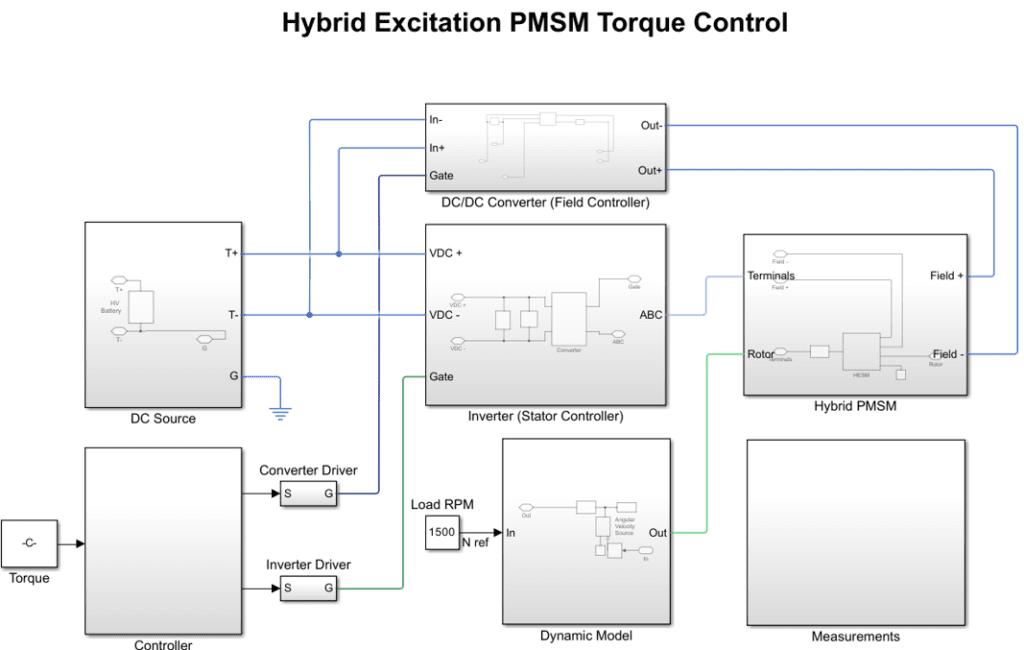
本项目重 torque control in a Hybrid Excitation Synchronous Machine (HESM)electric traction applicationsHESM utilizes a dual excitation mechanism, combining permanent magnets (PMs) and an excitation winding实现 improved flux control and operational flexibility. By optimizing torque production and flux regulation, this simulation provides insights into efficient control strategiestraction motor applications in electric vehicles (EVs) and railway systems.

Hybrid Excitation PMSM Torque Control

系统概述

What is a Hybrid Excitation Synchronous Machine (HESM)?

Hybrid Excitation Synchronous Machine (HESM) is a type of synchronous motor that integrates both permanent magnets (PMs) and a separately controlled excitation winding. This structure provides dynamic control over the air-gap flux, enabling:

  • Wide-speed operation with field-weakening capability.
  • Improved efficiency over conventional PM and wound-field synchronous machines.
  • Better torque control for electric traction applications.

仿真的目的

本次仿真旨在:

  • Analyze torque production and flux regulation across different speed ranges.
  • Evaluate direct torque control (DTC) and field-oriented control (FOC) strategies.
  • Optimize efficiency and operational flexibility for electric traction.

主要特性

Dual-Mode Excitation Control

By adjusting the excitation winding current, the flux can be controlled dynamically.
➡️ HIL/PHIL 优势: 在部 real-time tuning of excitation strategies for efficiency optimization.

Advanced Torque Control Strategies

仿真平台支持:

  • 磁场定向控制(FOC): Decoupled control of torque and flux for precise performance.
  • 直接转矩控制(DTC): Fast dynamic response without the need for current loops.
    ➡️ HIL/PHIL 优势: 支持 real-world evaluation of control strategies before hardware implementation.

Field-Weakening Capability for High-Speed Operation

The machine can adjust its flux at high speeds to avoid excessive back EMF.
➡️ HIL/PHIL 优势: 在部 real-time assessment of field-weakening efficiency in electric traction applications.

Precise Torque Control

HESMs provide precise and smooth torque control, improving performance and efficiency in electric traction systems.

高效率

HESMs combine the advantages of PMSMs and WRSMs, offering high efficiency and flexible excitation control.

再生制动:

Torque control enables efficient energy recovery during braking, improving overall energy efficiency.

灵活性

HESMs can operate under a wide range of conditions, making them suitable for various industrial applications.

仿真目标

本仿真用于评估:

  • The effectiveness of torque and flux control methods.
  • Dynamic performance of the HESM under varying load and speed conditions.
  • Energy efficiency improvements for electric traction applications.
    ➡️ HIL/PHIL 优势: 支持 real-time validation before deployment in traction systems.

技术说明

系统配置

  • 输入端: DC power supply or battery system for EV applications.
  • 输出端: Controlled torque and speed via an inverter-fed HESM.
  • 功率级: IGBT/MOSFET-based three-phase inverter.

控制方法学

  • Torque Control: Implemented via FOC and DTC strategies.
  • Flux Regulation: Achieved through excitation current adjustment.
  • 调制技术 Space Vector PWM (SVPWM) for smooth inverter switching.
    ➡️ HIL/PHIL 优势: 支持高 real-time implementation of different control algorithms.

Advantages of HESM for Electric Traction

  • Improved Efficiency: Optimal flux control reduces losses.
  • Wide Speed Range: Field-weakening capability allows high-speed operation.
  • Higher Torque Density: Better performance compared to traditional synchronous machines.
    ➡️ HIL/PHIL 优势: 支持 precise tuning of control parameters for real-world applications.

应用领域

铁路与地铁系统

Electric Trains: HESMs are used in electric locomotives and metro trains for efficient traction and regenerative braking. Torque control ensures smooth operation and energy recovery during braking.

Light Rail and Trams: HESMs provide precise torque control for light rail and tram systems, improving energy efficiency and passenger comfort.

电动汽车(EVs)

Passenger Cars: HESMs with torque control are used in electric cars to provide smooth acceleration, regenerative braking, and efficient power conversion. Simulations optimize torque control algorithms for improved performance and energy efficiency.

Commercial Vehicles: Electric buses, trucks, and delivery vans use HESMs for reliable and efficient traction, especially in stop-and-go urban driving conditions.

工业机械

Electric Forklifts: HESMs with torque control are used in electric forklifts for precise load handling and efficient operation in warehouses and factories.

Conveyor Systems: HESMs provide reliable torque control for conveyor systems in manufacturing and logistics, ensuring smooth material handling.

航空航天与国防

Electric Aircraft: HESMs are used in electric and hybrid aircraft for propulsion and auxiliary systems. Torque control ensures efficient and reliable operation under varying flight conditions.

Military Vehicles: Electric and hybrid military vehicles use HESMs for traction, providing high torque and efficiency in challenging terrains.

船舶与海上平台应用

Electric Ships: HESMs are used in electric and hybrid ships for propulsion and auxiliary systems. Torque control ensures efficient operation and energy recovery during braking.

Underwater Vehicles: HESMs provide precise torque control for remotely operated vehicles (ROVs) and autonomous underwater vehicles (AUVs), enabling efficient and reliable operation.

农业与工程机械设备

Electric Tractors: HESMs with torque control are used in electric tractors for efficient and precise operation in agricultural applications.

Electric Excavators: HESMs provide reliable torque control for electric excavators, improving energy efficiency and performance in construction sites.

物料搬运与物流系统

Automated Guided Vehicles (AGVs): HESMs are used in AGVs for precise torque control, ensuring efficient and reliable operation in warehouses and factories.

Cranes and Hoists: HESMs provide reliable torque control for cranes and hoists, improving safety and efficiency in material handling.

研究与开发

电池集成:: Simulations are used to test and validate HESM prototypes, reducing the need for physical testing and accelerating development.

控制策略开发:: Simulations help develop and optimize torque control algorithms for HESMs, ensuring efficient and reliable operation.

故障分析:: Simulations help study the behavior of HESMs under fault conditions, improving system reliability and safety.
➡️ HIL/PHIL 优势: 为后 real-time simulation of diverse applications before hardware deployment.

仿真带来的优势

通过本仿真,用户可以:

  • Analyze torque dynamics and flux control efficiency.
  • Compare FOC and DTC performance for optimal selection.
  • Optimize excitation strategies for energy-efficient operation.
    ➡️ HIL/PHIL 优势: 无需 hardware-level validation before real-world implementation.

总结

系统 Torque Control in a Hybrid Excitation Synchronous Machine (HESM) Simulation 为分 detailed framework for studying torque control strategies, flux regulation, and efficiency optimization. Impedyme的HIL与PHIL 解决方案,开发流程得以大幅提升:

开发阶段Impedyme 的贡献
Torque Control DesignHIL-based validation of FOC and DTC algorithms
Flux Regulation TestingPHIL with real excitation control implementation
Field-Weakening AssessmentReal-time evaluation of high-speed operation
Energy Efficiency OptimizationSimulation-based tuning for traction applications

未来提升方向

  • Integration of AI-based adaptive control for real-time torque optimization.
  • Development of predictive maintenance models using machine learning.
  • Implementation of multi-objective optimization for efficiency and performance trade-offs.


系统 Torque Control in a Hybrid Excitation Synchronous Machine (HESM) Simulation 为分 comprehensive platform for optimizing motor efficiency, enhancing performance, and validating advanced control strategies借助 Impedyme 的 HIL/PHIL解决方案,工程师 fine-tune torque control methods, improve energy efficiency, and ensure seamless integration into electric traction systems.