
三相电网连接型太阳能光伏(PV)系统可实现高效的太阳能转换,并与电网实现无缝并网。本仿真模型包含 最大功率点跟踪(MPPT) 以及可配置的 太阳能并网逆变器 选项,以确保系统稳态运行、高电能质量和实时电网同步。工程师可利用该仿真环境在动态光照条件下测试系统性能,并优化可再生能源的输出与利用。
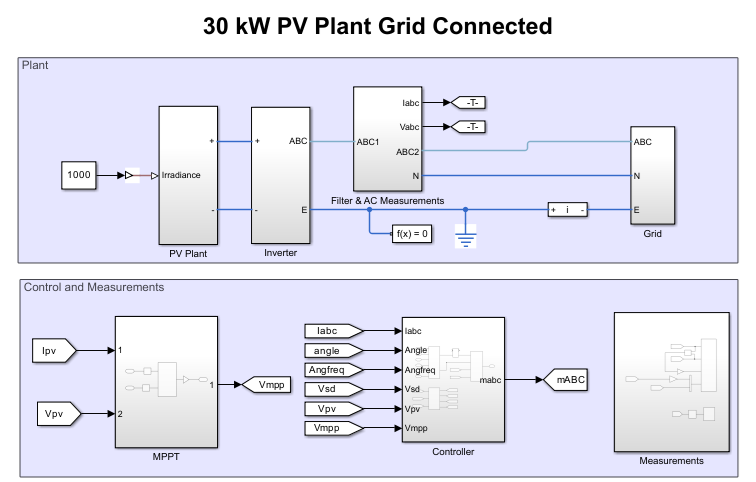
电网连接型光伏系统由太阳能电池板、带有 MPPT 算法的 DC-DC 变换器以及将功率注入电网的 三相太阳能并网逆变器 组成。该系统能够实现实时电力输出,同时保持与电网电压和频率的同步。
本仿真旨在:
➡️ HIL/PHIL 优势: 在部署至实际硬件前,实现实时控制策略验证。
系统实现 MPPT 算法(如扰动观察法、增量电导法),以最大化太阳能电池板的功率输出。
➡️ HIL/PHIL 优势: 在动态太阳能条件下实现实时 MPPT 评估。
升压型 DC-DC 变换器用于调节光伏阵列电压,并确保逆变器的直流母线电压稳定。
➡️ HIL/PHIL 优势: 支持对变换器控制算法的硬件级测试。
基于 IGBT 的 太阳 并网逆变器 将直流电能转换为交流电,并确保与电网同步。
➡️ HIL/PHIL 优势: 验证并网逆变器在真实工况下的性能。
PLL 确保逆变器与电网在相位和频率上的同步。
➡️ HIL/PHIL 优势: 支持对并网同步技术的高精度测试。
仿真可优化光伏系统的设计与运行,实现最大化的能源输出与效率。
通过仿真可确保太阳能并网过程的稳定性,提高电网的电压调节能力与频率稳定性。
通过在设计阶段提前识别潜在问题,可显著降低原型制作与测试成本。
仿真确保光伏系统符合行业安全与性能标准。
本仿真用于评估:
Power Generation Optimization: Simulations are used to optimize the design and operation of large-scale solar farms, maximizing energy output and efficiency.
电网并网: Simulations ensure stable integration of solar power into the grid, analyzing voltage regulation, frequency stability, and power quality.
故障分析: Simulations study the behavior of solar PV systems under grid faults, ensuring reliable operation and compliance with grid codes.
Rooftop Solar Systems: Simulations are used to design and optimize rooftop solar installations for commercial and industrial buildings, ensuring efficient energy generation and grid compatibility.
Energy Cost Reduction: Simulations help businesses analyze the economic benefits of solar PV systems, reducing energy costs and improving sustainability.
Load Matching: Simulations optimize the alignment of solar power generation with on-site energy consumption, reducing reliance on grid power.
孤岛微电网: Simulations are used to design solar PV systems for islanded microgrids, ensuring reliable power supply in remote areas.
并网微电网: Simulations optimize the integration of solar PV systems into grid-connected microgrids, enabling seamless transition between grid-connected and islanded modes.
混合能源系统: Simulations help design hybrid systems combining solar PV with other energy sources (e.g., wind, batteries) for stable and efficient power generation.
电池储能系统(BESS): Simulations are used to integrate solar PV systems with battery storage, optimizing energy management and grid stability.
Peak Shaving: Simulations analyze the use of solar PV and storage to reduce peak demand charges, improving economic efficiency.
Grid Services: Simulations validate the ability of solar PV systems with storage to provide grid services like frequency regulation and voltage support.
太阳能充电站: Simulations are used to design solar PV systems for EV charging stations, ensuring efficient power generation and grid compatibility.
双向充电(V2G): Simulations analyze the integration of solar PV systems with V2G technology, enabling EVs to feed power back into the grid.
Solar-Powered Irrigation: Simulations are used to design solar PV systems for agricultural irrigation, providing a sustainable and cost-effective energy solution.
农村电气化: Simulations help design solar PV systems for rural electrification, improving access to electricity in remote areas.
太阳能水泵: Simulations are used to design solar PV systems for water pumping in agricultural, industrial, and municipal applications.
海水淡化: Simulations optimize the integration of solar PV systems with desalination plants, supporting water supply in arid regions.
➡️ HIL/PHIL 优势: Enables real-time testing under diverse grid conditions.
通过本仿真,用户可以:
系统 Three-Phase Grid-Connected PV System Simulation provides a scalable and accurate testing framework for solar energy conversion and grid integration. Impedyme’s HIL/PHIL 平台 support fast validation, safer designs, and improved power quality through advanced 太阳能并网逆变器 control and MPPT evaluation.
| 开发阶段 | Impedyme 的贡献 |
|---|---|
| PV System Modeling | HIL for real-time solar energy simulation |
| MPPT Algorithm Testing | HIL validation under dynamic irradiance |
| 电网同步 | PHIL-based real grid interaction |
| 电能质量评估 | THD analysis with real-time inverter control |
As Impedyme evolves its HIL/PHIL platforms, engineers gain deeper modeling flexibility, smarter automation, and faster controller validation—empowering solar teams to meet next-generation grid challenges with confidence.