Electric Motor Simulation Software with Impedyme MotorSim
As electric mobility, robotics, industrial automation, and renewable energy systems grow more sophisticated, engineering teams face mounting pressure to validate motor drives, inverters, and power electronics faster and with greater confidence. The right electric motor simulation software has become central to that effort, because traditional testing methods built around physical motors, dynamometers, and mechanical rigs introduce cost, safety risk, maintenance overhead, and limited scalability. Impedyme's MotorSim Studio addresses these challenges directly, giving engineers a high-fidelity electric motor simulation software platform that drives real-time motor emulation hardware and replaces physical machines with accurate, programmable electrical models.
This article explains what electric motor simulation software does, why it matters for modern drive development, and how MotorSim Studio from Impedyme connects simulation to real hardware validation in a single, continuous workflow.
What Is Electric Motor Simulation Software (Motorsim Studio)?
Electric motor simulation software is a tool that lets engineers model, test, and validate the behavior of electric machines and their control systems before, and alongside, physical prototyping. Rather than relying solely on offline calculations or isolated bench tests, a modern motor simulation software environment reproduces real operating conditions, supports dynamic parameter changes, and validates system behavior so that expensive design mistakes are caught early.
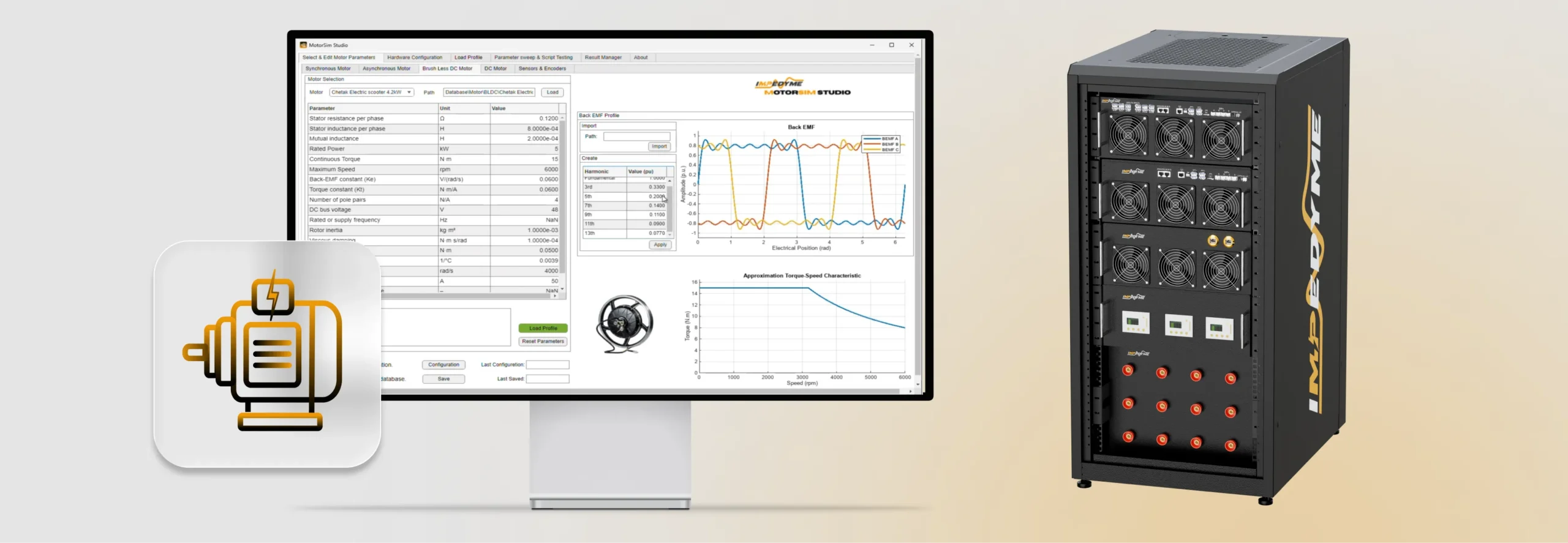
MotorSim Studio is Impedyme's electric motor simulation software platform, built specifically to configure, monitor, automate, and optimize real-time motor emulation. It is not a standalone offline solver. Instead, it is tightly integrated with Impedyme's motor emulator hardware, which means the same models you build in software are the models that run on the emulator during physical testing. For engineering teams, this continuity removes one of the most persistent problems in drive development: the gap between simulation and lab validation, where teams are often forced to rewrite models or switch tools.
In Impedyme's broader ecosystem, MotorSim Studio works alongside the motor emulator hardware, PowerHIL Studio for system-level Hardware-in-the-Loop orchestration, and the HIL/RCP-Box for early-stage controller prototyping. Together these components enable Combined Hardware-in-the-Loop and Power (CHP) testing, allowing engineers to validate control systems and power electronics simultaneously.
Why Electric Motor Simulation Software Matters
Reduce Risk & Improve Performance
The core value of electric motor simulation is risk reduction. By simulating motor and inverter behavior before committing to physical hardware, engineers detect control instabilities, tuning errors, and design flaws early, when they are inexpensive to fix. This avoids the slow, costly trial-and-error cycle that dominates dynamometer-based testing. In industries such as electric vehicles, aerospace electrification, robotics, smart grids, and industrial automation, where efficiency and precision are decisive, this early validation directly shortens development timelines and improves reliability.
Better Collaboration & Faster Development
A strong motor simulation workflow allows control engineers, hardware engineers, and test engineers to work from the same shared model. This improves team alignment and prevents integration problems later in development.
Solutions such as real-time HIL and PHIL testing, like those emphasized by Impedyme, show how simulation tools can support the entire engineering process — from design to system validation.
Motorsim Studio and Impedyme
Motorsim Studio fits naturally within Impedyme’s broader platform because Impedyme specializes in advanced testing and emulation systems for power electronics and motor drives. The company offers a motor emulator designed to accelerate inverter development by simulating real-world loads and validating control logic from signal-level testing to high-power hardware emulation. That makes Motorsim Studio a strong content topic for users who want to understand how simulation connects with actual validation hardware.
Impedyme’s motor emulator supports both real-time control prototyping and high-power hardware emulation, giving engineers a unified development path. This is important because many teams struggle to move from simulation to lab testing without rewriting models or changing tools. By presenting Motorsim Studio alongside Impedyme’s motor emulator, you can position the content around a seamless workflow: simulate, validate, test, optimize, and scale.
Key Components of the Ecosystem
| Component | Role |
|---|---|
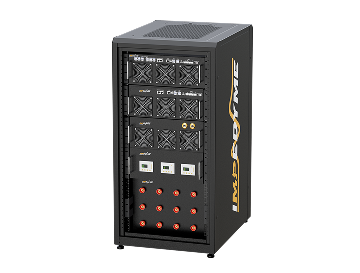
| Motor Emulator Hardware | Replaces physical motors with real-time electrical models |
| MotorSim Studio | Configures and manages motor emulation |
| PowerHIL Studio | System-level Hardware-in-the-Loop orchestration |
| HIL/RCP-Box | Early-stage controller prototyping |
Together, these components enable Combined Hardware-in-the-Loop and Power (CHP) testing, allowing engineers to test control systems and power electronics simultaneously.
Key Features of MotorSim Studio
High-Fidelity Motor Modeling
MotorSim Studio provides advanced models for multiple motor types including:
These models support nonlinear behaviors such as magnetic saturation, hysteresis, and torque ripple, enabling highly realistic simulation results.
Multi-Motor Emulation
The platform enables simultaneous emulation of multiple motors, a capability that few electric motor simulation software tools offer.
This is critical for testing systems such as:
-
Electric vehicle multi-motor powertrains
-
Industrial automation systems
By emulating multiple motors at once, engineers can validate complex system interactions and control strategies.
Fault Injection Testing
Real motors cannot safely be pushed into extreme failure scenarios, which is why fault injection is a critical part of electric motor simulation software. MotorSim Studio supports programmable fault injection, including:
- Phase short circuits
- Open phase faults
- Sensor failures
- Torque disturbances
- Power anomalies
These controlled tests improve controller robustness and safety validation.
Automation and API Integration
Automation is essential to modern engineering workflows. Through API integration, MotorSim Studio turns electric motor simulation software into a fully automated test environment, supporting:
- Parameter sweeps
- Stress testing
- Regression testing
- Batch experiments
Automated testing significantly reduces development cycles and human error.
Integrated Waveform Analysis
MotorSim Studio includes built-in waveform monitoring tools that allow engineers to analyze:
-
Phase currents
-
Voltage waveforms
-
Torque responses
-
Control signals
This built-in oscilloscope functionality enables high-resolution performance diagnostics during testing.
MATLAB / Simulink Integration
MotorSim Studio integrates directly with MATLAB and Simulink, enabling engineers to import control models for Hardware-in-the-Loop validation.
This integration allows teams to:
-
Convert simulation models into real-time testing scenarios
-
Validate control algorithms
-
Ensure software-hardware consistency
Motor Types Supported by MotorSim Studio
MotorSim Studio supports numerous machine types.

PMSM (Permanent Magnet Synchronous Motors)

BLDC Motors

Induction Motors

High-speed traction motors

Industrial AC drives

Multi-phase electric machines
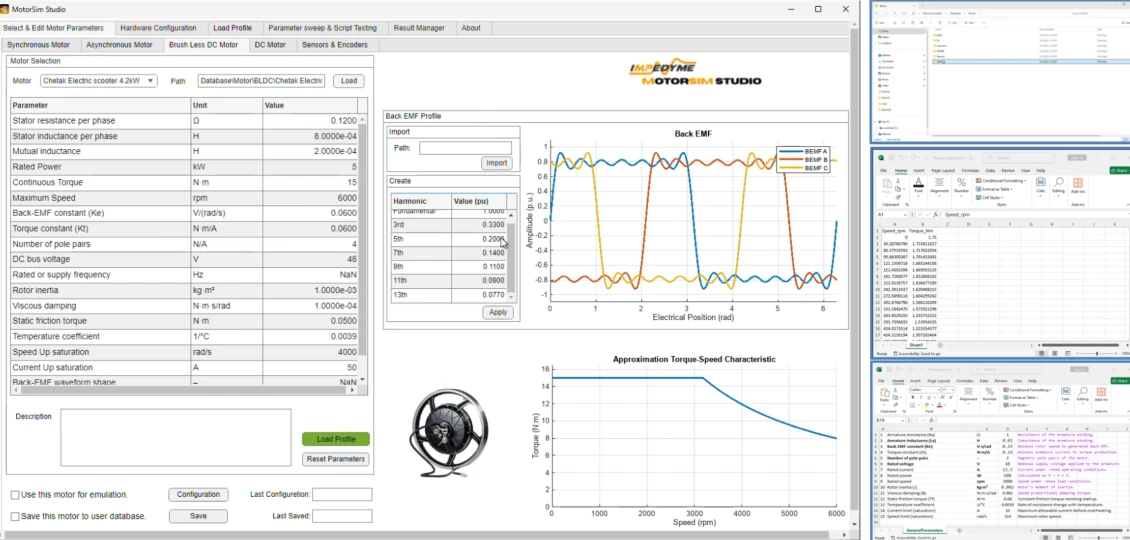
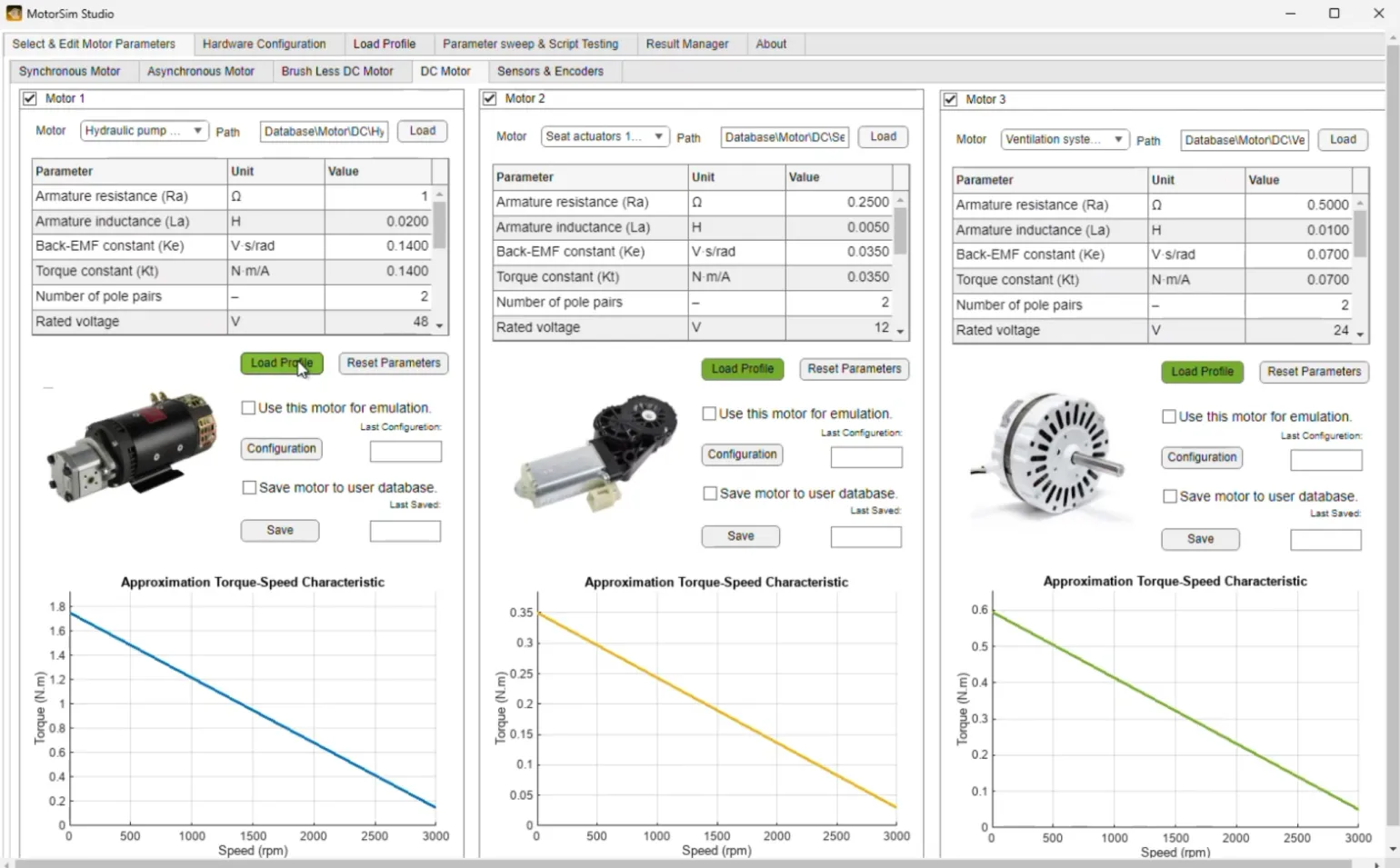
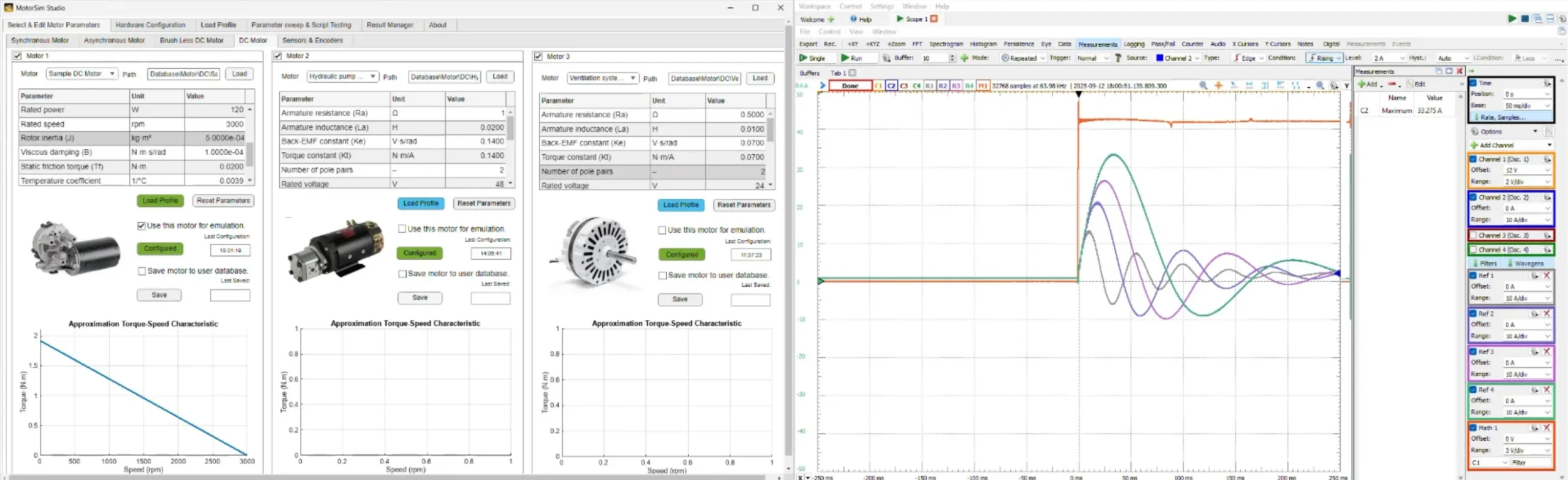
MotorSim Studio provides a structured environment for defining and editing motor models before emulation begins. Engineers can work with separate motor panels, each containing key parameters such as armature resistance, inductance, back-EMF constant, torque constant, pole pairs, and rated voltage, allowing accurate setup of different motor types for simulation and testing.
The platform also supports DC and brushless DC configurations, making it flexible for a wide range of drive applications. Its torque-speed plots and profile-loading options help engineers verify operating behavior quickly, reuse validated settings, and streamline the motor emulation workflow across multiple projects.
Applications of Electric Motor Simulation Software
1
Electric Vehicle Development
EV traction inverters
Drive electronics
Regenerative braking systems
Battery-motor interactions
2
Robotics & Automation
Multi-axis robotic drives
Servo motor behavior
Dynamic load changes
Motion control systems
6
System-Level Integration & Testing
Combines key system models
Enables realistic simulation
Ensures repeatable tests
Validates control strategies
Real-Time Results
MotorSim Studio provides a real-time results view for monitoring motor behavior during testing. Engineers can observe waveform changes, transient response, and live measurements to evaluate how the system performs under different operating conditions. The available signal and channel controls make it easier to inspect key data, compare behavior, and identify issues quickly.
This view turns MotorSim Studio from a setup environment into a practical validation tool. By combining live monitoring with detailed analysis, it helps engineers confirm controller performance, motor response, and emulator accuracy without relying on separate analysis software.
Frequently Asked Questions
Ready to Transform Your Motor Testing?
Join leading automotive OEMs, industrial teams, and research institutions using Impedyme's electric motor simulation software for safe, accurate, and efficient real-time motor emulation.