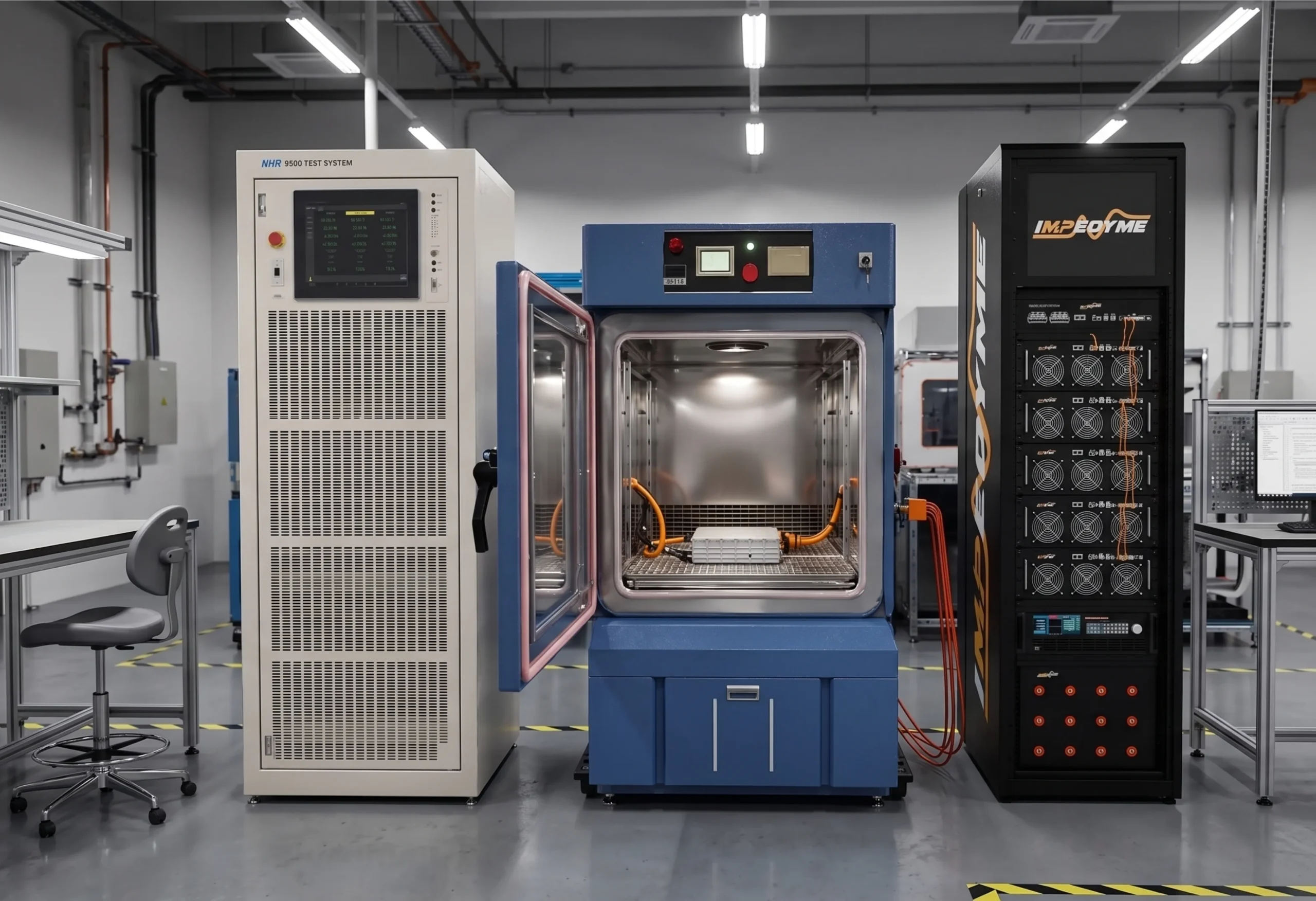
If your lab runs an NHR grid simulator, you already know what it does well. The NH Research 9510 and its smaller sibling, the 9410, became fixtures in grid-tied test benches for a reason: regenerative four-quadrant power, wide phase flexibility, and a built-in amplifier mode that made them usable for Power Hardware-in-the-Loop work long before that was a mainstream requirement.
You also probably know the harder part. Across the distribution channel, the NH Research AC product line — including the 9410, 9430, and 9510 series — is now listed as end-of-life. Resellers describe these platforms as no longer supported. Owners are being told that repairs run through third-party refurbishment channels rather than a factory service path. For a cabinet that weighs over half a tonne, sits on a dedicated 200 A feed, and carries no user-serviceable parts inside, that is not a small problem.
This page is about what comes next. Not a like-for-like swap of one power cabinet for another, but a genuine look at what an NHR grid simulator was actually being asked to do in your lab, which parts of that job have outgrown the hardware, and how Impedyme replaces or upgrades those systems with an FPGA-based real-time simulation architecture built for how validation actually works now.
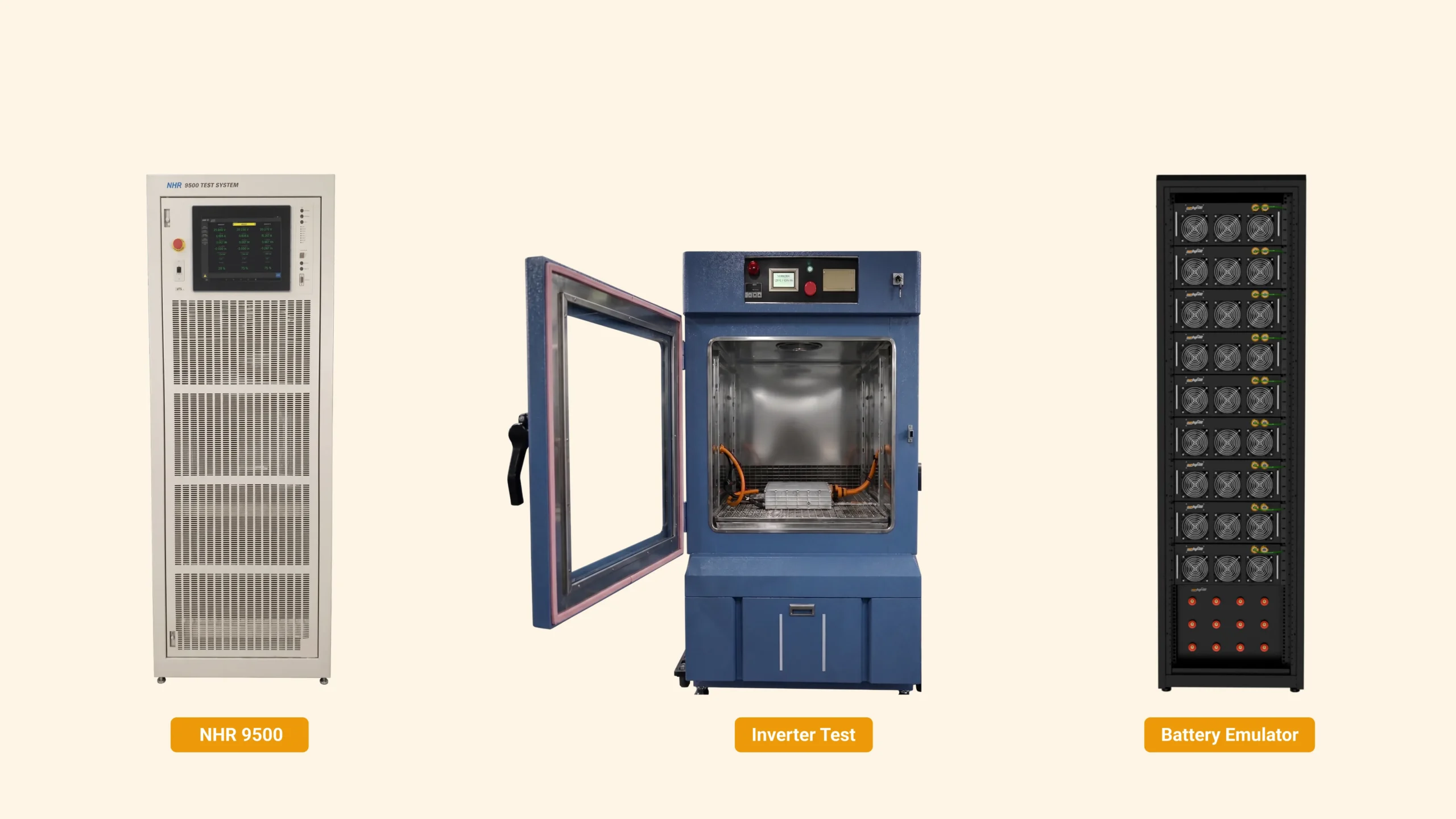
The Impedyme Replacement and Integration Ecosystem
CHP Series
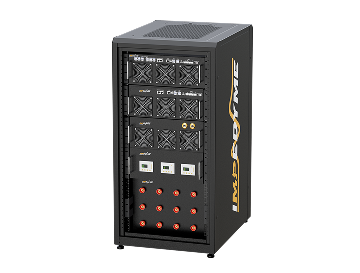
Impedyme's combined HIL and Power HIL platform: an FPGA-based regenerative power system uniting real-time simulation, power amplification, measurement and control. Plant models execute directly on FPGA fabric with time steps as low as 90 nanoseconds. Multi-channel analog and digital I/O, high-speed fibre, stand-alone liquid cooling, benchtop to high-power scaling. For an NHR grid simulator approaching end of standard service, the CHP Series absorbs both the power-stage and the real-time-simulation roles in a single platform — replacing the regenerative grid simulator and the sequencer that drove it in one step rather than two.
Grid Emulator / GridSim Studio
A programmable regenerative grid emulator platform that reproduces the electrical behaviour of a distribution network rather than replaying a fixed stimulus. Source impedance, transformers, feeders, protection logic, neighbouring distributed energy resources and voltage- and frequency-dependent loads all exist as solved models, alongside the compliance library — low voltage ride-through profiles, sags, swells, interruptions, unbalance, frequency and phase excursions, harmonic and interharmonic injection. Where the NHR grid simulator holds a programmed voltage and plays back a downloaded macro, GridSim Studio runs a network that reacts to your converter and lets your converter react back to it.
Real-Time Battery Emulator / BatterySim Studio
A programmable bidirectional battery emulator platform reproducing the electrical behaviour of a physical battery without cells or packs — SOC, OCV, internal resistance, dynamic polarisation, current and power limits, temperature dependence and equivalent-circuit models. For storage inverters, hybrid PV-plus-storage systems and V2G work, it supplies the DC side of the test that an NHR grid simulator alone was never able to provide, on the same platform and under the same automation.
Real-Time HIL / RCP Platform
Higher-level system models and control algorithms operate dynamically with the physical power hardware — feeder and microgrid models, protection coordination, plant-level dispatch, supervisory and grid-forming controllers, thermal and environmental effects — connected directly to the Grid Emulator, DUT and Battery Emulator. The Impedyme Simulink Blockset moves plant models from desktop simulation to real-time execution without a rewrite, and the HIL/RCP-Box lets controller algorithms be prototyped against a high-fidelity grid model long before a power stage is involved.
PowerHIL Studio
The orchestration, automation and test-management layer. Automated sequences synchronise grid emulation, battery emulation, loads, DUT controls, measurements and fault conditions, with pass/fail criteria, reporting, programmable protection limits, controlled shutdown and MATLAB scripting. Two things happen here specifically for NHR migrations: existing macro sequences and test recipes are re-implemented as hardware-agnostic, reusable assets; and a retained NHR 9510 can be driven through its amplifier input as the power interface for a properly modelled network, which is what makes the hybrid path practical rather than theoretical.
Charger Box
EV/EVSE and charger-validation solution for on-board chargers, DC fast chargers, charging interfaces and bidirectional V2G/V2H. Combined with the Grid and Battery Emulators, it validates complete charging-system energy flow and grid interaction without a production vehicle or physical pack.
FPGA Scope
Acquisition running in the same FPGA fabric as the model, so internal model states and real measured signals are observed together at switching resolution on one timebase. This closes the gap left by the cycle-resolution digitizer in the NHR grid simulator: when a ride-through test fails, you see the controller's internal decision and the terminal waveform side by side rather than inferring one from the other.
NHR Grid Simulator vs. an Impedyme HIL/PHIL Platform
| Dimension | NHR grid simulator | Impedyme platform |
|---|---|---|
| Core function | Programmable regenerative power stage | Real-time simulation system with power interface |
| Grid representation | Scripted macro sequences | Solved network model with reactive dynamics |
| Simulation engine | None — sequencer only | FPGA-based, sub-microsecond effective time steps |
| PHIL role | Amplifier with analog input | Full loop: model, interface algorithm, compensation, amplifier drive |
| Measurement | Cycle-resolution digitizer for compliance metrics | Switching-resolution capture, model states and real signals time-aligned |
| Reconfiguration | Hardware mode change, usually rewiring | Model change in software |
| Development workflow | SCPI scripting layer, custom-built per lab | Model-based, Simulink-integrated, automation-ready |
| Domain coverage | Grid simulation and AC/DC load | Grid, battery, motor, charger, aerospace power on one platform |
| Lifecycle status | End-of-life across the channel | Actively developed and supported |
What the NHR Grid Simulator Family Covers
Before talking about replacement or upgrade, it is worth being precise about what is being replaced. The NHR grid simulator range spans several distinct products, and the right migration depends on which one you own.
NHR 9510 / 9530 Regenerative Grid Simulator. The flagship. A cabinet-based, bidirectional AC/DC source built on 100 kW power blocks, with the 9530 designation applied when the same hardware is configured as a four-quadrant AC or DC load. Published model designations run from the 9510-50 through the 9510-1200, covering roughly 50 kW to 1.2 MW, though only the 100 kW cabinet supports parallel expansion — the 50 kW variant is standalone.
NHR 9410 Regenerative Grid Simulator. The lower-power member of the family, generally in the 12 kW to 36 kW range, aimed at PV inverter and grid-tied compliance work that does not need megawatt-class capability.
NHR 9420 and 9430. The AC source and regenerative load siblings that frequently shared a bench with the grid simulators, and which face the same lifecycle situation.
Key published capabilities of the 9510 give a fair picture of the class:
Why NHR Grid Simulator Owners Are Evaluating Now
The service path closed
After acquisition, the AC line was discontinued, leaving aging equipment without factory repair support. The manual confirms there are no user-serviceable parts inside.
The devices under test moved
Its 350 V RMS / 400 V DC limits suited its era but are less suited to today’s 800 V EVs, 1500 V PV systems, and multi-port storage and charging systems.
The test method moved
This is the important one, and it is why a straight power-cabinet swap is usually the wrong answer.
Where the Architecture Runs Out of Room
A sequencer is not a model
A macro is a scripted list of setpoint changes. It plays back regardless of what the unit under test does — fine for a compliance waveform where the standard defines the stimulus in advance, but unable to represent a network. A real feeder has source impedance that changes with configuration, protection devices with their own logic, transformers that saturate, and other inverters that respond to yours. Inject current and the network voltage moves; your inverter then responds to that. A scripted sequence cannot close that loop. A real-time model can.
PHIL stability is set by the loop, not the amplifier
Amplifier latency around 50 µs was respectable for the generation. But what determines whether a Power Hardware-in-the-Loop setup stays stable — and how much of the operating envelope you can actually reach — is the total delay around the loop and the interface algorithm closing it. The simulation time step, the model solver, and the analog and digital I/O path all count. If the simulation side runs on a general-purpose CPU at tens of microseconds per step, the stability budget is spent before the power stage contributes anything.
Measurement built for compliance metrics, not converter behaviour
A 125 kSample/sec digitizer with 64 k of memory is well matched to RMS quantities, harmonics, power factor, and cycle-level event capture. It is not built to observe what happens inside a wide-bandgap converter switching at high frequency, or to correlate a controller's internal state against the terminal waveform. When the failure you are chasing lives in gate timing, current-loop response, or a single anomalous switching event during a fault transition, cycle-resolution measurement tells you that something went wrong — not what.
Reconfiguration is a wiring job
Thirteen hardware modes sounds like flexibility until you read the caution in the manual: changing configuration is likely to require a change in fixture wiring, and it disables previously set safety limits. Moving between a three-phase grid-tied test, a split-phase test, and a DC test is a bench rebuild with an electrician involved, not a software action. In a lab running a validation campaign across several product variants, that rebuild time is often larger than the test time.
The integration story is thin
SCPI over Ethernet is a solid, universal control interface and the right choice for instrument control. It is a poor foundation for model-based development. There is no natural route from a control model in a simulation environment, to a plant model running in real time, to an automated regression suite that runs overnight and reports which commit broke ride-through behaviour. Teams end up maintaining a bespoke scripting layer around the instrument — usually owned by one person.
One box, one job
An NHR grid simulator simulates a grid. If the same team also needs to emulate a battery pack, a PV array, a DC fast charger, or a motor and load, that means separate capital, separate benches, separate software, and separate training — in a lab already short on floor space and three-phase feeds. The bench count grows faster than the test coverage does, and every added platform carries its own service and calibration exposure.
A Practical Migration Plan
Replacing a working piece of capital equipment is a project, not a purchase. A staged approach de-risks it.
Audit Your Current Testing
Identify how the NHR grid simulator is actually used: standards compliance, engineering development, or field-failure debugging. Development and debugging are often the first areas where HIL can reduce testing time and complexity.
Add Real-Time HIL
Deploy Impedyme Real-time HIL alongside the existing bench. Build the grid model in GridSim Studio and move fault injection, ride-through characterization, and regression testing into simulation—without replacing the existing NHR grid simulator.
Close the PHIL Loop
Connect the existing 9510 amplifier through PowerHIL Studio. This turns the current cabinet into the power interface for a properly modeled grid, delivering the upgrade without adding new power hardware.
Replace the Power Stage When Needed
When the NHR grid simulator reaches end of life or no longer meets your DUT requirements, replace only the power interface. Models, test suites, automation, and expertise remain unchanged, making the power hardware a replaceable part rather than the foundation of the entire lab.