NHR Battery Systems
Request InformationNHR battery equipment is now running against a published end-of-service date, which turns a maintenance question into a capital-planning one. If your lab depends on an NHR battery cycler — a 9200, an NHR 9300, a 4800 compact cycler, a 9210 or 9220, or the DC loads and grid units around them — Impedyme can upgrade or replace both the hardware and the software with a modern FPGA-based real-time platform, preserving your existing test profiles, racks, safety interlocks, and facility power. This page explains what each model in the NH Research battery portfolio does, why owners are planning an NHR replacement, and which Impedyme path fits each unit on your floor.
We are Impedyme, a power-electronics company that builds FPGA-based Hardware-in-the-Loop (HIL) and Power Hardware-in-the-Loop (PHIL) real-time simulation, testing, and validation systems. This article is written engineer-to-engineer for teams who need a clear, non-hyperbolic migration path off legacy NHR battery cyclers, testers, and emulators.
What an NHR battery system actually is
At its core, every NHR battery test system is a fast, programmable, bidirectional DC converter. In charge mode it acts as a DC source; in discharge mode it reverses current to act as a regenerative DC load, returning energy to the facility mains rather than dissipating it as heat. Both directions support constant-current, constant-voltage, and constant-power regulation. NHR published regenerative efficiency of "87% of discharge power returned to AC mains" for the mid-voltage 9200 line, and "greater than 95% (typical)" for the high-voltage 9300. A built-in digital measurement system captures voltage, current, amp-hours, and watt-hours, and integrated safety hardware — isolation contactors, pre-charge circuitry, and a reverse-polarity checker — protects the unit under test.
How Impedyme Integrate, Upgrades or Replaces NHR Battery Equipment
Impedyme treats every NHR migration as an engineering integration project, not a forklift replacement — protecting your existing investment and test continuity while opening the bench into a modern, software-defined HIL and Power HIL environment.
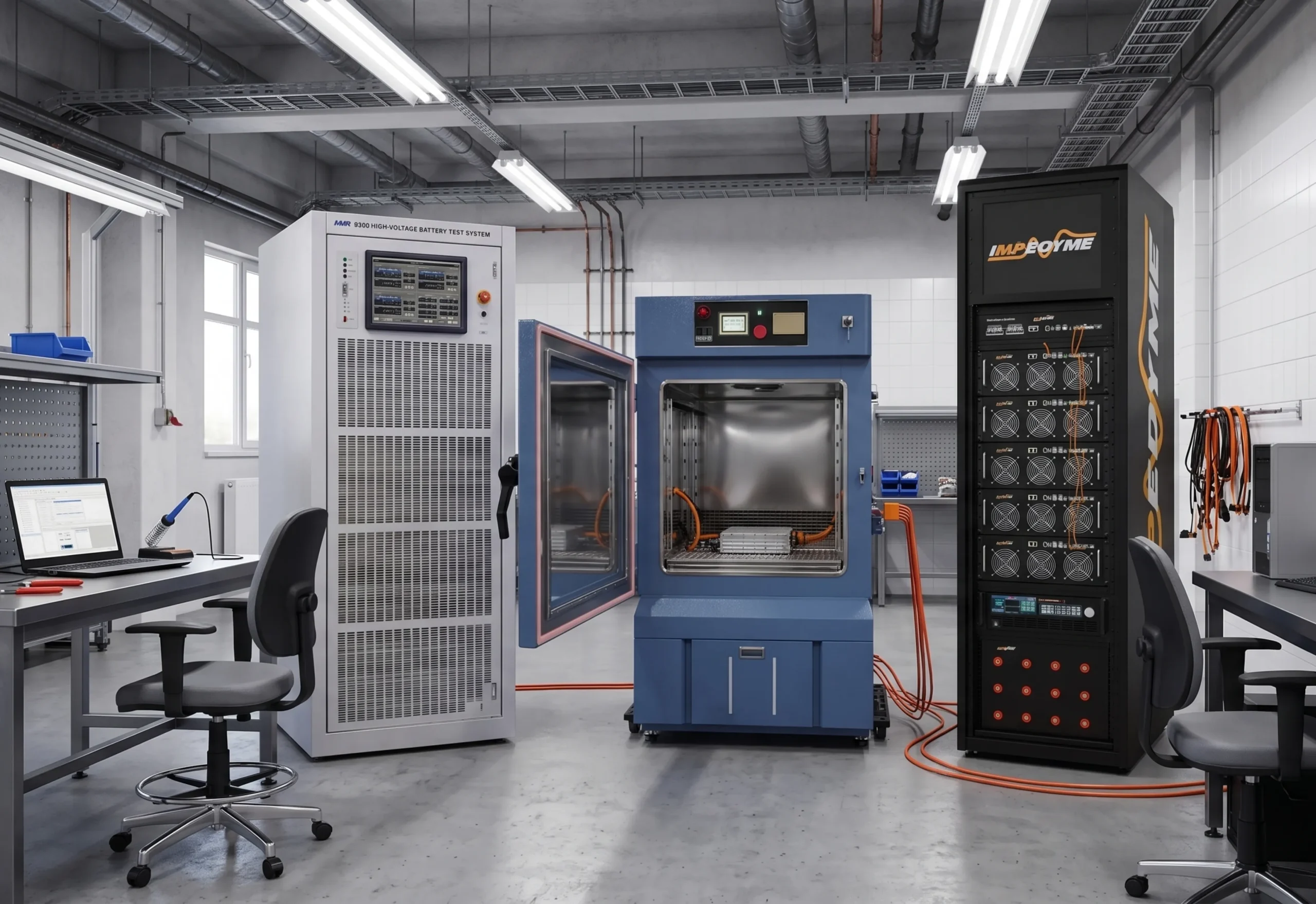
Depending on the condition of your existing equipment — a single NHR battery cycler or a multi-cabinet lab — we can integrate with the installed hardware, replace functions in stages, or deliver a complete next-generation platform. That is what separates a planned NHR replacement from a forced rip-and-replace: an operational NHR 9300 can stay in service as the DC-side power stage while new capability is layered around it.
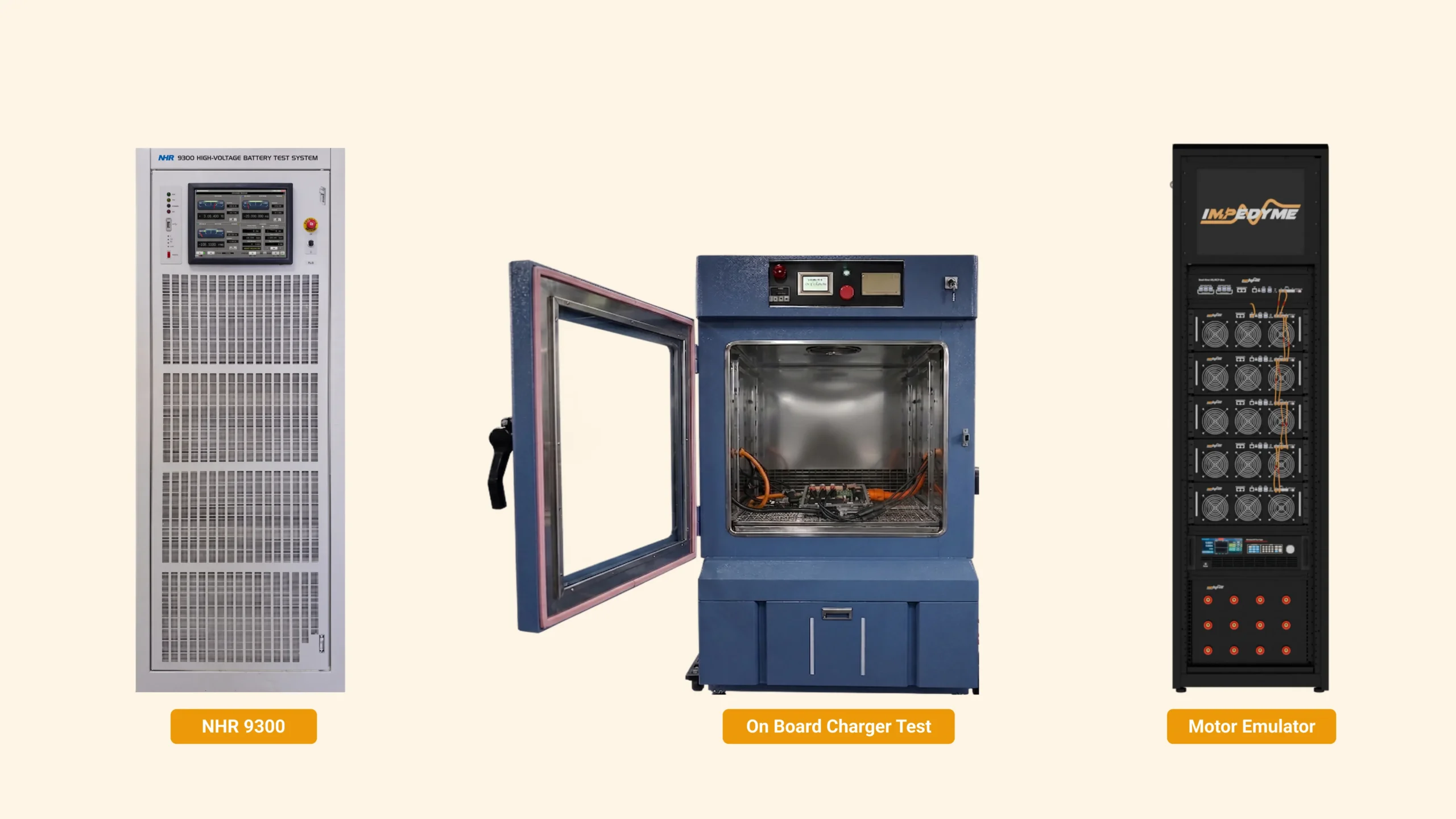
The Impedyme Replacement and Integration Ecosystem
CHP Series
Impedyme's combined HIL and Power HIL platform: an FPGA-based regenerative power system uniting real-time simulation, power amplification, measurement and control. Plant models execute directly on FPGA fabric with time steps as low as 90 nanoseconds. Multi-channel analog and digital I/O, high-speed fibre, stand-alone liquid cooling, benchtop to high-power scaling. For an NHR battery tester approaching end of standard service, the CHP Series absorbs both the power-stage and the real-time-simulation roles in a single platform.
Real-Time Battery Emulator / BatterySim Studio
A programmable bidirectional battery emulator platform reproducing the electrical behaviour of a physical battery without cells or packs. Models incorporate SOC, OCV, internal resistance, dynamic polarisation, current and power limits, temperature dependence and equivalent-circuit models — plus EIS, automated model fitting, fault simulation, DAQ and MATLAB/Simulink workflows. Where the NHR battery emulator holds an open-circuit voltage and a programmable series resistance, BatterySim Studio runs a physics-aware model in real time.
Motor Emulator / MotorSim Studio
Real-Time HIL / RCP Platform
PowerHIL Studio
PowerHIL Studio is the orchestration, automation and test-management layer. Automated sequences synchronise battery emulation, motor emulation, grid emulation, loads, DUT controls, measurements and fault conditions, with pass/fail criteria, reporting, programmable protection limits, controlled shutdown and MATLAB scripting. This is where Enerchron sequences and existing NHR battery test recipes are re-implemented in PowerHIL Studio as hardware-agnostic, reusable assets.
Charger Box
EV/EVSE and charger-validation solution for on-board chargers, DC fast chargers, charging interfaces and bidirectional V2G/V2H. Combined with the Battery and Grid Emulators, it validates complete charging-system energy flow without a production vehicle or physical pack.
Extend the Existing NHR Battery System into a Complete Powertrain Emulator
For customers whose NHR Battery Emulator is still operational, the existing equipment does not necessarily need to be removed or replaced immediately.
Instead, Impedyme can integrate the NHR system with its Motor Emulator and Real-Time HIL/RCP platform, transforming an existing battery test bench into a comprehensive electric-powertrain Power HIL system.
The key architecture is a shared common DC link between the:
NHR Battery Emulator ↔ DUT Inverter ↔ Impedyme Motor Emulator
The NHR Battery Emulator continues to provide and regulate the DC-link power, representing the battery side of the powertrain. The customer's actual inverter or motor controller remains the physical Device Under Test, while the Impedyme Motor Emulator reproduces the electrical and electromechanical behavior of the target motor at the inverter terminals.
In this configuration, the NHR Battery Emulator, DUT, and Impedyme Motor Emulator operate as one integrated power system around the common DC link.
This allows the complete electric powertrain to be represented around the real DUT:
Battery Behavior → DC Link → Physical DUT Inverter → Emulated Motor → Emulated Mechanical Load / Vehicle
The existing NHR equipment provides the DC-side battery and bus functionality, while the Impedyme Motor Emulator replaces the physical motor and dynamometer with a programmable, real-time electrical machine model.
NHR battery Systems we can upgrade or replace
| NHR family | What it does | Impedyme upgrade / replacement path |
|---|---|---|
| 9200 series (mid-voltage module/pack test system) | 8 kW source / 12 kW sink bidirectional modules, 40/120/600 V, expandable to 252 kW; cycling and battery emulation | Replace with CHP Series channels driven by BatterySim Studio; re-implement charge/discharge and drive-cycle recipes in PowerHIL Studio; add real-time HIL/PHIL for BMS and inverter test |
| 9300 series (high-voltage pack test system/emulator) | 100 kW blocks, 600/1,200 V, 333 A per cabinet, up to 2.4 MW / 8,000 A; high-voltage cycling and emulation | Replace or augment with paralleled CHP Series for high-voltage packs; add nanosecond-class real-time battery emulation and closed-loop pack/BMS validation the 9300 cannot perform |
| 9210 (single-channel cycler) | Single 12 kW module, benchtop/mobile cycling and emulation | Replace with a compact CHP configuration plus BatterySim Studio for benchtop HIL/PHIL and EIS |
| 9220 (low-voltage/high-current cycler) | Dual-bay, large-format low-voltage ESS batteries, regenerative | Replace with CHP channels configured for high current; add real-time emulation and automated cycling |
| 4700/4760 DC electronic loads | High-current/high-voltage DC loading in battery and power benches | Replace loading function with the regenerative CHP power stage, which sources and sinks; consolidate load + source + emulation in one platform |
| 4800 compact battery cycler | 4U multi-mode: source, load, emulator, PHIL amplifier; 80 V/400 A, 16.5–165 kW, SiC-based | Replace with CHP Series, which delivers the same multi-role flexibility plus a far higher-fidelity real-time model and integrated Simulink automation |
| 9410 / 9510 grid simulators, 9430 AC load (bench-adjacent) | AC-side grid emulation / four-quadrant AC load in inverter/EVSE/V2G benches | Replace or integrate with the CHP Series grid-emulation capability and GridSim Studio so the whole DC+AC bench runs in one environment |
| Enerchron / NI BTS automation | Hardware-coupled battery-test sequencer | Replace with PowerHIL Studio + Impedyme-RT: hardware-agnostic, MATLAB/Simulink-native, portable test assets |
Understanding the NHR Battery Test Family
NHR Battery built a strong reputation for regenerative, bidirectional power test instruments. NHR became part of NI and is now within Emerson’s test and measurement business. Understanding the NHR battery testing portfolio helps identify the right Impedyme upgrade path for each system.
9200 Series: Mid-Voltage Battery Testing
The NHR 9200 is a modular, bidirectional system for battery module and pack testing. With scalable power and regenerative operation, it supports automated characterization, cycling, life testing, and battery emulation for EV and energy-storage applications. For NHR battery testing, the 9200 is a common platform for flexible multi-channel testing.
9300 Series: High-Voltage Battery Testing
The NHR 9300 is designed for high-voltage, high-power battery testing, supporting 600 V and 1,200 V systems with scalable power up to the megawatt range. It is suited to EV, energy-storage, solar, and aerospace applications, while also providing battery-emulation capabilities. This makes the 9300 a key NHR battery test platform for modern high-power systems.
9210 & 9220: Compact Battery Cyclers
The 9210 provides single-channel testing in a compact, mobile-friendly design, while the 9220 offers dual-bay, low-voltage/high-current battery cycling. Both provide bidirectional, regenerative operation for module and pack testing, making them practical options for smaller or specialized NHR battery testing setups.
4700/4800 Series: Loads & Compact Cyclers
The NHR 4800 combines a DC source, regenerative load, battery emulator, and PHIL power amplifier in a compact system. With scalable power and high regenerative efficiency, it supports charge/discharge, MPPT, and battery-emulation testing. The older 4700 series and 4760 DC loads are also commonly used in power-conversion and NHR battery test benches.
Why NHR Battery Systems Owners Are Migrating Now
End of Service
NHR systems face scheduled end-of-service, making long-term repairs, calibration, and spare parts harder to guarantee.
Software Gap
Legacy Enerchron systems can limit integration with modern hardware, software, and model-based testing tools.
Capability Gap
Modern NHR battery testing needs real-time HIL/PHIL, physics-based models, and closed-loop validation beyond traditional cyclers.
How an NHR Battery Systems Replacement Project Works in Practice
1
Audit the NHR battery test bench
Inventory each NHR cycler, tester, emulator, and DC load, including safety I/O, facility connections, cooling, and calibration status.
2
Preserve your test logic
Re-implement drive cycles, charge/discharge protocols, and pass/fail limits from Enerchron and Macros in PowerHIL Studio as portable MATLAB/Simulink sequences.
3
Reuse existing infrastructure
Keep racks, cabinets, cabling, safety enclosures, and facility power where they meet the new bench requirements.
4
Replace the NHR channel by channel
Migrate one channel or bay at a time to keep the lab operational throughout the transition.
5
Add advanced capabilities
Integrate real-time simulation, motor and vehicle emulation, physics-based battery models, and EIS-based model fitting in one platform.
6
Ensure long-term support
Move aging NHR battery testers to a current platform with clear calibration, spares, and support beyond 2026.
Legacy NHR Battery Cycler vs. the Impedyme Platform
| Capability | Legacy NHR battery cycler | Impedyme CHP Series + Software |
|---|---|---|
| Primary function | Charge/discharge cycling, regenerative source/load | Cycling plus real-time HIL and PHIL emulation |
| Battery model | Open-circuit voltage + series resistance (simplified) | Physics-aware real-time model with EIS and ECM fitting |
| Real-time model step | Not a real-time HIL simulator | FPGA execution with steps as low as 90 ns |
| Closed-loop with BMS/inverter at power | Limited (emulation mode, hardware-regulation speed) | Full closed-loop PHIL with switching power electronics |
| Automation software | Enerchron / BTS, coupled to NHR hardware | PowerHIL Studio + Impedyme-RT, MATLAB/Simulink-native, hardware-agnostic |
| Fault injection on emulated cells | Limited to over/under-charge emulation | Scripted internal short, over/under-charge, ground fault, cell imbalance |
| Regenerative | Yes | Yes |
| Lifecycle status | End of standard service Dec 31, 2026 | Actively supported current platform |
Planning Your NHR Battery Systems Replacement
The end-of-service date is fixed, but your response to it is not. Replacing only the automation layer leaves you running aging power hardware; replacing only the power stage leaves your test logic vendor-locked and still needs a separate real-time simulator behind an analog cable. We replace both and fold the simulator into the power stage, so an NHR replacement delivers integrated HIL and Power HIL rather than a faster DC supply.
It also need not happen at once. A working NHR battery emulator — an NHR 9300 still holding calibration — can stay in service as the DC-side power stage while motor emulation and automated sequencing are built around it, with the NHR battery cycler replaced only at end of life. Your Macros, drive cycles, safety interlocks, and analog monitors carry across, and years of NHR battery test assets stay portable rather than stranded.
Frequently Asked Questions
Ready to Replace Your NHR Battery Test System?
Discover how Impedyme replaces NHR battery cyclers, testers, and emulators with integrated real-time simulation, staged migration, and long-term support.