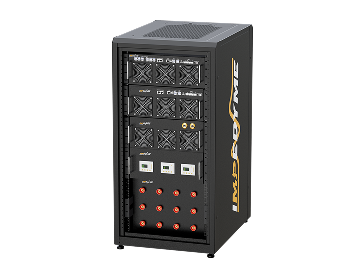
Software-assigned channels re-map source and load roles without rewiring. Adding modules, up to 5 MW, extends power without changing profiles or software.
Overview
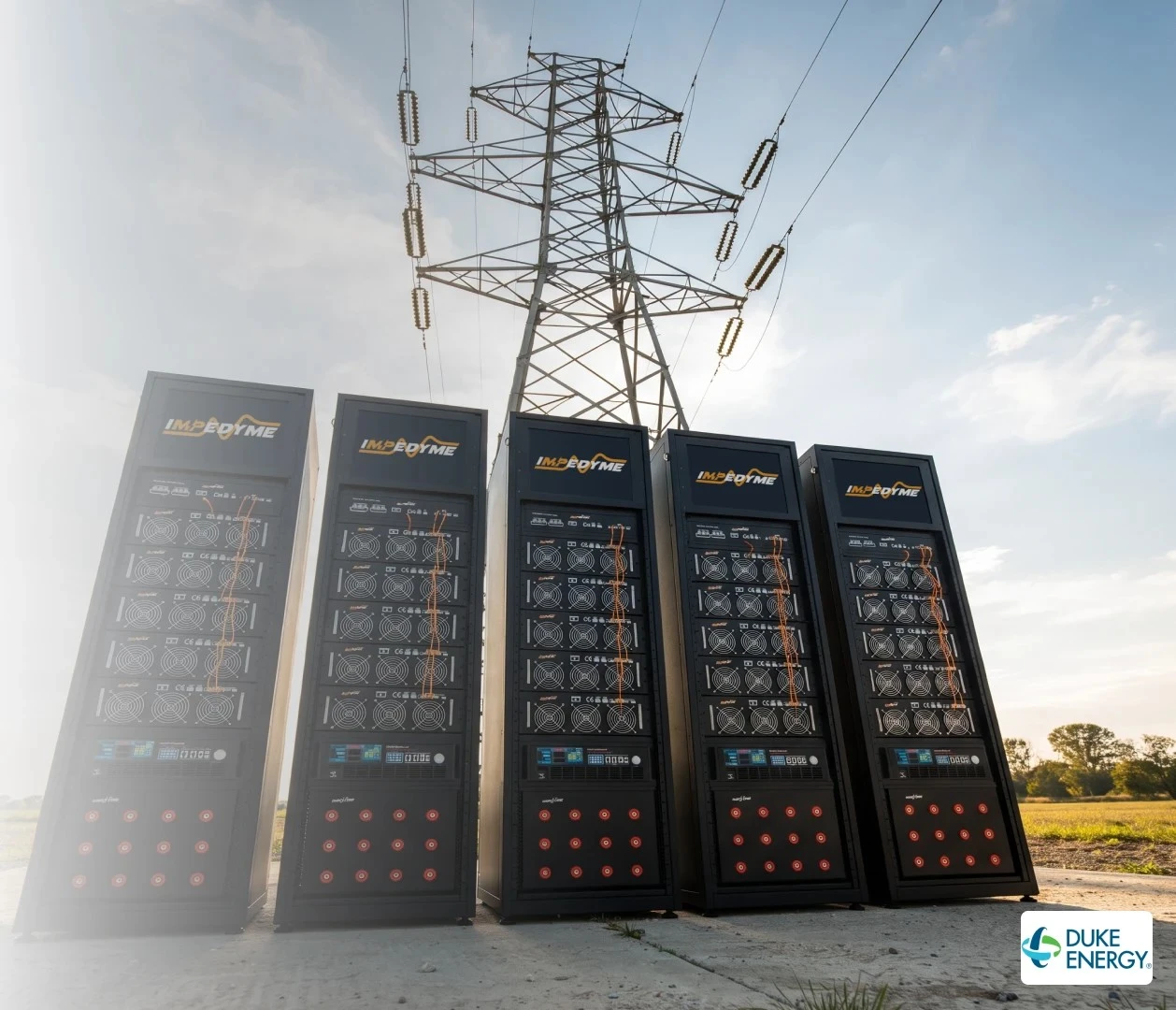
how Duke Energy uses an Impedyme Grid Emulator and a bidirectional regenerative Load Bank to validate grid-connected inverters and power-conversion systems — with programmable grid conditions on one side of the device under test and controlled source-and-sink loading on the other.
Learn how Impedyme’s interfacing support brings the source, load, device under test, controls, communications, measurements, and safety interlocks together as one coordinated laboratory system — repeatable, regenerative, and automated.
−45 %
testing time
−40 %
validation time
+55 %
test coverage
+55 %
system safety
The Challenge
More than a stable source and a resistor
01
Duke Energy, headquartered in Charlotte, North Carolina, is one of the largest energy holding companies in the United States, delivering electricity to millions of customers across the Carolinas, Florida, and the Midwest. As inverter-based resources, storage, and power electronics spread across its system, the equipment connecting to the grid has to be proven under the conditions the grid will actually present.
02
In Duke Energy’s own words, validating grid-connected equipment requires more than a stable AC source or a resistive load. The test system must reproduce grid conditions, disturbances, unbalance, harmonics, impedance, and bidirectional power flow. Separate source, load, control, and protection systems create complex interfaces, fragmented data, and long setup cycles.
03
Duke Energy needed programmable grid conditions and bidirectional loading as one coordinated system — with the electrical, controls, communications, measurement, and interlock integration to make it run safely and repeatably. The goal was a single laboratory platform that could reproduce source and load conditions in software and run repeatable tests across devices and revisions, without rebuilding the bench for each program.
The Solution
Grid emulator and regenerative load, integrated as one lab
- One Scalable Platform
Built on the CHP Series
The Grid Emulator and the regenerative Load Bank both run on CHP modules, housed in 19-inch, 42U liquid-cooled cabinets. Every module is a bidirectional, four-quadrant power stage, so a single architecture covers the whole test program.
5 kW to 50 kW per module · Scalable to 5 MW
- Real-Time Control in Every Module
FPGA Speed, Simulink Models
Each CHP module has its own Zynq UltraScale+ quad-core Arm processor and a 600K-cell FPGA running IMPEDYME-RT. This Linux OS with Impedyme’s real-time kernel runs MATLAB/Simulink™ models directly on the hardware.
200 ns FPGA update rate
- Programmable Grid, Regenerative Load
Both Sides of the DUT, Covered
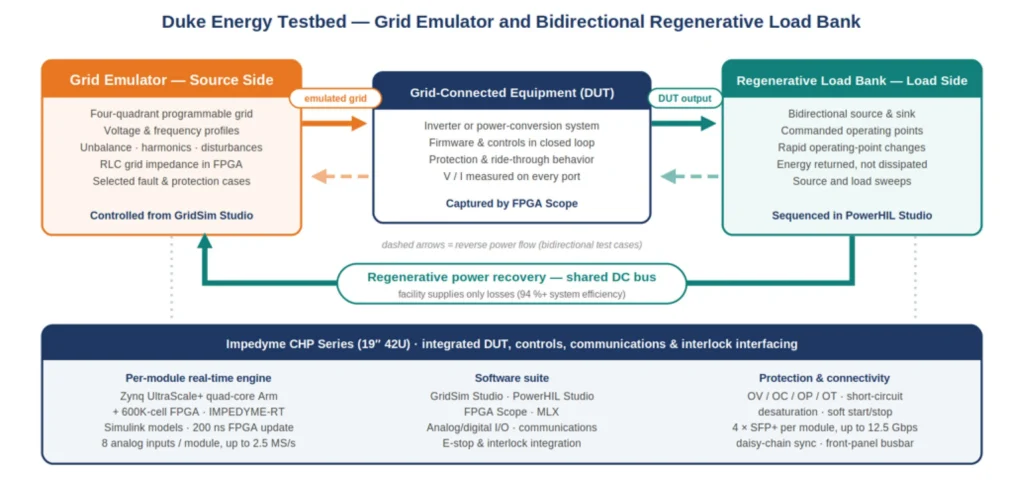
GridSim Studio sets up a four-quadrant grid source with voltage and frequency profiles, phase unbalance, disturbances, harmonic injection and an RLC grid impedance emulated in the FPGA. On the other side of the DUT, the Load Bank sinks or sources power and sends the energy back into the test setup instead of losing it as heat.
Four-quadrant · Energy recovered, not wasted
- Turnkey Integration
From Wiring to Reports
Impedyme handled the full integration: I/O, communications, E-stop and interlock circuits, measurement scaling, control sequences and data capture, all tied into the DUT, the lab controls and the facility power. PowerHIL Studio runs the test sequences and keeps them inside safety limits. FPGA Scope captures every port at the same time, and MLX sends the results to MATLAB for analysis.
Sequenced · Safety-enforced · Fully synchronized
| Software | Role in Duke Energy’s grid-connected equipment validation workflow |
|---|---|
| GridSim Studio | Grid-parameter and profile management; V/I source modes in AC and DC; voltage and frequency profiles; FPGA-emulated RLC grid impedance; harmonics per phase; unbalance, sag/swell, frequency, and phase disturbances; layered protection with fault logging. |
| PowerHIL Studio | Cabinet-level control and signal routing; per-module mode and reference selection; dynamic test sequencing; failure emulation; safety limits and device-level protections; launches MLX, Simulink, and FPGA Scope. |
| IMPEDYME-RT | Linux with Impedyme’s proprietary real-time kernel on every module; runs MATLAB/Simulink™ models on the Arm cores and FPGA (200 ns FPGA update); real-time monitoring, control, and parameter tuning from MATLAB. |
| FPGA Scope | On-module oscilloscope: waveform preview before enable, per-phase real-time monitoring, trigger-based capture, measurement table (max / min / pk-pk / gain / phase), and sync verification across modules. |
| MLX | Post-processing and analytics of streamed data in MATLAB — operating-point sweeps, efficiency and response metrics, pass/fail overlays, and automated test reports. |
| Integration & interfacing | Analog and digital I/O, communications, E-stop and interlock circuits, measurement scaling, and control sequences engineered by Impedyme to connect the DUT, laboratory controls, and facility power infrastructure. |
In Practice
The complete power path, source to sink
Source to Sink
The Grid Emulator connects to the AC side of a grid-connected inverter or power-conversion system, and the bidirectional Load Bank connects to the opposite power interface.
Full Grid Control
Engineers vary voltage, frequency, phase balance, harmonics and grid impedance while commanding source and sink operating points through the DUT.
Safe, Repeatable Operation
Impedyme coordinates the I/O, communications, interlocks, control sequences and data capture, so the whole system runs safely and repeatably while power recirculates.
Re-map and Scale
| Benefit (vs. previous workflow) | Customer-reported impact |
|---|---|
| Reduced development time | −30 % |
| Reduced testing time | −45 % |
| Reduced validation time | −40 % |
| Reduced testing costs | −35 % |
| Improved engineering productivity | +40 % |
| Improved test coverage | +55 % |
| Improved system safety | +55 % |
| Improved confidence before hardware deployment | +50 % |
The Results
The platform creates a reusable workflow for equipment bring-up, performance characterization, grid-disturbance testing, source and load sweeps, regenerative operation, and protection verification. Programmable profiles are automated and repeated across firmware, hardware, and control revisions, and integrated measurements and coordinated controls reduce manual setup and make results easy to compare across test campaigns.
The measured impact, as reported and approved by Duke Energy: development time down 30 %, testing time down 45 %, validation time down 40 %, and testing costs down 35 %; engineering productivity up 40 %, test coverage up 55 %, system safety up 55 %, and confidence before hardware deployment up 50 % (table below). The integrated source, load, automation, and interfacing architecture reduces custom bench engineering and lets approved test profiles be reused across devices and revisions.
The platform also enabled testing that was previously difficult, expensive, or impossible: repeatable voltage and frequency disturbances, phase unbalance, harmonic injection, programmable grid impedance, bidirectional power flow, regenerative loading, rapid operating-point changes, and selected fault or protection cases — all difficult to reproduce with conventional utility feeds and passive load banks.
The result is a laboratory where the grid is a profile, the load is a setpoint, and every test runs the same way twice.
The Added Value
Duke Energy chose Impedyme for a coordinated Grid Emulator and bidirectional Load Bank architecture with regenerative operation and application-specific integration support: a programmable grid source that also absorbs power from the device under test and returns energy through the test architecture — with the electrical, controls, communications, measurement, interlock, and automation interfaces needed to make the equipment function as one laboratory system.
The capabilities Duke Energy rates most valuable — four-quadrant grid emulation, the bidirectional regenerative load, voltage and frequency profiles, harmonics and grid impedance, phase unbalance and disturbances, source and sink operation, DUT and facility interfacing, controls and communications, safety interlocks and E-stop, and automation and data capture — are the system. And every module is a fault-isolating unit with layered protection — over-voltage, over-current, over-power, over-temperature, short-circuit and desaturation detection, device-level destruction monitoring, and soft start/stop — so a test that goes wrong stops the test, not the program.
| Function | Conventional approach | Impedyme CHP Series at Duke Energy |
|---|---|---|
| Grid source | Utility feed or fixed AC source | Four-quadrant Grid Emulator with programmable V, f, unbalance, harmonics, impedance |
| Load | Passive resistive load bank (dissipative) | Bidirectional regenerative Load Bank — source and sink |
| Integration | Separate source, load, controls, and protection systems | One coordinated system: I/O, comms, E-stop, interlocks integrated by Impedyme |
| Disturbance testing | Hard to reproduce on a utility feed | Voltage, frequency, unbalance, and harmonic profiles on demand |
| Energy handling | Full test power drawn and dissipated | Regenerative — facility supplies only losses |
| Data | Fragmented measurements per instrument | Synchronized capture in FPGA Scope; analysis in MLX |
WHY IT WORKS
Four-Quadrant Grid Emulation
Control voltage, frequency, unbalance, harmonics and grid impedance.
Regenerative Load Bank
Source and sink power at commanded operating points.
Full System Integration
DUT, controls, communications and interlocks, all integrated by Impedyme.
Repeatable Test Profiles
Grid disturbances and protection cases saved as repeatable profiles.
Energy Recirculated
94%+ efficiency, with no passive load bank needed.
Automated Testing
Automated sequences with synchronized data capture.
Native MATLAB/Simulink™ Workflow
No third-party HIL simulator required.
Comprehensive Protection
OV, OC, OP, OT, short-circuit and desaturation protection.
Ready to Bring the Grid Into Your Lab?
Partner with Impedyme to validate your grid-connected equipment with programmable grid emulation, regenerative loading, and integration support built around your test program.
Products