Flex needed a single, reusable verification environment that works for every motor output and product configuration. It had to provide programmable motor behavior across the full 1 A to 30 A range, synchronized with automated test sequences.
Overview
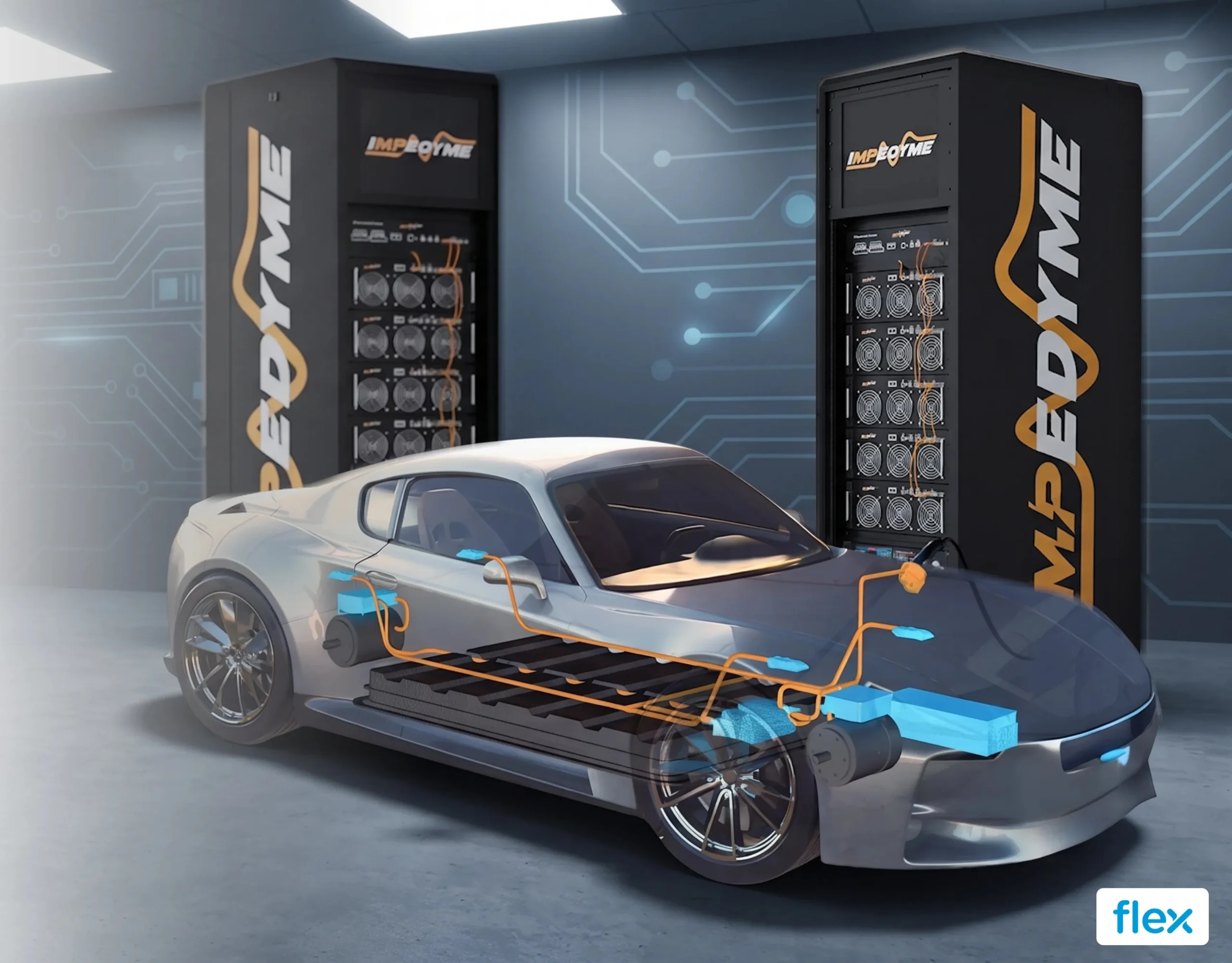
Flex Automotive verifies the motor outputs of its new automotive zone-controller portfolio on Impedyme’s CHP Series Motor Emulator — with brushed and brushless DC motors emulated from approximately 1 A to 30 A and faults injected on demand.
Learn how software-defined motor models replace the collection of physical motors, harnesses, and mechanical fixtures a zone-controller portfolio would otherwise need — and turn startup, stall, regeneration, and fault cases into repeatable, automated regression tests.
−45 %
testing time
−40 %
validation time
+50 %
test coverage
+55 %
system safety
The Challenge
One controller family, many motors
01
Flex is one of the world’s leading manufacturing and technology partners. Its automotive business, Flex Automotive GmbH in Filderstadt, Germany, develops modular zone-controller platforms for software-defined vehicles. The platforms combine eFuses, high- and low-side switches, motor and actuator drivers, and in-vehicle networking into configurable, pre-validated building blocks.
02
Flex’s new zone-controller portfolio has to drive many low-current brushed and brushless DC motor loads. Conventional verification depends on physical motors, wiring harnesses and mechanical fixtures, and these differ from one motor type to the next. That makes it hard to reproduce the same conditions across controller variants and software releases, including current profiles, startup behavior, stall conditions, back EMF, regeneration and fault cases.
03
The Solution
An emulated motor for every output
- The Testbench
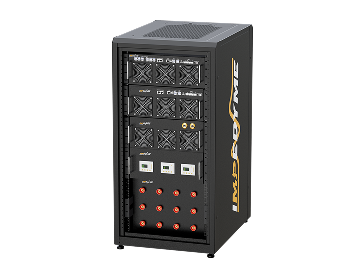
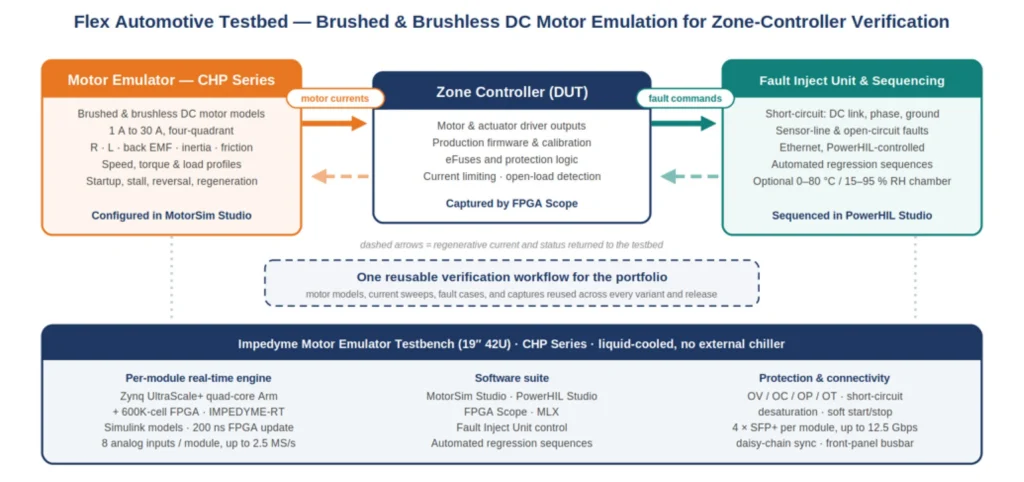
Impedyme built a Motor Emulator Testbench on the CHP Series in a 19-inch, 42U liquid-cooled cabinet, sized for the controller’s 1 A to 30 A motor outputs. Real-time motor models run on the module’s Zynq UltraScale+ FPGA under IMPEDYME-RT. A bidirectional, four-quadrant interface means each controller output drives what it sees as a real machine, at real current.
- Programmable Motor Models
In MotorSim Studio, engineers choose brushed or brushless DC motor models. They then set winding resistance and inductance, back EMF, inertia, friction and mechanical loading, along with speed and torque profiles and operating sequences. The motor behavior is fully controlled, so it repeats identically across revisions of the controller hardware, firmware and calibration.
- On-Demand Fault Injection
A Fault Inject Unit, reached over Ethernet and controlled from PowerHIL Studio, applies fault cases on demand. Short-circuit cases include DC link, phase-to-phase, phase-to-ground and sensor lines, and open-circuit cases are also available. Engineers can test fault scenarios safely and reproduce them at any time, without damaging physical motors or wiring.
- Automated Campaigns and Data Capture
PowerHIL Studio sequences the test campaigns and enforces safety limits. FPGA Scope captures synchronized voltage, current, speed, position and status data. An optional environmental chamber (1000 L, 0–80 °C, 15–95 % RH) runs the same tests across a range of temperature and humidity conditions.
| Software | Role in Flex’s zone-controller verification workflow |
|---|---|
| MotorSim Studio | Motor-emulation control: brushed and brushless DC motor models on the FPGA; winding R and L, back EMF, inertia, friction, and mechanical-load profiles; parameter variation and LUT management. |
| PowerHIL Studio | Testbench operation: cabinet-level control, signal routing, safety monitoring, automated regression sequencing, failure emulation, and Fault Inject Unit control. |
| IMPEDYME-RT | Linux with Impedyme’s proprietary real-time kernel on every module; runs MATLAB/Simulink™ models on the Arm cores and FPGA (200 ns FPGA update); real-time monitoring, control, and parameter tuning from MATLAB. |
| FPGA Scope | Real-time FPGA-based capture of voltage, current, speed, position, and status with trigger-based precision — waveform evidence for every startup, stall, and fault case. |
| MLX | Post-processing and analytics of streamed data in MATLAB — operating-point sweeps, efficiency and response metrics, pass/fail overlays, and automated test reports. |
In Practice
Startup to stall, reversal to regeneration
Direct Connection
A zone-controller output connects directly to the Impedyme Motor Emulator. The emulator reproduces the selected brushed or brushless DC motor, from back EMF to inertia and load.
Full Operating Range
Engineers evaluate startup, acceleration, steady operation, reversal, braking and regeneration, all under controlled and repeatable conditions.
Protection and Faults
Engineers also test stall response, current limiting, open-load behavior and selected electrical faults. The controller’s own eFuses and protection logic respond to each case.
Automated Regression
Motor models are reusable, and currents sweep from 1 A to 30 A in software. The same automated sequence runs on every zone-controller variant and runs again after every hardware or software change
| Benefit (vs. previous workflow) | Customer-reported impact |
|---|---|
| Reduced development time | −30 % |
| Reduced testing time | −45 % |
| Reduced validation time | −40 % |
| Reduced testing costs | −30 % |
| Improved engineering productivity | +40 % |
| Improved test coverage | +50 % |
| Improved system safety | +55 % |
| Improved confidence before hardware deployment | +50 % |
The Results
The Impedyme Motor Emulator gives Flex one verification workflow for the whole zone-controller portfolio. Test engineers load reusable brushed or brushless motor models, sweep current and operating conditions from about 1 A to 30 A, automate regression sequences, and capture synchronized voltage, current, speed, position and status data. Bench reconfiguration drops, and results stay consistent across development teams and product variants.
Flex Automotive reported and approved the measured impact. Development time fell 30 %, testing time 45 %, validation time 40 % and testing costs 30 %. Engineering productivity rose 40 %, test coverage 50 %, system safety 55 % and confidence before hardware deployment 50 %. Repeated motor and fixture changes became software-defined configurations, which sped up verification. The automated tests are reusable, so they apply to every variant and run again after any hardware or software change.
The platform makes many cases repeatable across the 1 A to 30 A range: startup, stall, rapid load changes, reversal, regeneration, current limits, parameter variation and faults. These conditions are hard to reproduce precisely and safely with a collection of physical brushed and brushless motors.
Flex’s platform is built from pre-validated blocks, and the testbench verifies it the same way. Every output is proven with a modular, repeatable method by design.
The Impedyme Motor Emulator covers a low-current range of 1 A to 30 A and runs both brushed and brushless DC motor models on one platform. It makes dynamic cases such as startup, stall and regeneration fully repeatable. A built-in Fault Inject Unit applies short-circuit and open-circuit faults on demand.
The motor models run in real time on a Zynq UltraScale+ FPGA (quad-core Arm, 600K logic cells) at a 200 ns update rate. Module ratings run from 5 kW to 50 kW and scale up to 5 MW. An optional 1000 L environmental chamber extends testing to 0–80 °C and 15–95 % RH.
The Added Value
Flex chose Impedyme because its approach combines programmable real-time motor models with a bidirectional electrical interface sized for the required 1 A to 30 A range: one platform reproduces brushed and brushless motor behavior, changes motor and load parameters in software, and synchronizes measurements with automated test sequences — a reusable verification environment for multiple zone-controller outputs and product configurations.
The capabilities Flex values most — the 1 A to 30 A operating range, brushed and brushless DC motor emulation, zone-controller verification, startup and stall testing, dynamic mechanical loads, back EMF and regeneration, motor parameter variation, automated regression testing, and protection and fault testing — are exactly what this testbench delivers. And every module is a fault-isolating unit with layered protection — over-voltage, over-current, over-power, over-temperature, short-circuit and desaturation detection, device-level destruction monitoring, and soft start/stop — so a test that goes wrong stops the test, not the program.
| Function | Conventional bench | Impedyme testbench at Flex Automotive |
|---|---|---|
| Motor loads | One physical motor and fixture per motor type | Brushed and brushless DC motors emulated on FPGA — variants as parameter sets |
| Current range | Different motors to cover 1 A to 30 A | One emulator swept across the full range in software |
| Dynamic cases | Hard to reproduce startup, stall, regeneration | Scripted startup, stall, reversal, braking, and regenerative cases |
| Fault coverage | Risky, manual, often destructive | Fault Inject Unit: scripted short-circuit, open-circuit, and sensor-line cases |
| Regression | Bench rebuilt per variant and release | Automated sequences rerun after every hardware or software change |
| Environmental testing | Separate rig in the chamber | Same testbench with the optional 0–80 °C / 15–95 % RH chamber |
WHY IT WORKS
One Platform
Brushed and brushless DC motors emulated on one platform
Full Current Range
Full 1 A to 30 A range swept in software
Repeatable Dynamics
Startup, stall, reversal, braking, and regeneration — repeatable
Software-Defined Motors
Motor variants as parameter sets, not physical motors and fixtures
Fault Injection
Fault Inject Unit: scripted short- and open-circuit cases
Reusable Regression
Automated regression reused across every variant and release
Native Simulink Workflow
Native MATLAB/Simulink™ workflow — no third-party HIL simulator
Comprehensive Protection
Comprehensive protection: OV/OC/OP/OT, short-circuit, desaturation
Testing zone controllers without the motors?
Impedyme builds motor-emulation testbenches that replace physical motors and fixtures with one reusable setup, from 1 A to 30 A on every output.
Products