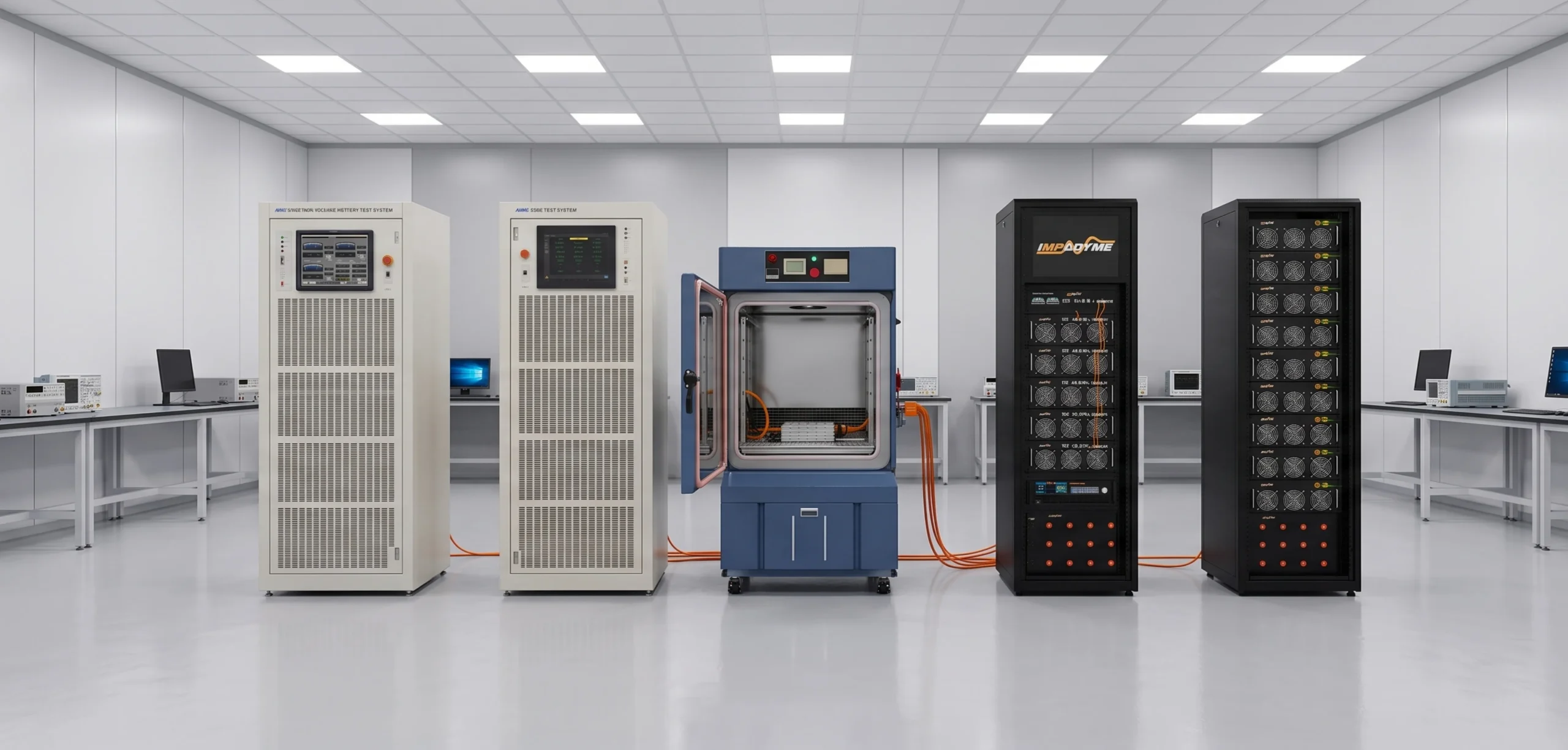
If your lab runs an NH Research cabinet, you already know how much of your validation programme depends on it. Battery cyclers, regenerative grid simulators, four-quadrant AC loads and high-current DC loads from NH Research sit at the centre of thousands of test benches in automotive, aerospace, defence, energy storage and national research laboratories. Many have been running for a decade or more.
That installed base is now facing a hard deadline. The NH Research product line has been retired, and standard service for the remaining families ends on 31 December 2026. Older NHR families lost standard service in mid-2025. After those dates, factory repair, calibration, spare modules and firmware support are no longer guaranteed.
This page is a practical reference for engineers and test managers in that position. It maps the complete NH Research cabinet line, separates the battery-oriented systems from the grid-oriented ones, explains what the support timeline actually means for a working lab, and sets out how Impedyme replaces or upgrades every major NHR cabinet family — usually with more capability than the cabinet being retired, not less.
What NH Research Built, and Why Those Cabinets Are Everywhere
NH Research spent more than fifty years building programmable power test equipment out of Irvine, California. The company's signature approach was the modular cabinet: a floor-standing enclosure taking three-phase mains input, populated with independent power modules that could be added, paralleled and reconfigured as a lab's power requirements grew.
Three design decisions made NHR cabinets popular and explain why so many are still in service:
- Regeneration. Rather than burning absorbed energy as heat, NHR systems returned it to the mains at efficiencies above ninety percent. That cut utility cost, cut room cooling load, and made high-power battery cycling practical without a dedicated chiller plant.
- Modularity. A cabinet could ship half-populated and be filled later. Individual modules were independently programmable, so one cabinet could run several units under test on different profiles at the same time.
- Air cooling. NHR deliberately avoided liquid cooling on most families, trading power density for simpler facility requirements.
Those are genuine engineering virtues, and they are the reason a fifteen-year-old NHR cabinet is often still doing useful work. They are also the reason the end-of-support timeline hurts: this is not equipment that labs were planning to replace.
Three Kinds of NH Research Systems
NHR's range is easiest to think about not as a parts catalogue but as three families of purpose. Knowing which one you are standing in front of determines both your support horizon and your upgrade options.
Battery-side cabinets
Grid-side cabinets
These are regenerative AC sources, four-quadrant AC loads and grid simulators. They generate sags, swells, harmonics and frequency excursions, absorb power regeneratively when the unit under test pushes back, and run certification profiles against IEEE 1547, UL 1741 and the IEC 61000 series. One family in this group adds a power amplifier mode intended for power hardware-in-the-loop work. These cabinets dominate inverter, PV and grid-tied storage benches.
Load and power-supply test systems
The older DC and AC electronic loads, modular load subsystems for ATE and defence racks, and multi-channel power-supply characterisation and production test systems built the company's reputation long before the battery and grid cabinets arrived. Many are still installed. All of them reached end of standard service ahead of the newer families, which makes them the most exposed equipment in most labs — and the ones most likely to be quietly running an ageing control PC nobody wants to touch.
Integrate, Upgrade, or Replace?
Three routes are open, and you do not have to decide before you start.
Integrate. Keep a cabinet that still works and add what it cannot do: 永磁同步电机 runs your plant model in real time on the same bench while the NHR system keeps doing the cycling or sourcing it does well.
Upgrade. Replace the limiting part of the bench, not all of it — usually emulation fidelity, where our 实时 电池仿真器 replaces a voltage-and-resistance approximation, or grid realism, where GridSim Studio adds live impedance modelling.
Replace. Start clean on a single platform when the cabinet is already at the edge of what it can prove. The CHP 系列 is regenerative, liquid cooled and parallelable, with one software environment across battery, grid and motor work.
How Impedyme Replaces Any NH Research Systems
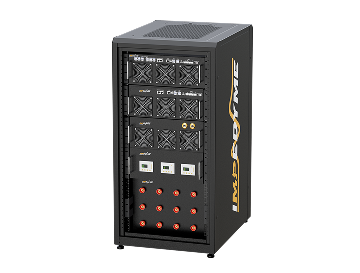
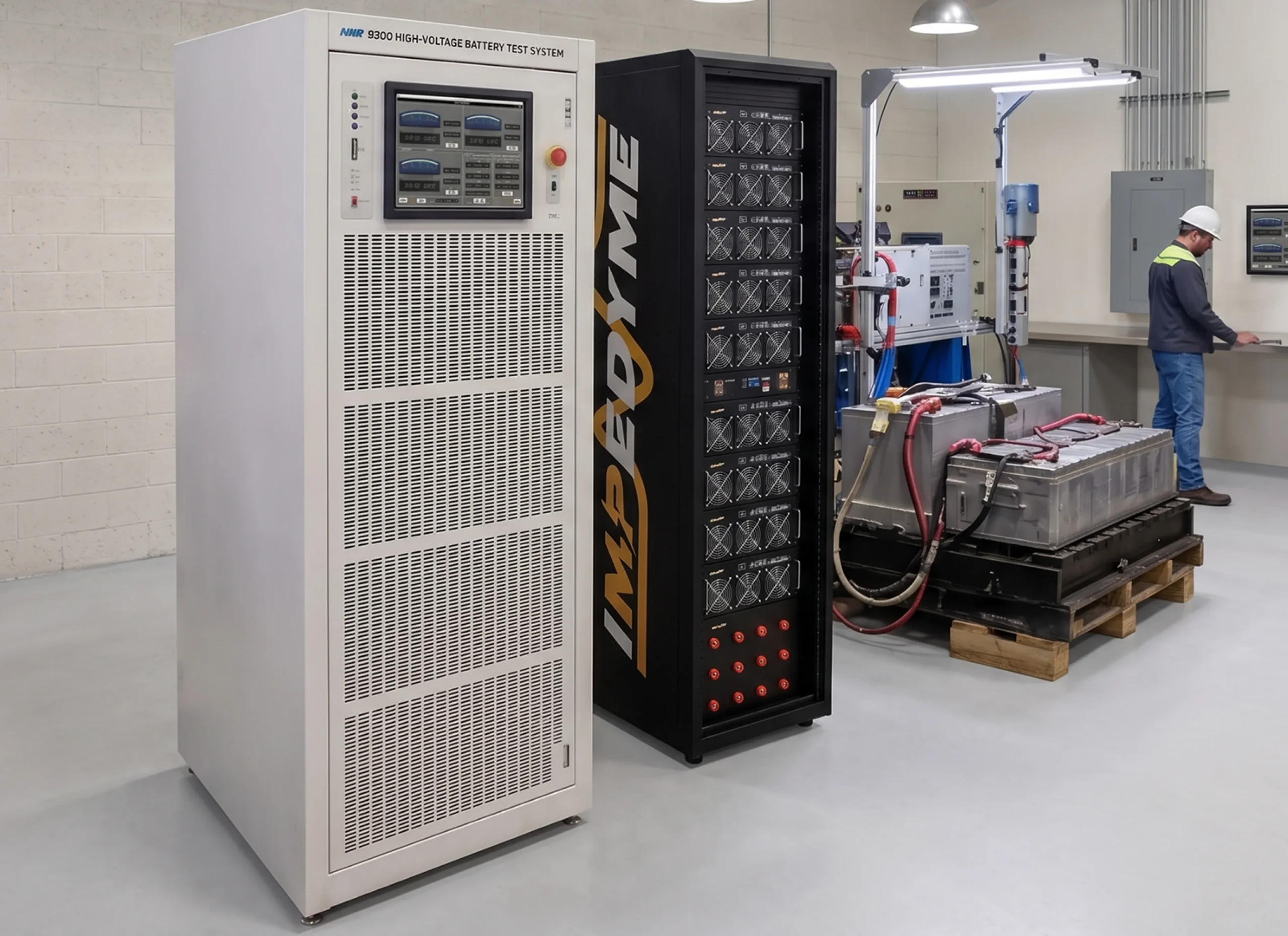
We build FPGA-based 硬件在环 与 power hardware-in-the-loop systems: the CHP 系列 cabinets, the 永磁同步电机 real-time engine, and the 关闭 suite. The hardware covers the same regenerative source-and-sink duty an NHR cabinet performs, and the real-time layer adds the model-based capability those cabinets never had.
| What you run today | Impedyme replacement | What changes |
|---|---|---|
| Battery cyclers for cell, module and pack test | CHP Series with BatterySim Studio | Equivalent regenerative bidirectional DC and channel structure, plus closed-loop BMS testing |
| Hardware battery emulation | Real-Time Battery Emulator with BatterySim Studio | FPGA cell modelling and per-cell emulation replace a fixed voltage-and-resistance approximation |
| Regenerative grid simulators | CHP grid emulator with GridSim Studio | Direct replacement, plus live grid-impedance modelling and a far tighter PHIL loop |
| AC power sources | CHP grid emulator in source mode | Like-for-like, with programmable disturbance libraries and automated IEEE 1547 sequences |
| Four-quadrant regenerative AC loads | CHP grid emulator in sink mode | Like-for-like, plus model-based load behaviour |
| Programmable AC electronic loads | CHP in AC load mode | Replacement with model-based and PHIL capability added |
| High-current and high-voltage DC electronic loads | CHP in DC load mode, or RCP-Box on smaller benches | Replacement with added real-time capability |
| Small modular bench loads for ATE and defence racks | No direct equivalent | Different approach: we build system-level HIL and PHIL, not modular bench loads |
| NHR test-sequencing and reporting software | PowerHIL Studio with the Impedyme Simulink Blockset | Sequencing and reporting retained; model-based automation and MATLAB scripting added |
NHR Battery: Cyclers, Emulators and Pack Test
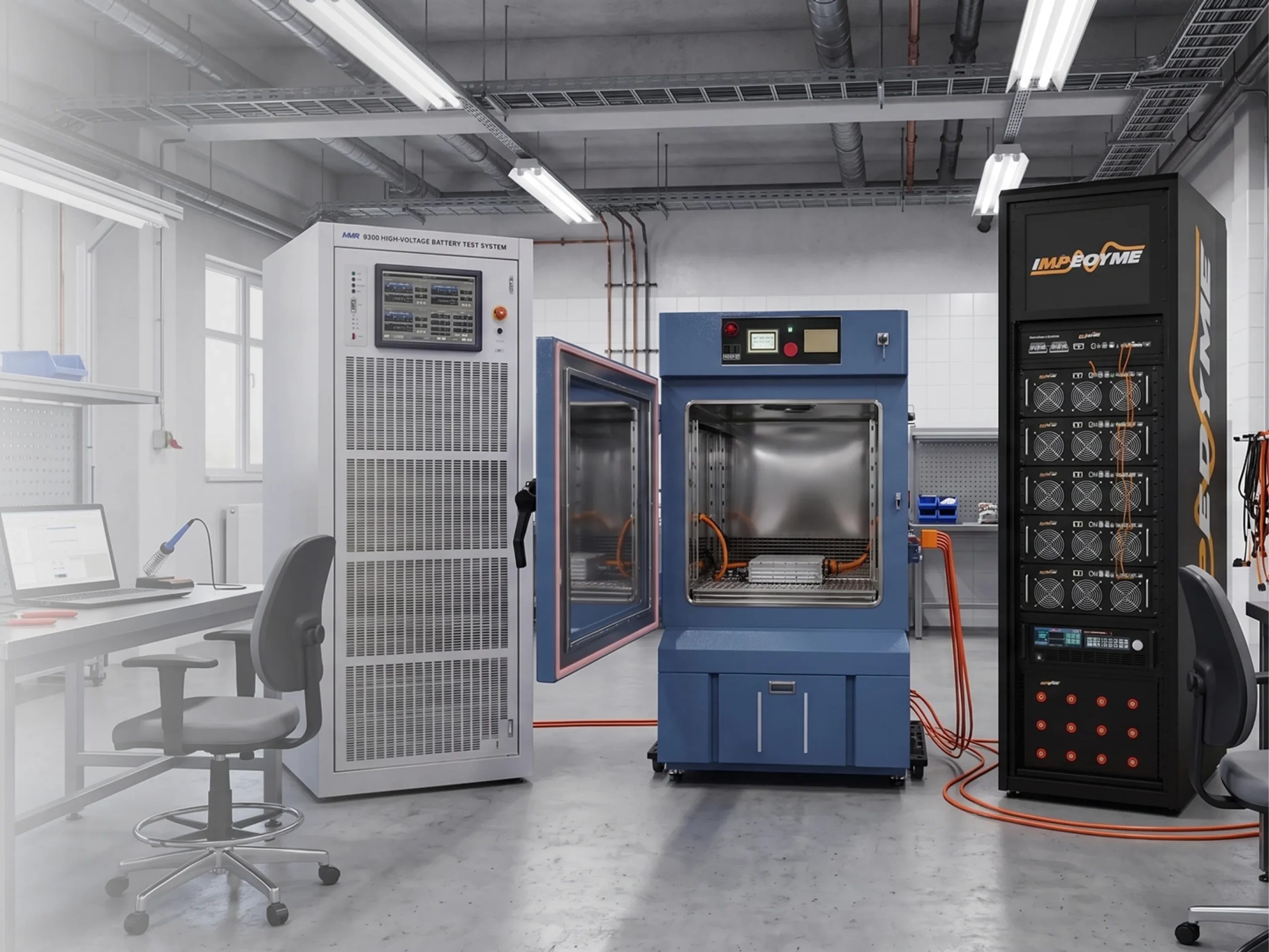
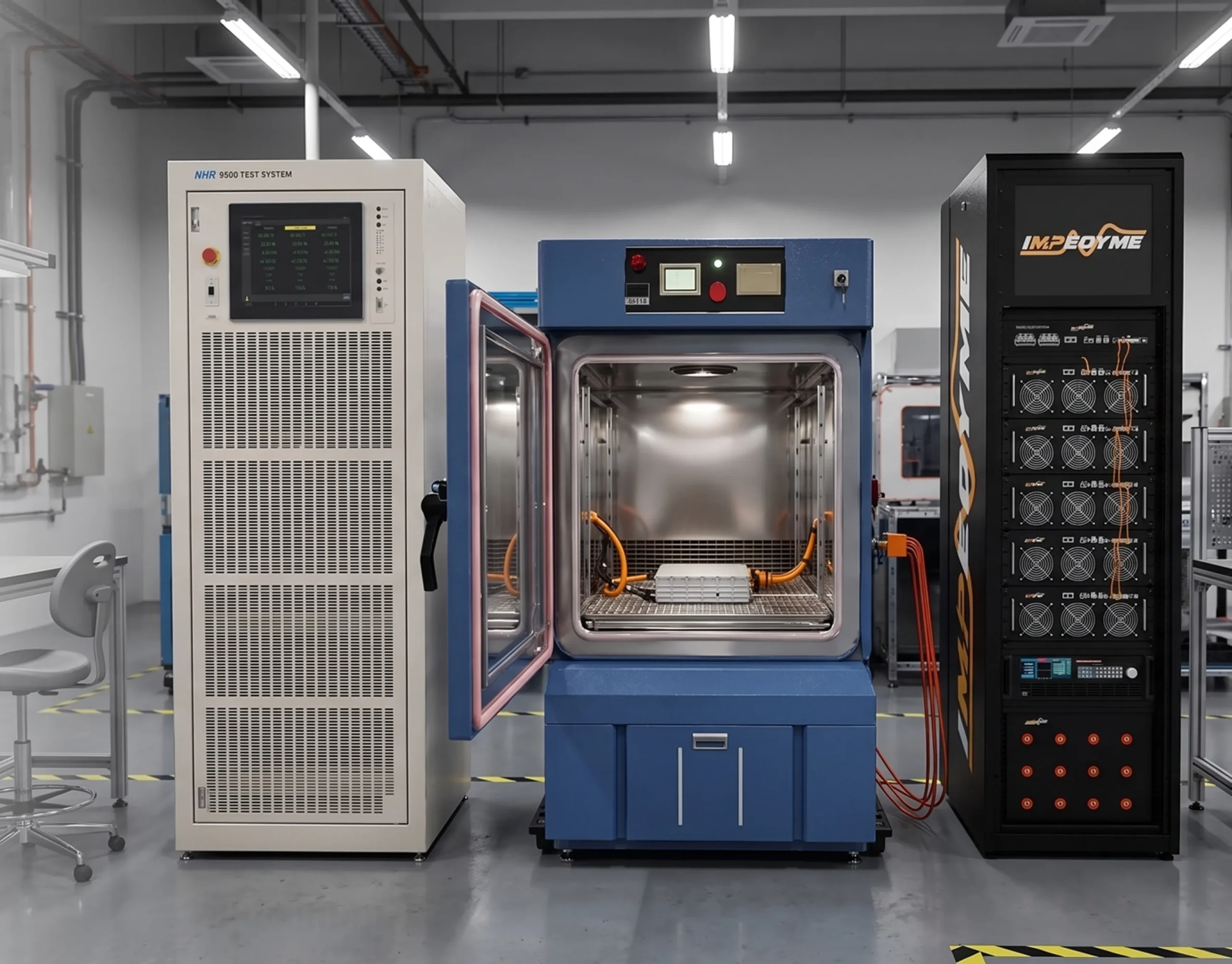
The battery-side cabinets handle cell, module and pack cycling, drive-cycle profiles, and hardware emulation for testing a BMS or powertrain without a physical pack in the room.
What matters is channel count, emulation versus cycling time, fault-injection depth — and how much BMS validation still runs against a real pack because the emulation isn't trusted. That testing is slow, hazardous and never exactly repeatable, and most labs do it anyway.
Our path: CHP Series hardware with BatterySim Studio and the Real-Time Battery Emulator — an electrochemical cell model on FPGA, per-cell emulation stacking into full HV strings, with cell-level faults, impedance measurement and thermal coupling built in.
NHR Grid: Simulators, AC Sources and Four-Quadrant Loads
The grid-side cabinets cover inverter test, grid-tied validation, energy storage and certification against IEEE 1547, UL 1741 and IEC 61000 — sags, swells, harmonics, frequency excursions, and regenerative absorption.
The upgrade question is sharper here. A ride-through sequence is a ride-through sequence whoever builds the simulator; what differs is whether it can present a live grid impedance model, so you catch control instabilities against weak grids before a field deployment does. Certification proves compliance, not stability.
Our path: CHP Series grid emulator with GridSim Studio — automated IEEE 1547 ride-through sequences and real-time impedance modelling through a genuine PHIL loop, not a replayed waveform.
The Capability Gap Nobody Mentions
There is a second, less obvious reason to look at this now.
NH Research cabinets are excellent programmable sources and loads. You set a profile, the hardware executes it, the software logs the result. The battery-side cabinets even emulate a pack in hardware, using a voltage characteristic and a series resistance.
What they are not is real-time simulators. With one partial exception, NHR cabinets do not run a plant model in closed loop with the unit under test. One grid-side family offers a power amplifier mode intended for power hardware-in-the-loop work, with a loop latency in the region of fifty microseconds — usable, but an order of magnitude away from what modern power electronics validation asks for. No NHR cabinet executes a model on an FPGA, deploys a Simulink model to hardware, or closes a control loop in the microsecond class.
That matters because the hard failures in modern power electronics are not steady-state failures. They are transient and interaction failures: a battery management system that miscounts state of charge during a fast transient, an inverter control loop that becomes unstable against a particular grid impedance, a traction inverter whose fault response is correct in isolation and wrong in the vehicle. A programmable source cannot expose those. A model running in closed loop with the hardware can.
We call this the validation gap — the space between what bench equipment proves and what the product has to survive in the field. An NHR cabinet closes part of that gap. It was never built to close all of it.
So the honest framing of a replacement decision is not "how do we buy the same thing again?" It is "if we are replacing this cabinet anyway, what should the replacement be able to do that the old one couldn't?"
What the Ownership Changes Mean for Your Lab
NH Research was acquired in 2021 by a large test-and-measurement corporation, itself absorbed by a global industrial automation group in 2023. In September 2025 the remaining NHR products were retired, with end of standard service set for 31 December 2026 — service having already moved from the original Irvine facility to the acquirer's centres in Texas and Hungary.
Repair becomes uncertain
Once standard service ends, a failed power module or controller has no guaranteed factory repair path. Third-party repair covers some assemblies, but not proprietary control boards or firmware.
Calibration gets harder
Traceable calibration depends on manufacturer procedures and reference units. Losing that path complicates ISO 17025 audits and any certification resting on documented traceability.
Spares dry up
The used market is already absorbing decommissioned NHR systems — useful now, a warning for later. The spares pool is finite and is not being replenished.
Software is the quiet risk
Enerchron and the older emPower drive NHR hardware and nothing else. Years of test plans, drive-cycle profiles and reporting formats sit in an environment with no forward path — often on a control PC your IT department dropped years ago.
What a Migration Actually Involves
A cabinet changeover is a facilities project as much as a procurement one. The sequence we work through with labs looks like this:
1
Inventory and lifecycle audit
Every NHR unit on the floor — model, install date, service history, service status.
2
Duty analysis
What each cabinet is actually used for, not what it was bought for; under-used pairs often consolidate into one higher-density system.
3
Capability specification
Where the bench falls short — BMS transients, weak-grid inverter stability, fault response, drive-cycle fidelity.
4
Facilities check
Mains capacity, breaker ratings, floor loading, cooling and footprint; our liquid-cooled cabinets change the room's heat balance and usually the floor plan.
5
Test-plan migration
Sequences, drive-cycle profiles and pass/fail criteria rebuilt in PowerHIL Studio — the step labs most underestimate.
6
Phased changeover
Where a programme can't pause, we run new alongside old and decommission only once the new bench reproduces the old numbers.
常见问题
Still Running NH Research Cabinets?
Partner with Impedyme to keep your battery and grid validation running, with a replacement path mapped cabinet by cabinet and no gap in coverage.