
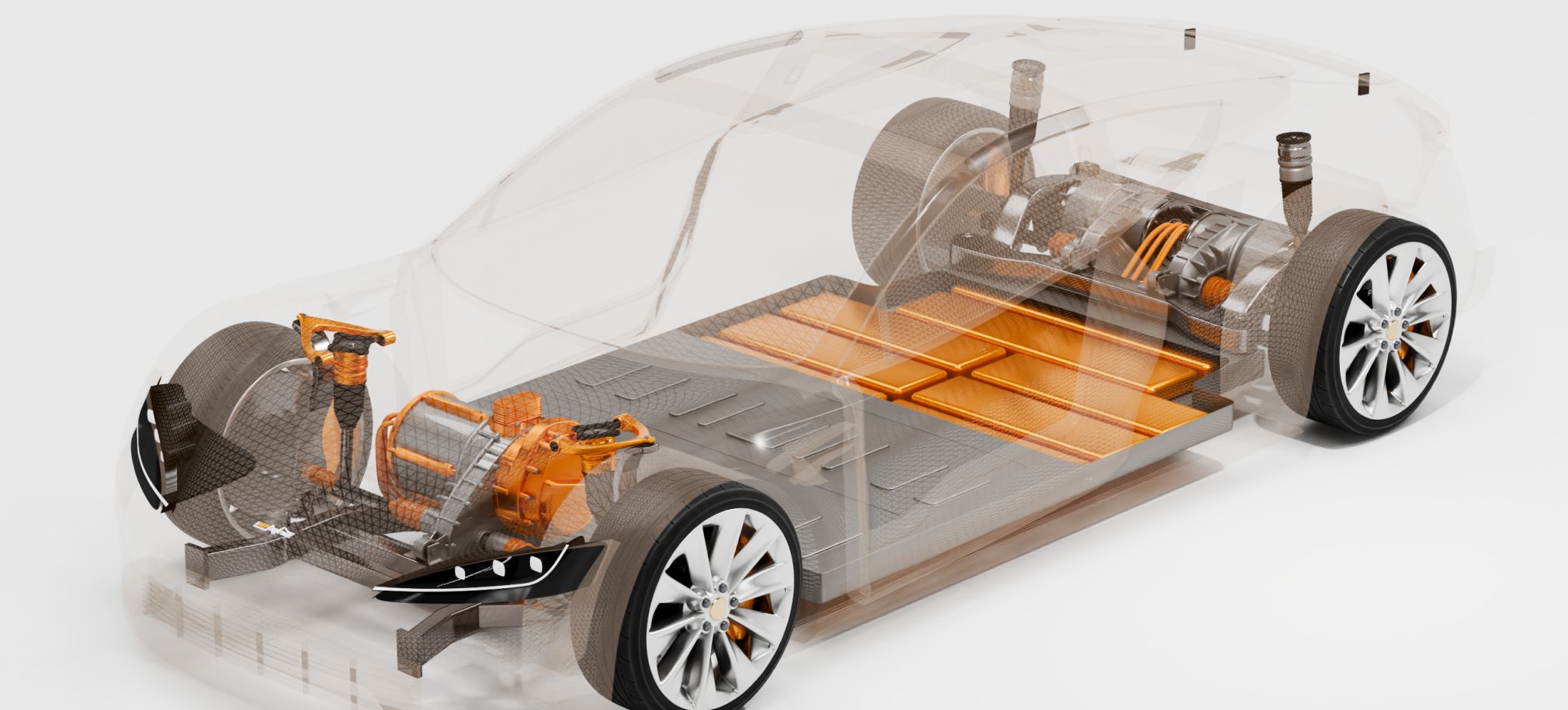
header IPMSM axle drive ev example car wireframe

Application knowledgeGridMotorProduct knowledgeWebinars

header IPMSM axle drive ev example car wireframe

Permanent Magnet Synchronous Motor for Electric Vehicles: Axle-Drive Simulation Approach

Introduction

Electric vehicles (EVs) rely on efficient powertrain systems to ensure optimal performance and energy efficiency. This project focuses on modeling and simulating a permanent magnet synchronous motor (PMSM) as part of an axle-drive system. The simulation incorporates key aspects of power delivery, torque control, and drivetrain dynamics, providing insights into EV propulsion and regenerative braking strategies. By integrating advanced control techniques and system modeling, this project enhances the understanding of permanent magnet synchronous motor behavior in EV applications.

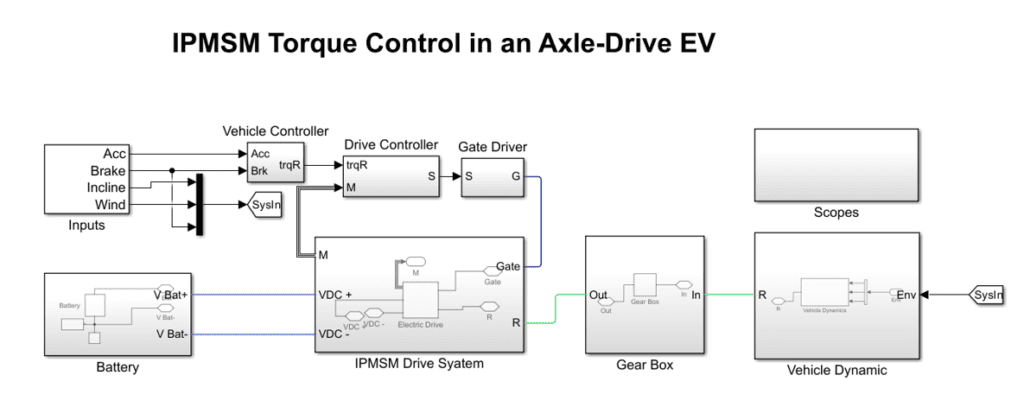
IPMSM Torque Control in an Axle-Drive EV

System Overview

What is a PMSM-Based Axle-Drive?

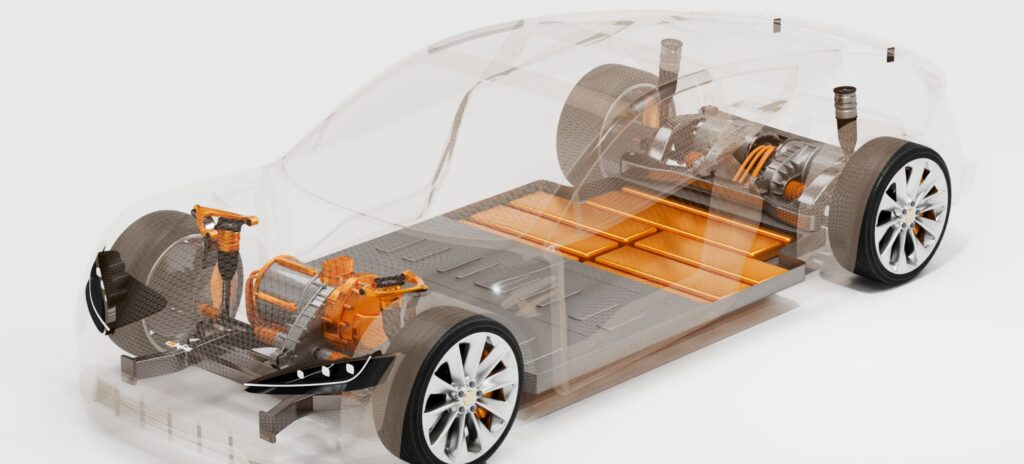
A permanent magnet synchronous motor-based axle-drive is a high-efficiency traction system used in EVs, where the motor is directly coupled to the drive axle, eliminating the need for a multi-speed transmission. The salient rotor structure of the PMSM enhances torque generation and field-weakening capability, making it ideal for high-performance EV propulsion.

Permanent Magnet Synchronous Motor for Electric Vehicles

A Permanent Magnet Synchronous Motor (PMSM) is widely used in Electric Vehicles (EVs) for its high efficiency, torque density, and fast dynamic response. The rotor uses permanent magnets, eliminating copper losses and ensuring synchronous rotation with the stator’s magnetic field. To test and validate its performance without relying on the actual hardware, a motor emulator can be employed, allowing researchers and engineers to simulate real-world operating conditions safely and cost-effectively.

Purpose of the Simulation

The simulation aims to:
✔ Analyze torque and speed control under different load conditions.
✔ Evaluate regenerative braking strategies to improve energy efficiency.
✔ Optimize drivetrain dynamics for smoother operation and enhanced vehicle response.

Key Features

1. High-Performance Torque and Speed Control
  • Implements advanced control algorithms such as Field-Oriented Control (FOC), Direct Torque Control (DTC), and Maximum Torque per Ampere (MTPA).
  • Enables precise regulation of torque and speed across various driving conditions, including acceleration, cruising, and deceleration.
  • Optimizes flux and current utilization for maximum drive efficiency.
  • HIL/PHIL Benefit: Allows real-time validation and fine-tuning of control strategies under simulated road scenarios.
2. Regenerative Braking and Energy Recovery
  • Models regenerative braking to capture kinetic energy during deceleration and feed it back to the battery.
  • Ensures smooth and controlled transition between motoring and braking modes to avoid torque shocks.
  • Enhances range and energy efficiency, especially in urban stop-and-go driving.
  • HIL/PHIL Benefit: Supports validation of braking energy recovery strategies before physical deployment.
3. Comprehensive Drivetrain Dynamics
  • Incorporates axle load variation, road gradient, tire slip, and wheel inertia for a realistic drivetrain response.
  • Models the effect of gear ratios and differentials on torque delivery and vehicle behavior.
  • Simulates vehicle dynamics under both linear and non-linear driving scenarios.
  • HIL/PHIL Benefit: Enables robust testing of complete EV powertrain behavior in real time.
4. Precision Control in Realistic Environments
  • Provides accurate torque and speed control under variable driving conditions such as uphill driving, rapid acceleration, and emergency braking.
  • Simulates external disturbances and control loop interactions for robust controller design.
  • Improves vehicle drivability and responsiveness through accurate transient and steady-state behavior modeling.
5. Energy Optimization and Efficiency Analysis
  • Enables power flow tracking from battery to motor and wheels to evaluate energy losses at each stage.
  • Supports thermal modeling and loss analysis in inverters and motors.
  • Identifies inefficiencies in control logic or drivetrain design early in the development cycle.
6. Cost and Time Reduction Through Simulation
  • Reduces dependency on physical prototyping by detecting system-level issues in the simulation stage.
  • Supports rapid iteration and optimization of design parameters such as motor sizing, gear ratios, and control algorithms.
  • Accelerates compliance testing by simulating regulatory drive cycles and evaluating performance metrics.

Simulation Objectives

This simulation helps evaluate:
Power and energy efficiency of the permanent magnet synchronous motor-based drive.
✔ Dynamic response to acceleration, braking, and road conditions.
✔ Effectiveness of different torque control strategies.
➡️ HIL/PHIL Benefit: Enables real-world testing of motor control and drivetrain efficiency.

Technical Description

System Configuration
  • Input: DC power source (battery pack).
  • Motor: IPMSM with dual-flux control capability.
  • Inverter: Three-phase IGBT-based or SiC-based traction inverter.
  • Transmission: Single-speed gearbox or direct axle-drive.
Control Methodology
  • Motor Control Strategies: FOC, DTC, and Maximum Torque per Ampere (MTPA) control.
  • Regenerative Braking Algorithm: Active energy recovery with optimized deceleration profiles.
  • Traction System Modeling: Real-time wheel torque and slip control.
    ➡️ HIL/PHIL Benefit: Enables tuning of control parameters in real-time scenarios.

Advantages of PMSM-Based Axle-Drives

Higher Efficiency: Reduced power losses due to optimized flux control.
Compact and Lightweight: Eliminates complex multi-speed transmissions.
Enhanced Dynamic Response: Superior acceleration and deceleration characteristics.
➡️ HIL/PHIL Benefit: Provides a controlled test environment to fine-tune EV powertrain strategies.

Applications of PMSM-Based Axle-Drive Simulation

1. Electric Passenger Vehicles
  • Design and optimize propulsion systems for electric cars using PMSM axle drives.
  • Analyze energy consumption patterns to extend driving range.
  • Evaluate regenerative braking efficiency for improved urban and highway driving cycles.
  • Support real-time testing of motor control strategies for seamless vehicle performance.
2. Commercial Electric Vehicles
  • Provide robust propulsion solutions for electric buses, delivery vans, and trucks.
  • Ensure consistent energy-efficient operation under variable payload and driving conditions.
  • Simulate torque distribution and control strategies tailored for heavy-duty applications.
  • Facilitate durability testing through virtual simulation of long-term load cycles.
3. Two-Wheeled Electric Vehicles
  • Optimize motor control and energy usage for electric scooters, motorcycles, and e-bikes.
  • Enhance acceleration response and regenerative braking for improved ride quality.
  • Simulate drivetrain dynamics specific to compact and lightweight EV platforms.
4. Off-Road and Utility Vehicles
  • Improve traction and power delivery in electric all-terrain vehicles (ATVs) and utility task vehicles (UTVs).
  • Model challenging operating environments, including uneven terrain and variable load conditions.
  • Support energy management and torque vectoring strategies for enhanced off-road performance.
5. Heavy-Duty Electric Vehicles
  • Deliver high-torque, efficient propulsion for electric trucks and construction machinery.
  • Simulate powertrain behavior under high load and variable duty cycles.
  • Assist in thermal management and system reliability analysis for demanding industrial applications.
6. Marine and Aerospace Propulsion
  • Design efficient electric drives for boats and marine vessels using PMSM-based axle systems.
  • Model integration of electric propulsion in aircraft, focusing on weight, thermal constraints, and energy efficiency.
  • Enable simulation of unique operational profiles for flight and marine environments.
7. Energy Management and System Optimization
  • Integrate battery management and thermal control models with PMSM drive simulation.
  • Optimize the synergy between motor, inverter, and battery to maximize overall vehicle efficiency.
  • Support real-time adaptive control strategies for varying environmental and load conditions.

Simulation Benefits

With this simulation, users can:
✔ Analyze motor dynamics and torque characteristics.
✔ Optimize regenerative braking for extended range.
✔ Evaluate drivetrain performance under real-world conditions.
➡️ HIL/PHIL Benefit: Ensures a seamless transition from simulation to real-world EV testing.

Summary

The permanent magnet synchronous motor-based axle-drive simulation provides a detailed framework for studying torque control, drivetrain dynamics, and regenerative braking in EVs. Impedyme’s HIL and PHIL solutions enhance the development process.

Development StageImpedyme’s Contribution
Powertrain ModelingHIL-based rapid validation of torque control strategies
Energy Efficiency TestingPHIL with real-time battery-inverter interaction
Regenerative Braking OptimizationSimulation-based testing for smooth braking transitions
Full-Vehicle ValidationPHIL-driven assessment under real driving cycles

Future Enhancements

✔ Integration of AI-based predictive torque control algorithms.
✔ Advanced thermal modeling for motor and inverter cooling optimization.
✔ Development of real-time adaptive regenerative braking strategies.

The PMSM-Based Axle-Drive Simulation serves as a vital tool for developing next-generation EV powertrains. With Impedyme’s HIL/PHIL solutions, engineers can optimize motor efficiency, enhance drivetrain performance, and validate control strategies before real-world deployment.