
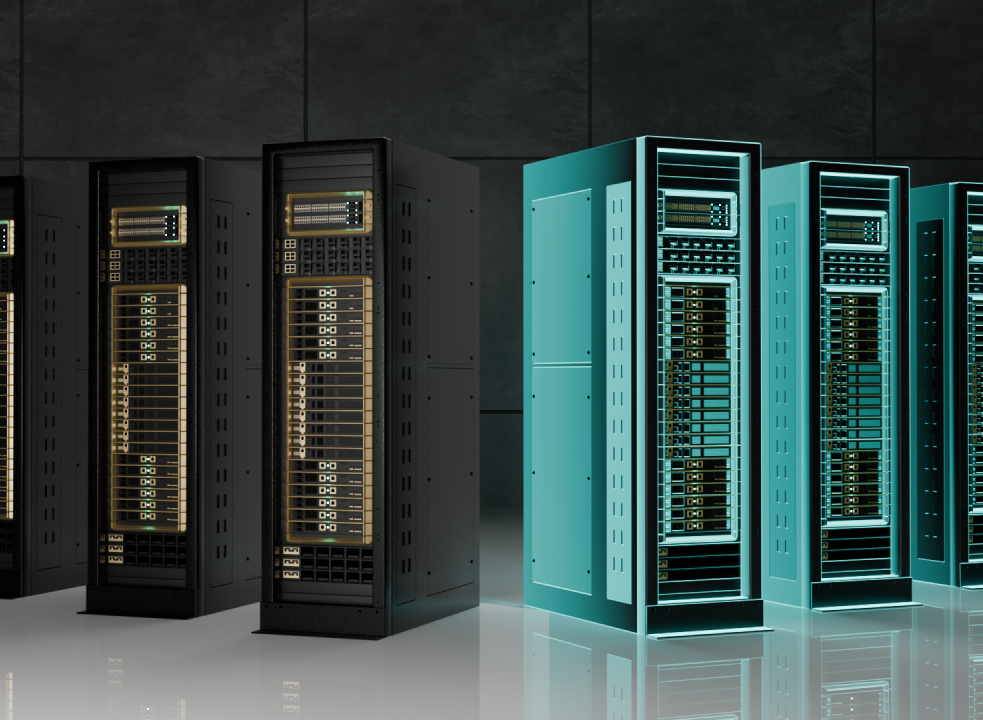
hardware in the loop data center card

Application knowledgeGridMotorProduct knowledgeWebinars

hardware in the loop data center

Data Center Powershelfs Testing with Grid Emulator and DC Load​

What Data Center Engineers and PSU Manufacturers Gain

  • End-to-end Powershelf validation across all global AC input voltages (230Vac, 277Vac, 415Vac, 480Vac) and full DC output ranges (±50Vdc, ±400Vdc, ±800Vdc) before field deployment.
  • Regenerative test architecture that recirculates power back to the source, dramatically reducing energy consumption and operating costs during high-power testing.
  • Real-time AC/DC load emulation that replicates the dynamic behavior of actual data center server loads, including rapid load steps and parallel configurations up to 800V / 600A.
  • FPGA-based power analysis at both input and output terminals for simultaneous, high-bandwidth measurement of efficiency, power quality, and harmonic distortion.
  • A proven closed-loop test methodology that de-risks Powershelf designs before mass production and field deployment.
  •  

Why Powershelf Testing Has Become a Critical Challenge

As hyperscale data centers scale to meet AI and cloud computing demand, the Powershelf — the AC-to-DC conversion stage that feeds server racks — has become one of the most power-dense and performance-critical components in the facility. A single Powershelf failure or underperformance event can cascade across thousands of compute nodes.

Yet traditional Powershelf test setups rely on passive resistive loads, fixed AC sources, and disconnected measurement instruments. These approaches cannot replicate the dynamic electrical environment a Powershelf experiences in a live data center — and they are blind to many of the failure modes that only emerge under real operating conditions.

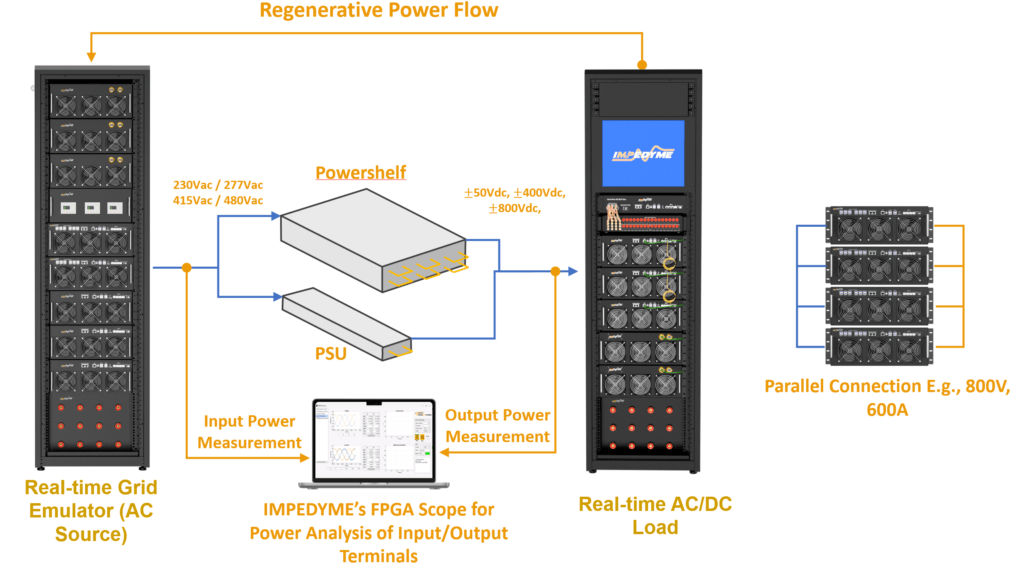
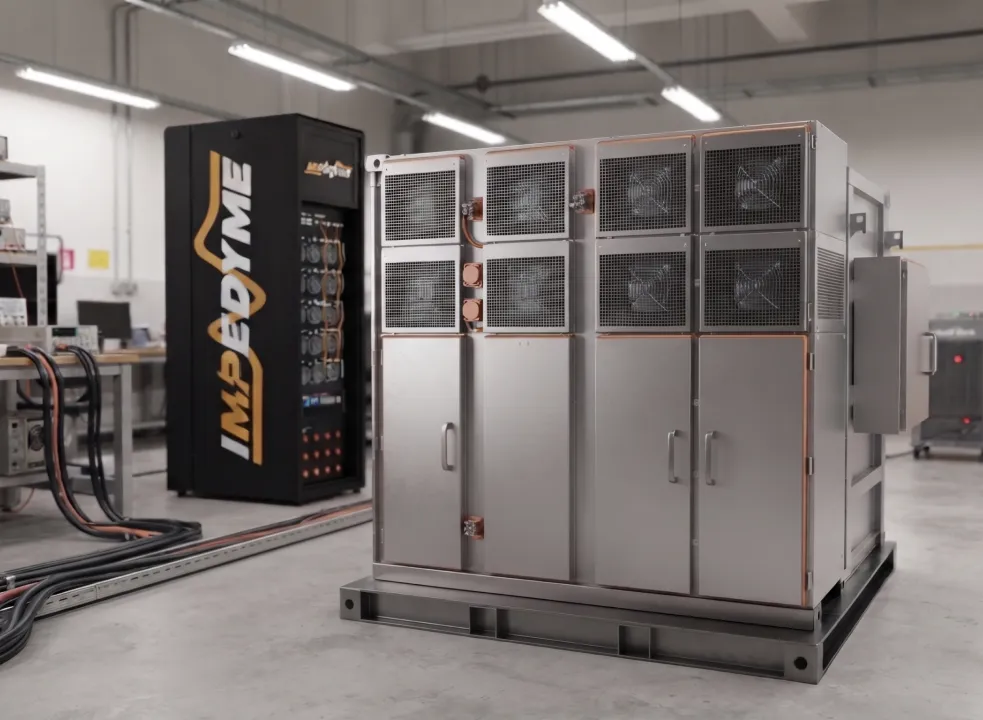
Impedyme’s answer is a simulation-first, regenerative test platform that brings together a Real-time Grid Emulator as the AC source, a Real-time AC/DC Load on the DC output, and an FPGA Scope for simultaneous power analysis — all operating in a closed regenerative loop.

The Test Setup: Three Systems, One Closed Loop

Real-Time Grid Emulator (AC Source)

The Impedyme Grid Emulator replaces the utility supply with a fully programmable, real-time AC source. It replicates any global grid standard the Powershelf will encounter in the field:

  • 230Vac / 277Vac / 415Vac / 480Vac — covering single-phase, split-phase, and three-phase industrial supplies used across North America, Europe, and Asia-Pacific.
  • Programmable frequency, phase angle, voltage imbalance, harmonic content, and impedance to simulate weak or distorted grid conditions.
  • Fault injection capability: voltage sags, swells, short-circuit events, and frequency deviations can be applied on demand to test ride-through and protection response.
  • Because the Grid Emulator is regenerative, power absorbed during testing is returned to the grid rather than dissipated as heat — enabling sustained high-power test runs at a fraction of the energy cost of conventional setups.

Real-Time AC/DC Load (DC Output)

On the DC output side, the Impedyme Real-time AC/DC Load dynamically absorbs and returns power across the full Powershelf output voltage range:

  • ±50Vdc, ±400Vdc, ±800Vdc — matching the intermediate bus and high-voltage DC architectures used in modern hyperscale facilities.
  • Parallel connection up to 800V / 600A, enabling testing of multiple Powershelf units operating simultaneously as they would in a populated rack.
  • Dynamic load profiles that reproduce real server workload transitions: idle-to-full-load steps, burst compute cycles, and sudden load drops — all programmable in real time.
  • Bidirectional operation supports regenerative return of DC power, completing the energy recirculation loop.

IMPEDYME’s FPGA Scope for Power Analysis

At the heart of the measurement chain is Impedyme’s FPGA-based scope, which monitors both the input and output terminals simultaneously:

  • Input Power Measurement: AC voltage and current waveforms, power factor, total harmonic distortion (THD), and input power — captured at the Grid Emulator output terminals.
  • Output Power Measurement: DC voltage, current, ripple, and power — captured at the AC/DC Load input terminals.
  • Real-time efficiency calculation across the full operating envelope, from light load to peak rated power.
  • High-bandwidth waveform capture enables detailed analysis of transient events — inrush currents, switching artifacts, and response to load steps.
  • All data is synchronized, allowing true input-to-output efficiency mapping with no timing ambiguity.

What This Test Platform Validates

Efficiency Across the Full Operating Envelope

Efficiency is not a single number — it is a surface. The regenerative test platform enables engineers to map Powershelf efficiency across every combination of input voltage, output voltage, load level, and temperature. Peak efficiency, part-load efficiency, and the shape of the efficiency curve under dynamic loading can all be characterized with precision. This data drives design optimization and directly informs energy consumption predictions for the deployed facility.

Input Power Quality and Grid Compatibility

Modern data centers are required to meet strict power quality standards. The test platform validates:

  • Power Factor Correction (PFC) performance across all AC input voltage variants
  • Input harmonic current content (THD-I) against IEC 61000-3-2 and similar standards
  • Input inrush current during cold-start and hot-plug events
  • Ride-through behavior during voltage sags, swells, and momentary interruptions — critical for facilities that must maintain uptime through grid disturbances

DC Output Regulation and Stability

The AC/DC Load exercises the Powershelf output regulation loop under conditions that passive resistive loads cannot replicate:

  • Dynamic load steps from 0% to 100% rated current, verifying transient response and voltage deviation
  • Parallel load sharing accuracy across multiple Powershelf units connected at 800V / 600A
  • Stability under the fast impedance transitions associated with power-electronic server loads

Protection System Verification

With the Grid Emulator’s fault injection capability, protection responses can be verified without risk to personnel or equipment:

  • Overcurrent and overvoltage protection trip points and response times
  • Behavior during AC input phase loss or severe imbalance
  • Recovery sequencing after fault clearance

Regenerative Architecture: The Energy Efficiency Advantage

A distinctive feature of this test platform is its fully regenerative power flow. Power delivered by the Grid Emulator to the Powershelf input is converted to DC and absorbed by the AC/DC Load — which then returns that energy back through the system. The net energy drawn from the utility supply covers only the conversion losses within the loop.

For a Powershelf with 94% efficiency under test, the regenerative architecture means that a 100 kW test consumes only approximately 6 kW from the wall. This has significant practical implications:

  • Lower facility power requirements — test labs do not need utility feeds sized for full rated power
  • Reduced cooling load — far less heat is generated during extended test campaigns
  • Lower operating cost — energy bills during product qualification and production testing are a fraction of those for resistive-load setups
  • Sustained long-duration testing — thermal steady-state testing and reliability screening can run continuously without excessive energy consumption

Test Coverage Across the Product Lifecycle

Design Validation

Early in the design cycle, the platform gives engineers visibility into efficiency, power quality, and stability performance before hardware is committed to production tooling. Simulation of worst-case grid conditions — weak grids, harmonic-rich inputs, severe voltage imbalance — reveals design margins and identifies the need for protection or filter enhancements while changes are still inexpensive.

Pre-Compliance Testing

Before formal regulatory submissions, the platform allows engineers to run pre-compliance sweeps against IEC, UL, and regional power quality standards. Issues are identified and corrected in-house rather than at a third-party lab, reducing costly re-test cycles.

Production Acceptance Testing

The closed-loop architecture is well-suited to production line testing, where every unit must be verified against efficiency and output regulation specifications within a defined cycle time. The regenerative design keeps per-unit test energy costs low even at scale.

Field Failure Analysis

When Powershelf units return from the field with reported failures, the platform can recreate the exact grid conditions and load profiles that preceded the event — enabling root-cause analysis that would be impossible with a static test setup.


Summary

The combination of Impedyme’s Real-time Grid Emulator, Real-time AC/DC Load, and FPGA Scope creates a complete, closed-loop Powershelf test environment that mirrors real data center operating conditions with high fidelity. The regenerative architecture eliminates the energy waste of traditional test setups, while real-time programmability ensures that every relevant grid condition, output voltage, and load profile can be characterized efficiently.

For data center equipment manufacturers and hyperscale operators who need to validate Powershelf performance before deployment, this platform delivers the certainty that conventional test approaches cannot provide: that the Powershelf has been tested against the actual electrical environment it will face in production — and passed

Impedyme Powershelf Testing

From Laboratory to Field: Why Fidelity Matters

Megawatt-scale fidelity ensures that grid-forming resources validated at Impedyme behave consistently when deployed in real-world renewable and hybrid grids. By combining power-level realism, real-time control, and communication co-validation, the PHIL platform provides an end-to-end environment where engineers can not only certify but optimize their designs for stability, compliance, and resilience.

For next-generation grids dominated by inverter-based resources, this level of fidelity isn’t optional—it’s foundational. Impedyme’s Power-HIL platform demonstrates how accurate, repeatable, and high-power testing bridges the gap between simulation and reality, helping industry partners bring smarter, more stable, and more reliable grid-forming solutions to life.

 Applications and Future Outlook

The insights gained from testing grid forming with PHIL are crucial for the global clean energy transition. As renewable penetration increases and system inertia declines, utilities and grid operators must rely on proven GFM resources capable of:

  • Providing virtual inertia and fast frequency response.
  • Supporting black-start and autonomous microgrid formation.
  • Enhancing voltage and reactive power control in hybrid energy systems.
  • Ensuring interoperability among diverse inverter manufacturers.

Future advancements at Impedyme will further scale PHIL testing for grid-forming systems to 34.5 kV and beyond, integrating more complex hybrid AC/DC systems and expanding validation of hydrogen-based energy storage and power-to-gas technologies.

Impedyme’s megawatt-scale PHIL platform represents the pinnacle of modern grid validation research. By combining real-time digital simulation, power hardware integration, and high-fidelity measurement systems, it provides an unparalleled environment for testing grid forming with PHIL and validating hybrid renewable systems. As global energy systems evolve toward 100% renewable operation, such high-fidelity, hardware-based validation platforms will be essential for ensuring stability, reliability, and confidence in the next generation of power grids.