
Integrating a massive data center into the power grid is far from a routine upgrade. In many cases, it is equivalent to adding a small power plant’s worth of load, and if poorly coordinated, it can seriously disrupt grid stability.
Hyperscale data centers are often constructed far faster than traditional grid reinforcements can be planned, approved, and built. Their electrical demand is also highly dynamic—creating risks that conventional planning methods were never designed to address.
From Impedyme’s perspective, this challenge is entirely solvable—but only if the grid and the data center first “meet” in a high-fidelity simulation environment, long before any physical connection is made.
A simulation-first strategy ensures that when the breaker finally closes, both the facility and the grid are fully prepared:
Hyperscale data centers are rapidly changing how utilities plan and approve large electrical loads:
This shift requires utilities to adopt simulation-first interconnection strategies to maintain grid stability while supporting rapid data center growth.
The challenge is not just scale—it is timing:
This mismatch forces utilities to connect enormous loads on schedules that outpace traditional grid expansion, increasing the risk of instability, congestion, and reliability events.
Beyond scale and speed, data centers behave in ways that defy traditional load assumptions. Unlike industrial plants or residential neighborhoods, data center demand can swing sharply in seconds:
Backup power systems add another layer of uncertainty. During even brief grid disturbances, many data centers rapidly disconnect and transfer to on-site generation. In one documented U.S. grid event, dozens of large data centers transitioned off-grid almost simultaneously, resulting in the sudden loss of more than 1,000 MW of load within seconds as uninterruptible power supply (UPS) systems engaged.
Traditional planning tools were never designed to model a single customer appearing—or disappearing—as a gigawatt-scale load instantaneously. Without advanced modeling, operators are left reacting in real time, threatening frequency control, voltage stability, and system resilience.
This new reality demands a fundamentally different interconnection strategy. Impedyme enables utilities and data center operators to move beyond static studies by using:
By testing ride-through performance, fault response, protection coordination, and power quality in advance, stakeholders gain shared confidence in how the load will behave under normal and abnormal conditions. Issues are identified early—when they are inexpensive to fix—rather than during commissioning or, worse, after energization.
The result is a repeatable, proven interconnection playbook that supports reliable, large-scale data center integration without compromising grid stability.
Faced with the scale, speed, and volatility of modern data centers, utilities and operators are increasingly relying on grid stability simulation to ensure a smooth and reliable interconnection—long before a facility ever draws live power.
By creating a high-fidelity digital twin of both the data center and its grid interconnection, engineers can safely explore failure modes, extreme operating conditions, and rare edge cases in a virtual testbed. This simulation-first approach transforms interconnection from a risky leap of faith into a well-rehearsed, predictable process that protects schedules, budgets, and power system reliability.
Engineers build an accurate digital representation of the data center’s electrical ecosystem—including servers, power supplies, uninterruptible power systems, and backup generators—alongside the utility’s transmission and distribution network. This digital twin reproduces real-world electrical behavior across steady-state operation, dynamic events, and fast transients, providing a realistic foundation for grid stability analysis.
Real-time simulation enables engineers to safely impose worst-case scenarios that would be dangerous or impractical to test in the field. Sudden 100-MW load steps, deep voltage sags, utility short-circuits, or frequency disturbances can all be applied to the model. If instability is going to occur, it appears first in the simulation lab—not during the live grid connection.
Grid stability simulation reveals exactly how the data center and the power system influence one another. Engineers can confirm, for example, that transformer energization will not cause unacceptable voltage dips, and that power-factor correction and inverter-based systems behave correctly during grid disturbances. Joint modeling of the facility and the grid uncovers interaction issues that isolated studies often miss.
The digital twin environment allows teams to validate control algorithms and protective relay settings under realistic, time-synchronized conditions. Engineers verify that data center controls ride through minor grid disturbances without unnecessary tripping, while utility breakers and transfer switches operate in the correct sequence during faults. Hidden software bugs, timing issues, or miscoordination are exposed early—well before commissioning.
Simulation provides a safe environment for continuous improvement. If testing reveals weaknesses—such as voltage oscillations during generator startup—engineers can adjust control logic, tune protection settings, or upgrade equipment. The scenario is then re-run to confirm the fix. This iterative process is far more cost-effective than discovering problems during construction or after energization.
In short, a grid stability simulation strategy de-risks large-load interconnection. Instead of guessing how a tens-of-megawatts–scale data center will behave, utilities and developers gain certainty—because they have already observed its performance under worst-case operating conditions in a simulated environment. That confidence is essential for achieving reliable, on-time grid integration.
While software-only simulation is powerful, Hardware-in-the-Loop testing takes validation to the next level by bringing real devices into the loop.
In an HIL setup:
This answers a critical question:
Will the real hardware maintain grid stability under real-world conditions?
By validating megawatt-scale equipment against a simulated grid, teams eliminate operational risk while gaining confidence that controls and protections will perform as intended.
During the design phase, a high-fidelity digital twin of the data center and its grid interconnection becomes a proving ground for ideas. Engineers use this virtual environment to conduct exhaustive grid stability studies before equipment is ordered or construction begins.
The simulation reveals how the proposed facility will behave under a wide range of operating conditions—and how that behavior affects the surrounding power system. For example, if the model shows that energizing a large server block causes unacceptable voltage drop or flicker, mitigation strategies such as controlled ramp-up sequences, capacitor banks, or advanced control logic can be specified immediately.
Traditional interconnection studies—steady-state power flow, short-circuit analysis, and transient stability—are significantly enhanced by real-time simulation. Dynamic effects like control interactions, inverter behavior, and harmonic distortion become visible, exposing issues that static calculations often miss.
The result is a simulation-validated design that stakeholders trust, because every major “what-if” scenario has already been tested against grid stability requirements.
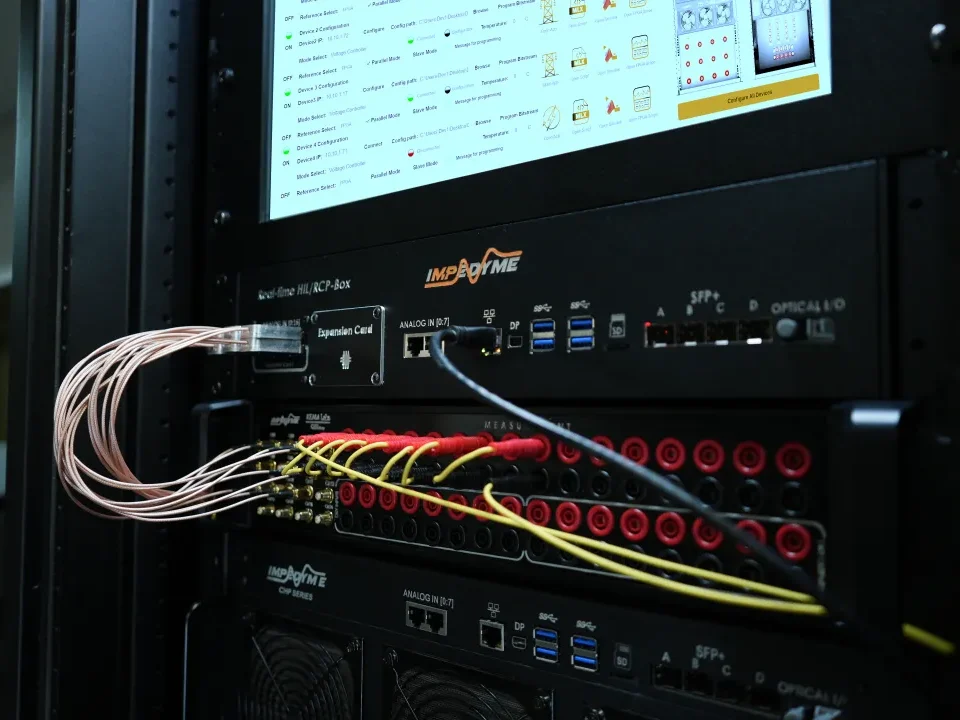
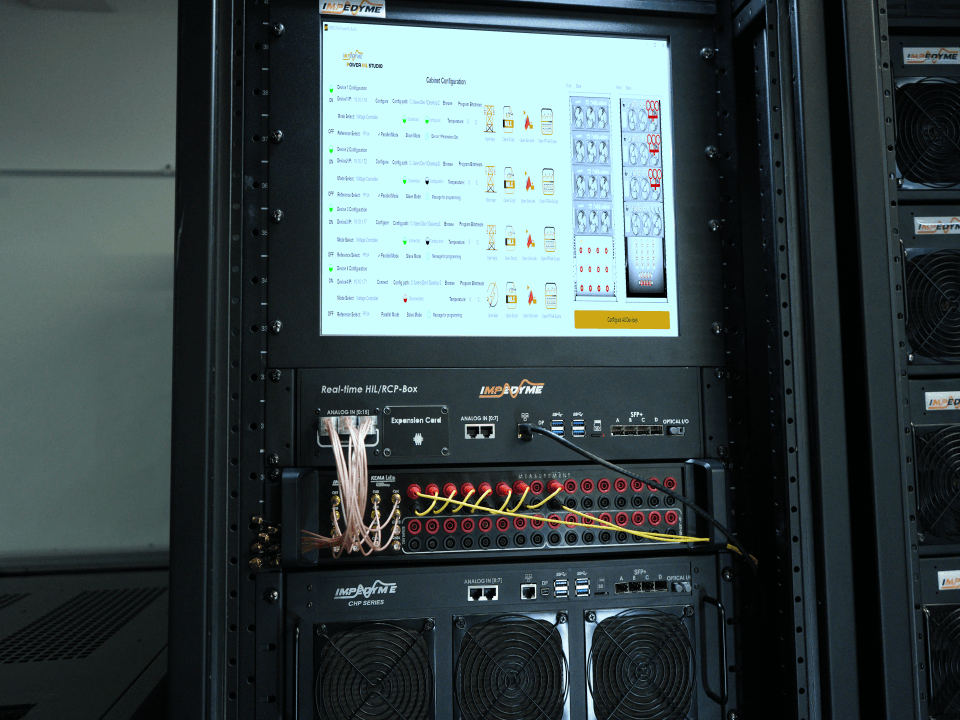
As the project moves into implementation, simulation remains central to the strategy. The focus shifts to testing and validation through HIL trials, where actual control and protection hardware is connected to the simulated grid.
Energy management systems, protection relays, and controller hardware are exercised against realistic operating scenarios, including:
Each test functions as a full rehearsal of the grid interconnection. When an issue is uncovered—such as overly sensitive protection settings or a transfer sequence that takes milliseconds too long—engineers adjust the configuration and immediately verify the fix in simulation.
This iterative validation process continues until system behavior is robust, predictable, and compliant with grid stability requirements. By the end of this phase, utilities and data center operators share a complete, transparent understanding of how the integrated system will perform under both normal and extreme conditions.
While controller-level HIL testing validates logic and coordination, Power Hardware-in-the-Loop (PHIL) takes simulation-guided planning one step further by introducing actual power equipment into the loop. This phase is where grid stability assumptions are confirmed at full electrical fidelity.
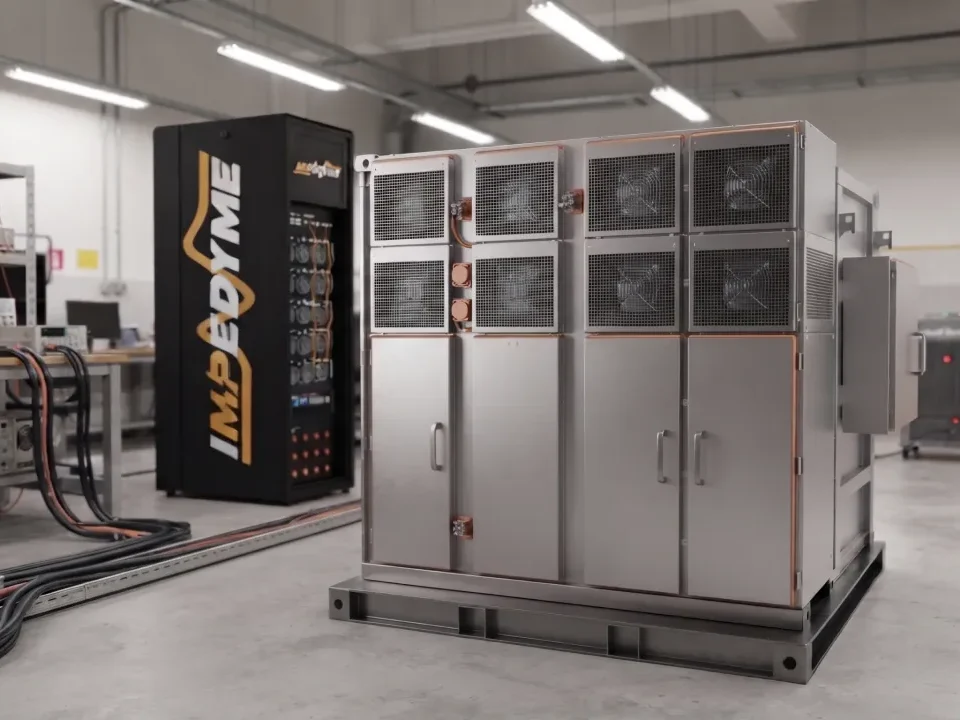
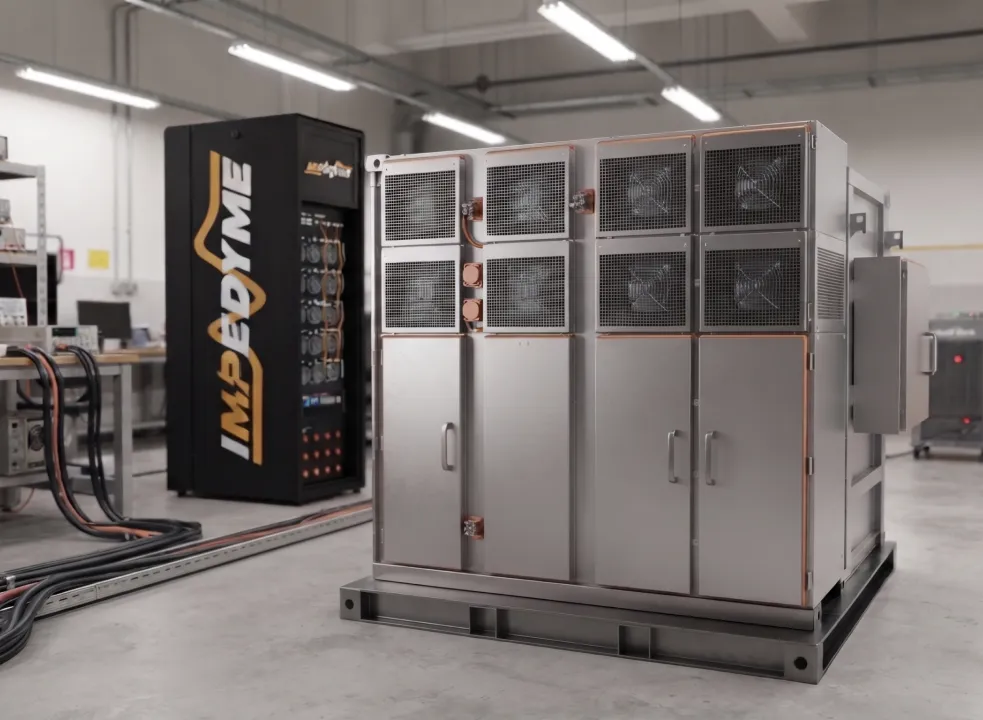
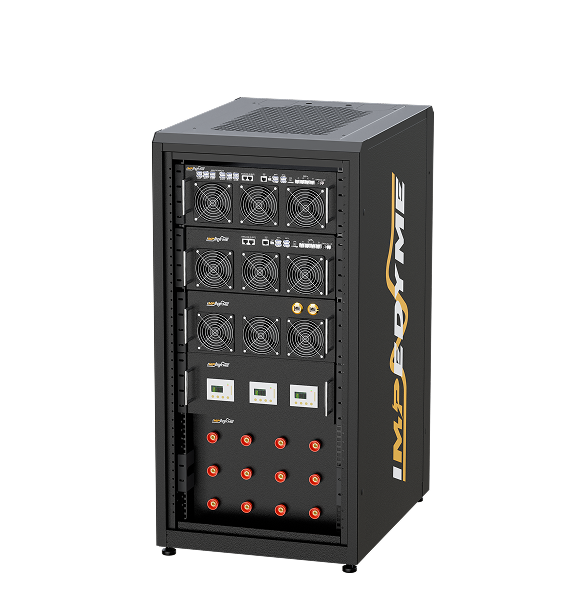
In a PHIL environment, Impedyme’s real-time simulator is electrically coupled to physical power devices—such as UPS systems, inverters, power converters, and protection hardware—allowing real power exchange between the hardware and a high-fidelity digital twin of the grid and data center.
This enables engineers to observe how real equipment behaves under realistic and extreme grid conditions before any live interconnection occurs.
PHIL testing allows utilities and data center operators to validate behaviors that cannot be fully captured with software models alone, including:
By testing physical equipment against a simulated grid, PHIL reveals subtle behaviors—firmware delays, control saturation, unexpected trips—that often only appear during live commissioning if left untested.
PHIL serves as the final proving ground before energization. Engineers can apply severe but realistic scenarios—deep voltage sags, frequency excursions, sudden large load steps, and fault recovery sequences—while monitoring how real hardware responds in real time.
If issues are identified, settings, firmware, or control strategies can be adjusted and immediately revalidated within the same environment. This dramatically reduces the risk of discovering hardware-related stability problems during commissioning, when changes are costly and schedules are tight.
By the time a project advances beyond PHIL testing:
PHIL ensures that when commissioning begins, the grid and the data center have already interacted under worst-case conditions—just not on the real system yet.
Commissioning is often the most stressful phase of a large data center project—but with simulation-guided preparation, it becomes remarkably routine.
Before energization, teams can run a final end-to-end simulation of the startup sequence as a last verification step. On the day of power-on, the data center is brought online methodically, and the system behaves exactly as predicted. Voltage remains stable, protections operate correctly, and no unexpected trips occur.
In effect, commissioning becomes anticlimactic—and that is the desired outcome. All surprises were resolved months earlier in the simulation environment, where changes were safe, fast, and inexpensive. Guided by the digital twin, the real-world interconnection proceeds on schedule and without incident, and the new large load becomes a stable, reliable part of the grid.
| Project Phase | Primary Objective | Role of Simulation | Grid Stability Value |
|---|---|---|---|
| Design | Identify and mitigate grid risks early | High-fidelity digital twin studies | Prevents voltage flicker, instability, and poor interconnection design |
| Testing & Validation | Verify control and protection behavior | Controller-level HIL testing | Ensures predictable response to grid disturbances |
| PHIL Validation | Confirm real hardware behavior | Real power exchange with simulated grid | Reveals hardware-level stability risks before commissioning |
| Commissioning | Energize safely and on schedule | Final end-to-end simulation rehearsal | Eliminates surprises during live grid connection |
As data center loads grow larger and more dynamic, ensuring grid stability requires more than theoretical validation. Power Hardware-in-the-Loop (PHIL) testing bridges the critical gap between simulation and real-world performance by allowing actual power equipment to interact with a real-time digital twin of the grid and facility. This capability is central to Impedyme’s approach to de-risking hyperscale data center interconnections.
Impedyme’s real-time simulation platforms are designed to support controller HIL and full Power HIL, enabling utilities and data center operators to validate stability at both the control and power levels.
Key capabilities include:
Real-time digital twins of transmission, distribution, and data center electrical systems
Closed-loop power exchange between simulated grids and physical hardware
Support for inverter-based resources, UPS systems, protection relays, and controllers
High-bandwidth, low-latency interfaces required for fast grid dynamics
These platforms allow Impedyme to test not just what the model predicts, but what the real equipment will actually do under grid disturbances.
Modern data centers rely heavily on power-electronic interfaces—UPS systems, inverters, static switches, and fast transfer devices. PHIL testing allows these assets to exchange real power with a simulated grid, revealing how they respond to:
Voltage sags and swells
Frequency deviations
Fault-induced transients
Rapid load ramps and shedding events
This level of validation is essential for confirming ride-through performance and preventing unintended disconnections that can destabilize the grid.
Impedyme’s PHIL workflows integrate actual protection relays and control hardware into the simulation loop. This enables engineers to verify:
Protection coordination between the utility and the data center
Breaker and transfer-switch timing under fault conditions
Control logic behavior during abnormal grid events
Mis-coordination that might only appear during commissioning—or worse, during live operation—is identified and resolved early.
Certain stability risks only emerge when real hardware is involved:
Firmware-specific timing behaviors
Nonlinear responses at high power levels
Control interactions between multiple inverter-based devices
PHIL testing exposes these issues in a safe, repeatable laboratory environment, eliminating the need to “learn” on the live grid.
From a utility perspective, PHIL-validated results provide objective evidence that a hyperscale data center will behave predictably during disturbances. This shared confidence:
Reduces interconnection uncertainty
Supports faster technical approval processes
Aligns expectations between utilities and operators
For large-load projects, PHIL becomes a risk-reduction tool for all stakeholders.
Impedyme’s philosophy is simple:
If a data center cannot maintain grid stability in a PHIL environment, it is not ready to connect to the real grid.
By combining real-time digital twins with Power Hardware-in-the-Loop testing, Impedyme ensures that grid stability, protection coordination, and control behavior are fully validated before energization. Every fault, surge, and contingency is rehearsed virtually—so the physical interconnection proceeds exactly as planned.
Building on this simulation-guided philosophy, Impedyme approaches every data center interconnection as a grid stability challenge that can—and should—be solved upfront.
Impedyme’s real-time simulation and HIL capabilities allow utilities and data center engineers to bring the grid and facility together virtually before any physical connection is made. High-fidelity models, combined with real controllers in the loop, enable teams to resolve stability, control, and protection issues well ahead of commissioning.
In Impedyme’s experience, a data center should only be physically connected to the grid after it has been fully vetted in a risk-free virtual environment. When grid stability, protection coordination, and control behavior are proven in advance, the real-world connection becomes predictable and smooth.
With deep expertise in simulation-driven power system validation, Impedyme helps clients de-risk large-scale, high-impact projects. By the time a data center is ready to draw live power, every surge has been absorbed in simulation, every control response has been verified, and every contingency has been rehearsed. When the switch is finally flipped, nothing unexpected happens—and that is the ultimate measure of success for both the grid and the data center.