

impedyme PV MPPT Solar pannel

Application knowledgeGridMotorProduct knowledgeWebinars

impedyme PV MPPT Solar pannel

Rotor Speed Control in PMSM-Based Electrical Traction Drives

Introduction

In high-performance electric traction applications, precise rotor speed control is essential for efficiency, stability, and smooth operation. This project focuses on implementing a cascade control structure for a Permanent Magnet Synchronous Machine (PMSM) powered by a high-voltage battery, enabling accurate and responsive rotor speed regulation under various operating conditions.

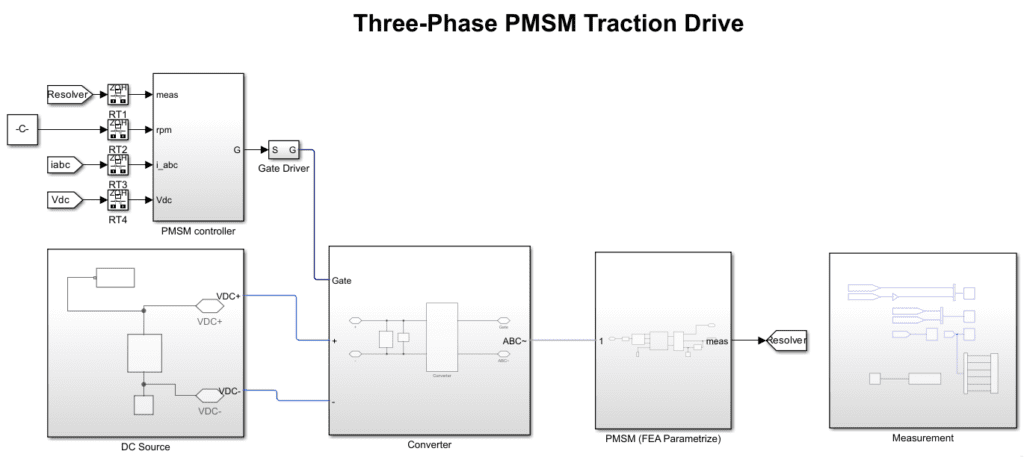
three phase PMSM traction drivepng

System Overview

What is a Permanent Magnet Synchronous Machine (PMSM)?

The PMSM is widely used in traction applications due to its:
✔ High power density and efficiency.
Fast dynamic response and accurate rotor speed control.
✔ Reduced losses compared to traditional AC induction motors.
✔ Compatibility with advanced control strategies for improved performance.

Purpose of the Simulation

This simulation is designed to:
✔ Implement a cascade control structure for precise PMSM rotor speed regulation.
✔ Optimize torque and flux control loops for stable operation.
✔ Analyze system response under different driving conditions.
✔ Ensure robust performance through real-time fault detection and protection mechanisms.


Key Features of Rotor Speed Control in PMSM Traction Drives

1. Advanced Cascade Speed Control
  • PI-Based Regulation – Maintains precise rotor speed under all driving conditions.
  • Inner Current Loops – Deliver fast dynamic response and smooth torque output.
  • Load Disturbance Compensation – Ensures stable operation during acceleration, deceleration, and load changes.

Benefit: Seamless driving experience with consistent speed stability.

2. Optimized Torque & Flux Management
  • d–q Axis Decoupling – Independently controls torque and flux for higher efficiency.
  • Active Current Regulation – Minimizes energy losses while maximizing output.
  • Load-Adaptive Performance – Maintains stability during varying torque demands.

Benefit: High performance with reduced power consumption.

3. High-Voltage Battery Integration
  • Direct Battery Connection – Supports high-power traction applications.
  • Voltage Regulation – Prevents performance drops under load.
  • Efficient Power Conversion – Extends driving range through minimized energy waste.

Benefit: Improved battery utilization for longer operation.

4. Field Weakening for Extended Speed Range
  • Dynamic Magnetic Field Control – Adjusts d-axis current at high speeds.
  • Beyond Base Speed Operation – Expands top speed without overloading the motor.
  • Balanced Torque-Energy Output – Maintains efficiency even at high RPMs.

Benefit: Greater speed flexibility without sacrificing efficiency.

5. Comprehensive Fault Detection & Protection
  • Real-Time Monitoring – Detects overcurrent, overvoltage, and overheating instantly.
  • Automatic Protective Actions – Prevents motor and system damage.
  • Stable Emergency Handling – The motor emulator ensures control stability even in fault conditions.

Benefit: Longer system life and higher operational reliability.

6. Regenerative Braking Capability
  • Energy Recovery – Converts kinetic energy into electrical energy during braking.
  • Controlled Deceleration – Maintains vehicle stability while recovering power.
  • Battery Recharge Support – Extends battery life and improves efficiency.

Benefit: Increased overall energy efficiency and reduced running costs.


Performance Highlights

  • Precise Rotor Speed Control – Ensures smooth, consistent performance in electric traction systems.
  • High Efficiency – PMSMs provide excellent energy conversion and power density.
  • Regenerative Braking – Rotor speed control enables efficient energy recovery during deceleration.
  • Flexibility – Suitable for a wide range of traction and industrial applications.

Simulation Objectives

This simulation aims to:
Develop and validate advanced rotor speed control strategies for PMSM traction drives.
✔ Investigate the impact of cascade control on system response and efficiency.
✔ Optimize control loops for improved speed regulation and dynamic performance.
✔ Enhance fault tolerance and operational safety for real-world applications.

Technical Description

System Configuration
  • Input: Electrical power from a high-voltage battery.
  • Machine: Permanent Magnet Synchronous Machine (PMSM).
  • Control Strategy: Cascade speed control with inner current loops.
  • Output: Stable and precise rotor speed regulation.
Control Methodology

Speed Control: Regulates rotor velocity using a PI-based cascade control strategy.
Current Control: Manages torque and flux components via d-q axis control.
Field Weakening: Extends speed range by adjusting the d-axis current dynamically.
Fault Protection: Implements real-time monitoring for system safety and reliability.


Advantages of PMSM-Based Electrical Traction Drives

1. High Energy Efficiency

Optimized rotor speed control reduces power losses, maximizing battery range and performance.

2. Precise Dynamic Response

Maintains stable speed under varying loads and driving conditions for smooth acceleration and deceleration.

3. Extended Speed Capability

Field weakening enables operation beyond base speed without sacrificing efficiency or torque.

4. Effective Regenerative Braking

Recovers energy during braking, improving overall efficiency and reducing battery recharge needs.

Applications of Rotor Speed Control in PMSM Traction Drives

Electric Vehicles (EVs)

  • Passenger Cars: PMSM-based traction drives with rotor speed control are used in electric cars to provide smooth acceleration, regenerative braking, and efficient power conversion. Simulations help optimize performance and energy efficiency.
  • Commercial Vehicles: Electric buses, trucks, and delivery vans use PMSM traction drives for reliable and efficient operation, especially in stop-and-go urban driving conditions.

Railway and Metro Systems

  • Electric Trains: PMSM traction drives are used in electric locomotives and metro trains for efficient propulsion and regenerative braking. Rotor speed control ensures smooth operation and energy recovery during braking.
  • Light Rail and Trams: PMSM traction drives provide precise speed control for light rail and tram systems, improving energy efficiency and passenger comfort.

Industrial Machinery

  • Electric Forklifts: PMSM traction drives are used in electric forklifts for precise load handling and efficient operation in warehouses and factories.
  • Conveyor Systems: PMSM traction drives provide reliable speed control for conveyor systems in manufacturing and logistics, ensuring smooth material handling.

Aerospace and Defense

  • Electric Aircraft: PMSM traction drives are used in electric and hybrid aircraft for propulsion and auxiliary systems. Rotor speed control ensures efficient and reliable operation under varying flight conditions.
  • Military Vehicles: Electric and hybrid military vehicles use PMSM traction drives for propulsion, providing high torque and efficiency in challenging terrains.

Marine and Offshore Applications

  • Electric Ships: PMSM traction drives are used in electric and hybrid ships for propulsion and auxiliary systems. Rotor speed control ensures efficient operation and energy recovery during braking.
  • Underwater Vehicles: PMSM traction drives provide precise speed control for remotely operated vehicles (ROVs) and autonomous underwater vehicles (AUVs), enabling efficient and reliable operation.

Agricultural and Construction Equipment

  • Electric Tractors: PMSM traction drives are used in electric tractors for efficient and precise operation in agricultural applications.
  • Electric Excavators: PMSM traction drives provide reliable speed control for electric excavators, improving energy efficiency and performance in construction sites.

Material Handling and Logistics

  • Automated Guided Vehicles (AGVs): PMSM traction drives are used in AGVs for precise speed control, ensuring efficient and reliable operation in warehouses and factories.
  • Cranes and Hoists: PMSM traction drives provide reliable speed control for cranes and hoists, improving safety and efficiency in material handling.

Renewable Energy Systems

  • Wind Turbines: PMSM traction drives are used in wind turbines for efficient power generation and speed control under varying wind conditions.
  • Hydroelectric Power: PMSM traction drives provide precise speed control in hydroelectric power systems, ensuring efficient and reliable operation.

Research and Development

  • Prototype Testing: Simulations are used to test and validate PMSM traction drive prototypes, reducing the need for physical testing and accelerating development.
  • Control Strategy Development: Simulations help develop and optimize control algorithms for PMSM traction drives, ensuring efficient and reliable operation.
  • Fault Analysis: Simulations help study the behavior of PMSM traction drives under fault conditions, improving system reliability and safety.

Simulation Benefits

By utilizing this simulation, engineers can:
Optimize rotor speed control strategies for traction applications.
✔ Validate motor performance under real-world operating conditions.
✔ Improve overall system efficiency and reliability before implementation.

Summary

This project provides a comprehensive framework for rotor speed control in PMSM-based traction drives. By integrating cascade control, field weakening, and fault protection, the system achieves high performance, energy efficiency, and operational safety.

Future Enhancements

✔ Implementation of sensorless control techniques for cost reduction.
✔ AI-based adaptive control for real-time performance optimization.
✔ Advanced fault detection and predictive maintenance using machine learning.

The PMSM rotor speed control system is a cornerstone of efficient, stable, and high-performance electric traction technology. This simulation delivers critical insights into advanced control strategies, performance tuning, and protection mechanisms—driving the evolution of electric mobility.