
header PMSG voltage stabilization motor

Control of an Interior Permanent Magnet Synchronous Generator (IPMSG) in a Low-Voltage Generator System for HEVs

Einführung

Hybrid Electric Vehicles (HEVs) utilize advanced power generation systems to enhance fuel efficiency and optimize energy management. One key component in HEV powertrains is the Interior Permanent Magnet Synchronous Generator (IPMSG), which provides reliable low-voltage power generation while ensuring efficient energy conversionDieses Projekt konzentriert sich auf die modeling, controlling, and simulating an IPMSG within a low-voltage generator system, enabling precise voltage regulation, load balancing, and dynamic response optimization for HEV applications.

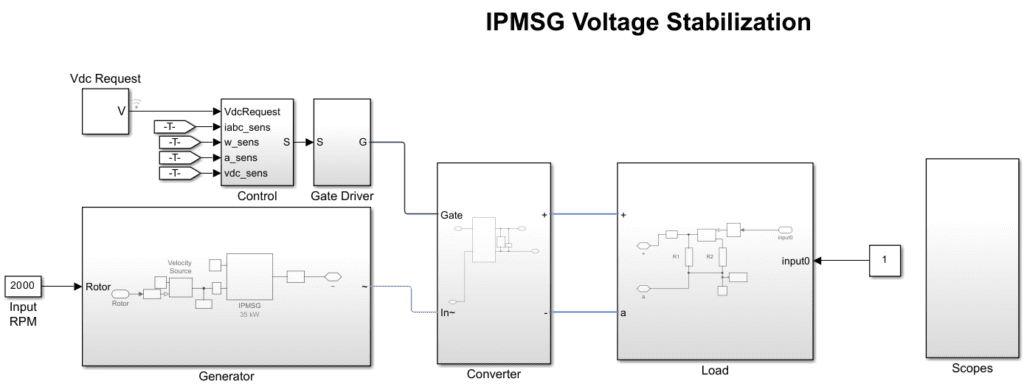
IPMSG Voltage Stabilization

Systemübersicht

What is an Interior Permanent Magnet Synchronous Generator (IPMSG)?

Die IPMSG is a type of synchronous machine with embedded permanent magnets in the rotor, offering:
High power density and efficiency.
Enhanced field control capabilities.
Improved dynamic response and load adaptability.
Reduced reliance on external field excitation.

Zweck der Simulation

The simulation is designed to:
Implement an advanced control strategy for an IPMSG in a low-voltage generator system.
Optimize voltage and current regulation under different loading conditions.
Analyze energy flow and power management within an HEV powertrain.
Evaluate system stability, transient response, and operational efficiency.

Hauptmerkmale

Closed-Loop Voltage Control for Stable Power Generation

PI-based voltage control for precise output voltage regulation.
Compensation for load variations and transient conditions.
Ensures stable DC-link voltage for HEV electrical subsystems.
➡️ Vorteil Enables seamless integration with HEV energy management systems.

Current Control for Optimal Performance and Efficiency

Active current regulation to optimize torque and energy conversion efficiency.
Decoupled d-q axis control for enhanced dynamic response.
Minimizes losses and ensures smooth operation under varying loads.
➡️ Vorteil Extends generator lifespan and improves power delivery consistency.

Load Adaptability and Energy Management

Dynamic response analysis under varying electrical and mechanical loads.
Energy flow optimization to maximize efficiency and reduce losses.
Supports regenerative braking and battery charging in HEVs.
➡️ Vorteil Improves overall fuel economy and reduces emissions.

Fault Detection and Protection Mechanisms

Overvoltage, overcurrent, and thermal protection for reliable operation.
Fast fault detection and response to prevent component damage.
Ensures stable power delivery under abnormal conditions.
➡️ Vorteil Increases system durability and safety.

Performance Optimization

Ensures optimal performance of IPMSGs under real-world conditions.

Hohe Energieeffizienz: Helps design energy-efficient systems with reduced fuel consumption and emissions.

Reliability and Durability: Validates the durability and reliability of IPMSGs, reducing the risk of failures.

Regulatory Compliance: Ensures compliance with emissions, efficiency, and safety standards.

Simulationsziele

This simulation aims to:
Analyze the performance of an IPMSG in a low-voltage HEV generator system.
Validate the effectiveness of the implemented voltage and current control strategies.
Evaluate system robustness under different loading conditions.
Optimize efficiency and performance for real-world HEV applications.

Technische Beschreibung

Systemkonfiguration

  • Eingang: Mechanical power from an Internal Combustion Engine (ICE) or traction system.
  • Generator: Interior Permanent Magnet Synchronous Generator (IPMSG).
  • Control Strategy: PI-based voltage and current regulation.
  • Ausgang: Stable low-voltage DC power for HEV electrical loads and battery charging.

Regelungsmethodik

  • Voltage Control: Regulates output voltage via PI-based closed-loop control.
  • Current Control: Ensures efficient power delivery and optimizes generator performance.
  • Load Adaptation: Dynamically adjusts power output based on HEV electrical demands.
  • Fault Protection: Implements real-time overcurrent and overvoltage protection mechanisms.

Advantages of IPMSG-Based Low-Voltage Generator Systems

High efficiency and power density for compact HEV applications.
Smooth voltage regulation under transient and steady-state conditions.
Reduced energy losses and improved regenerative braking performance.
Enhanced control flexibility for varying driving conditions.

Anwendungen

Hybrid Electric Vehicles (HEVs)

Power Generation: IPMSGs are used in HEVs to generate electrical power from the internal combustion engine (ICE), providing energy for the electric motor and battery charging.

Regenerative Braking: IPMSGs recover kinetic energy during braking, converting it into electrical energy to recharge the battery, improving overall energy efficiency.

Auxiliary Power Supply: IPMSGs provide power for auxiliary systems, such as HVAC, lighting, and infotainment, ensuring reliable operation.

Commercial Hybrid Vehicles

Hybrid Buses: IPMSGs are used in hybrid buses to generate electrical power, improving fuel efficiency and reducing emissions in urban environments.

Delivery Trucks and Vans: IPMSGs provide efficient power generation in hybrid delivery trucks and vans, optimizing energy management for stop-and-go driving conditions.

Off-Road and Utility Vehicles

Hybrid Construction Equipment: IPMSGs are used in hybrid construction equipment, such as excavators and loaders, to generate electrical power, improving fuel efficiency and reducing emissions.

Agricultural Machinery: IPMSGs provide efficient power generation in hybrid agricultural machinery, optimizing energy management for varying load conditions.

Marine- und Offshore-Anwendungen

Hybrid Ships: IPMSGs are used in hybrid ships to generate electrical power, improving fuel efficiency and reducing emissions in marine environments.

Offshore-Plattformen:: IPMSGs provide efficient power generation in hybrid offshore platforms, ensuring reliable operation in harsh conditions.

Luft- und Raumfahrt sowie Verteidigung

Hybrid Aircraft: IPMSGs are used in hybrid aircraft to generate electrical power, improving fuel efficiency and reducing emissions in aviation.

Military Vehicles:: IPMSGs provide efficient power generation in hybrid military vehicles, ensuring reliable operation in challenging terrains.

Energy Management and Optimization

Battery Integration: IPMSGs are integrated with battery systems in HEVs to optimize energy management and range.

Power Distribution:: IPMSGs ensure efficient power distribution between the ICE, electric motor, and battery, improving overall system efficiency.

Research and Development

Prototype Testing: Simulations are used to test and validate IPMSG control systems in low-voltage generator systems, reducing the need for physical testing and accelerating development.

Control Strategy Development: Simulations help develop and optimize control algorithms for IPMSGs, ensuring efficient and reliable operation.

Fault Analysis: Simulations help study the behavior of IPMSGs under fault conditions, improving system reliability and safety.

Vorteile der Simulation

By utilizing this simulation, engineers can:
Optimize IPMSG control strategies for HEV applications.
Validate generator performance under real-world conditions.
Enhance system efficiency and reliability before physical implementation.

Zusammenfassung

This project delivers a comprehensive framework for controlling an IPMSG in a low-voltage generator system, focusing on efficient power conversion, voltage regulation, and fault protection. By integrating advanced control strategies and real-time simulations, this system provides valuable insights into HEV powertrain design and optimization.

Zukünftige Erweiterungen

Implementation of sensorless control techniques for reduced hardware dependency.
Integration of AI-based adaptive control for dynamic load adjustments.
Advanced fault detection and predictive maintenance using machine learning.


Die IPMSG-Based Low-Voltage Generator System Simulation is essential for HEV power management and efficiency enhancement. By leveraging real-time control strategies and energy optimization techniques, this project contributes to the development of more sustainable and fuel-efficient hybrid vehicles.