dc fast charger for electric vehicle card
dc fast charger for ev header

DC-Schnelllader für EV-Batterien

Was ist ein DC-Schnelllader für EV-Anwendungen?

Ein DC-Schnelllader für EV-Anwendungen ist eine Hochleistungs-Ladestation, die den Wechselstrom (AC) des Netzes direkt in der Station in geregelten Gleichstrom (DC) umwandelt und diesen Gleichstrom dann direkt an die Fahrzeugbatterie sendet. Der Grund dafür ist einfach, aber wichtig: Eine Batterie kann nur Gleichstrom speichern , daher muss die Umwandlung von Wechselstrom in Gleichstrom irgendwo stattfinden. Beim gewöhnlichen AC-Laden zu Hause oder im Büro erfolgt diese Umwandlung im Auto selbst – mithilfe eines kleinen Onboard-Laders, der durch Platz, Gewicht und Kühlung begrenzt ist. Ein DC-Schnelllader verlagert die Umwandlung aus dem Auto heraus in einen viel größeren Schrank am Boden, in dem Platz für leistungsstarke Leistungselektronik, Kupfer und Kühlung vorhanden ist. Das Ergebnis ist ein dramatischer Sprung bei der Ladegeschwindigkeit – von 3 bis 22 Kilowatt zu Hause bis hin zu 50, 150, 350 Kilowatt und sogar bis in den Megawattbereich für Nutzfahrzeuge.

Dieser Sprung macht das Fahren über lange Strecken mit dem Elektroauto praktikabel. Ein moderner DC-Schnelllader für Elektrofahrzeuge kann ein typisches Personen-EV in etwa fünfzehn bis dreißig Minuten von 20 Prozent auf 80 Prozent Ladezustand bringen – je nach Fahrzeug und Station. Doch hinter diesem einfachen Versprechen steckt ein wirklich anspruchsvolles Stück Technik: dreiphasige aktive Gleichrichter, isolierte DC-DC-Wandler, Hochfrequenztransformatoren, kaskadierte Regelschleifen und strenge Normen zur Netzkonformität. In den folgenden Abschnitten erläutert dieser Leitfaden, wie ein DC-Schnelllader tatsächlich funktioniert, welche Normen für ihn gelten, wie Ingenieure ihn auslegen und abstimmen und wie Impedymes CHP-Prüfstand und Power-Hardware-in-the-Loop-Plattform zur sicheren Validierung eingesetzt werden – bei voller Leistung, jedoch ohne dass eine echte Lithium-Ionen-Batterie im Labor steht.

Warum DC-Schnellladen in einer eigenen Liga spielt

Wenn man beginnt, sich mit dem Laden von Elektrofahrzeugenzu befassen, ist eine der ersten Verwirrungsquellen die Terminologie. Man hört viele verschiedene Begriffe, die so verwendet werden, als hätten sie alle eine unterschiedliche Bedeutung:

  • Level 1, Level 2, Level 3
  • AC-Laden vs. DC-Laden
  • Langsames Laden, schnelles Laden, ultraschnelles Laden
  • DCFC, Schnellladen, Supercharging

Es handelt sich nicht wirklich um unterschiedliche Konzepte. Es sind verschiedene Blickwinkel auf dieselbe grundlegende Frage: Wie viel Leistung kann an die Batterie geliefert werden, und wo findet die Umwandlung von AC zu DC statt? Diese Unterscheidung zu verstehen ist der einfachste Weg, um zu erkennen, warum ein DC-Schnelllader für EV-Anwendungen in einer völlig anderen Liga spielt als das Ladegerät, das die meisten Menschen zu Hause haben.

Die Kernidee: Wo findet die Umwandlung von AC zu DC statt?

Jede EV-Lademethode beruht auf zwei einfachen Fakten:

  • EV-Batterien speichern Energie als Gleichstrom (DC).
  • Das Stromnetz liefert Wechselstrom (AC).

Irgendwo zwischen der Steckdose und der Batterie muss dieser Wechselstrom in Gleichstrom umgewandelt werden. Die einzige wirkliche Frage ist, wo diese Umwandlung stattfindet – und diese Antwort bestimmt alles andere: die Ladegeschwindigkeit, die Kosten, die Größe der Ausrüstung und sogar, welche technischen Normen gelten.

Level-1-Laden – Das Tröpfeln

Level 1 ist die langsamste Option, ausgelegt für gewöhnliche Haushaltssteckdosen:

  • Spannung: 120 V (Nordamerika) oder 230 V (Europa)
  • Leistung: 1,4 – 1,9 kW in den USA, bis zu ~2,3 kW in Europa
  • Wo die AC-zu-DC-Umwandlung erfolgt: Im Auto, mithilfe des kleinen Onboard-Laders
  • Am besten geeignet für: Plug-in-Hybride oder Fahrer, die über Nacht 50–60 km Reichweite hinzufügen
  • Einschränkung: Das Laden eines vollständig entladenen Langstrecken-EVs kann 30+ Stunden dauern – im Grunde nur ein Tröpfeln

Deshalb nutzt fast niemand Level 1 als primäre Lademethode.

Level-2-Laden – Der Alltagsstandard

Level 2 ist das, was die meisten EV-Besitzer tatsächlich zu Hause oder bei der Arbeit nutzen:

  • Spannung: 240 V (einphasig) oder 400 V (dreiphasig in Europa)
  • Leistung: 3,7 – 22 kW
  • Wo die AC-zu-DC-Umwandlung erfolgt: Weiterhin im Auto, mithilfe des Onboard-Laders
  • Typische Ladezeit: 4 – 12 Stunden für eine Vollladung eines modernen EVs
  • Am besten geeignet für: Laden über Nacht zu Hause, Laden am Arbeitsplatz, Hotels, Parkplätze

Die wesentliche Einschränkung von Level 2 ist die Größe des Onboard-Laders im Fahrzeug. Automobilhersteller können nicht unbegrenzt Umwandlungshardware in ein Auto einbauen, da jedes Kilogramm und jeder Kubikzentimeter gegen Folgendes abgewogen werden muss:

  • Fahrzeuggewicht und Crashsicherheit
  • Kühlanforderungen
  • Herstellungskosten
  • Verfügbarer Platz im Chassis

Dies ist die grundlegende Obergrenze der AC-Ladegeschwindigkeit – und genau dieser Engpass soll durch DC-Schnellladen überwunden werden.

Level 3 / DC-Schnellladen – Eine völlig andere Architektur

Ein DC-Schnelllader löst den Engpass, indem er die AC-zu-DC-Umwandlung aus dem Auto heraus in die Station verlagert.

Folgendes ändert sich dadurch:

  • Die Station ist nicht mehr durch das begrenzt, was in ein Auto passt.
  • Sie kann so groß wie ein großer Kühlschrank oder größer sein.
  • Sie kann mit industrietauglicher Leistungselektronik und Flüssigkeitskühlung vollgepackt sein.
  • Sie kann direkt an einen dreiphasigen oder Mittelspannungs-Netzanschluss angeschlossen werden.
  • Die Energie, die das Fahrzeug erreicht, ist bereits Gleichstrom (DC), sodass sie mit sehr hoher Leistung direkt an die Batterie gehen kann.

Dies sind alles Namen für dieselbe Sache:

  • Level-3-Laden
  • DCFC
  • DC-Schnellladen
  • Schnellladen
  • Ultraschnellladen
  • Supercharging 

Typische Leistungswerte heutiger DC-Schnelllader für Personenwagen:

  • Leistung: 50 – 350 kW (10× bis 100× mehr als Level 2 zu Hause)
  • Ladezeit (20 → 80 % SOC): etwa 15 – 30 Minuten
  • Hinzugefügte Reichweite: ungefähr 100 – 300+ km in einer einzigen 20-minütigen Sitzung, je nach Fahrzeug

Das ist der Unterschied zwischen einer nächtlichen Verpflichtung und einer Kaffeepause.

Die nächste Stufe: Megawattladen für Nutzfahrzeuge

Über den Pkw-Bereich hinaus entsteht eine noch höhere Stufe für Lkw und Busse:

  • Standard: Megawatt Charging System (MCS)
  • Spitzenleistung: bis zu 3,75 MW (mehr als 10× so viel wie die schnellsten Pkw-Lader)
  • Spannung und Strom: bis zu 1.250 V DC und 3.000 A
  • Status: Erste MCS-Korridore sind in Europa bereits in Betrieb
  • Warum es wichtig ist: Ein Fernverkehrs-Lkw kann es sich nicht leisten, stundenlang an einem Lader zu stehen – MCS ist die Technologie, die den elektrischen Lkw-Verkehr praktikabel macht

Die wichtigste Erkenntnis

Der Unterschied zwischen AC-Laden und DC-Schnellladen ist nicht nur eine Frage von „mehr Kilowatt“ – es ist eine Frage der Architektur.

Ein kurzer Vergleich:

  • AC-Laden ist durch das begrenzt, was in ein Auto passt.
    • Das Auto muss die AC-zu-DC-Umwandlung selbst durchführen.
    • Diese Hardware muss klein, leicht und günstig sein.
    • Das Ergebnis ist eine harte Geschwindigkeitsgrenze von rund 22 kW.
  • DC-Schnellladen ist durch den Netzanschluss und den Schrank begrenzt.
    • Beide können beliebig groß gemacht werden.
    • Deshalb kann ein DC-Schnelllader für Elektrofahrzeuge Hunderte von Kilowatt liefern.
    • Das ist auch der Grund, warum DC-Schnellladen eine ganze Reihe neuer technischer Herausforderungen mit sich bringt.

Zu diesen neuen technischen Herausforderungen gehören:

  • Strenge Normen für Oberschwingungen und Leistungsfaktor (damit der Lader das Netz nicht verschmutzt)
  • Galvanische Trennung zwischen Netz und Fahrzeug (für die Sicherheit der Nutzer)
  • Hochfrequenz-Leistungselektronik (um die Ausrüstung kompakt zu halten)
  • Digitale Kommunikationsstandards wie ISO 15118 (damit Lader und Fahrzeug die Sitzung aushandeln können)

Wie ein DC-Schnelllader funktioniert: Vom Netz zur Batterie

Um zu verstehen, wie ein DC-Schnelllader funktioniert, hilft es, der Energie auf ihrem Weg zu folgen – von der Versorgungsleitung bis hin zu Ihrer EV-Batterie. Das gesamte System ist im Grunde eine Kette aus vier Stufen, und jede löst ein Problem, das die vorherige Stufe geschaffen hat.

Die Reise beginnt am dreiphasigen Netzeingang, üblicherweise 400 bis 600 Volt AC. Der Strom gelangt über einen Leistungsschalter und einen kleinen Filter herein, der verhindert, dass elektrisches „Rauschen“ zurück ins öffentliche Netz gelangt. Stellen Sie sich diese Stufe als einen höflichen Handschlag zwischen dem Lader und dem Versorgungsnetz vor, der sicherstellt, dass die Energie sauber einfließt.

Als Nächstes kommt der aktive Gleichrichter, in dem AC in DC umgewandelt wird. Statt einer einfachen Diodenbrücke (die unsauberen, verzerrten Strom ins Netz einspeisen würde), setzt ein moderner DC-Schnelllader für Elektrofahrzeuge auf einen intelligenten Gleichrichter aus schnellen elektronischen Schaltern. Er formt den eingehenden Netzstrom aktiv, sodass er sauber und sinusförmig ist und mit der Spannung im Gleichtakt verläuft. Das Ergebnis ist ein nahezu perfekter Leistungsfaktor – die technische Umschreibung dafür, dass sich der Lader wie ein wohlerzogener Gast im Stromnetz verhält.

Der Ausgang des Gleichrichters speist den DC-Zwischenkreis, eine große Kondensatorbank, die typischerweise auf 800 bis 1000 Volt gehalten wird. Der DC-Zwischenkreis wirkt wie ein Stoßdämpfer. Immer wenn die vom Netz kommende Leistung nicht genau der von der Batterie angeforderten Leistung entspricht, gleicht dieser Kondensator die Differenz aus. Richtig dimensioniert, hält er die Spannung stabil; schlecht dimensioniert, wird der gesamte Lader entweder instabil oder unnötig teuer.

Vom DC-Zwischenkreis gelangt die Energie in den isolierten DC-DC-Wandler, die zweite große Umwandlungsstufe. Sie existiert aus zwei Gründen. Erstens die Sicherheit: Da Nutzer das Kabel und den Stecker physisch berühren, darf es keinen direkten elektrischen Pfad zwischen Netz und Fahrzeug geben. Ein Hochfrequenztransformator (der mit 20 bis 100 kHz arbeitet) sorgt für diese Isolierung und bleibt dabei kompakt. Zweitens die Flexibilität: Diese Stufe passt die Ausgangsspannung an die jeweils angeschlossene Batterie an – irgendwo zwischen 150 und 1000 Volt. So kann derselbe Lader sowohl ein älteres 400-Volt-EV als auch eine moderne 800-Volt-Plattform bedienen, ohne dass eine Neuverkabelung nötig ist.

Schließlich durchläuft der geregelte Gleichstrom einen Ausgangsfilter, die Sicherheitsüberwachung und Schütze, bevor er den Stecker erreicht – CCS, NACS oder MCS –, der in das Auto eingesteckt wird. Nach dem Anschließen handeln der Lader und das Batteriemanagementsystem (BMS) das Ladeprofil über ein digitales Protokoll wie ISO 15118 aus. Der Strom und die Spannung, die Sie auf dem Bildschirm sehen, sind das Ergebnis dieser gesamten Kette, die in Echtzeit zusammenarbeitet.

Kurz gesagt: Ein DC-Schnelllader für Elektrofahrzeuge ist mehr als nur ein „großer Stecker“. Es ist ein hochentwickeltes Leistungselektroniksystem, das rohe Netzenergie in präzise geregelte Gleichstromleistung umwandelt – sicher, effizient und auf eine Weise, die sowohl das Fahrzeug als auch das Stromnetz respektiert.

EV Charging Standards

DC-Schnellladestandards und Steckverbinder: CCS, NACS, CHAdeMO und MCS

Ein DC-Schnelllader ist nur dann nützlich, wenn er dieselbe physische und digitale Sprache spricht wie das angeschlossene Fahrzeug, und diese Sprache wird durch eine Handvoll regionaler und globaler Standards definiert. Sie zu verstehen ist wichtig, weil die Wahl des Steckverbinders drei Dinge gleichzeitig beeinflusst:

  • Welche Fahrzeuge die Station bedienen kann
  • Welche Märkte mit der Ausrüstung beliefert werden können
  • Welches Kommunikationsprotokoll der Lader intern implementieren muss

Heute sind vier Hauptstandards im Einsatz: CCS, NACS, CHAdeMO und das neuere Megawatt Charging System (MCS). Jeder wird im Folgenden erläutert.

Combined Charging System (CCS)

CCS ist der am weitesten verbreitete DC-Schnellladestandard außerhalb des Tesla-Netzwerks. Er kommt in zwei regionalen Varianten vor:

  • CCS1 – wird in ganz Nordamerika verwendet; kombiniert den Typ-1-AC-Stecker (J1772) mit zwei zusätzlichen DC-Pins darunter.
  • CCS2 – wird in Europa und Ozeanien verwendet; basiert auf dem Typ-2-AC-Stecker mit denselben zwei zusätzlichen DC-Pins.

Wichtige technische Punkte:

  • Unterstützt DC-Schnellladen bis zu etwa 350 kW in aktuellen kommerziellen Einsätzen.
  • Nutzt HomePlug Green PHY Powerline-Kommunikation , um den digitalen Handshake zu übertragen.
  • Communication is defined by ISO 15118 (and the older DIN 70121).
  • For any dc fast charger for ev programs targeting Europe or North America, CCS is the baseline that must be supported.

North American Charging Standard (NACS / SAE J3400)

NACS began as Tesla’s proprietary connector and has now been adopted by virtually every major automaker selling in North America from model year 2025 onward.

What makes NACS notable:

  • Mechanically much smaller than CCS — easier to handle and lighter on the cable.
  • Carries both AC and DC in a single unified plug (CCS uses two stacked sections).
  • Uses the same ISO 15118 communication layer as CCS, which makes dual-standard chargers relatively straightforward to build.
  • The May 2025 extension (SAE J3400/2) raised the supported voltage toward 1000 V, aligning NACS with modern 800-volt vehicle architectures.

CHAdeMO and ChaoJi

CHAdeMO is the Japanese standard, historically used on vehicles like the Nissan Leaf and still widely deployed in Japan and as a legacy installation across Europe.

How it differs from CCS:

  • Carries communication over a high-speed CAN bus rather than power-line communication.
  • A CCS-to-CHAdeMO adapter must therefore actively translate one protocol into the other — passive cables do not work.
  • The newer CHAdeMO 3.0 specification, harmonized with China’s GB/T standard under the name ChaoJi:
    • Raises the power ceiling above 500 kW.
    • Addresses the protocol differences that have complicated the older standard.
    • Aims to become a unified Asian-global standard for high-power DC charging.

Megawatt Charging System (MCS)

At the top of the power scale sits MCS, defined under SAE J3271 (issued March 2025) and the complementary IEC 63379 (released early 2026). MCS is built for heavy-duty commercial vehicles where even a 350 kW CCS station would take hours per fueling.

MCS at a glance:

  • Power delivery up to 3.75 MW (3,000 A at 1,250 V DC)
  • Industrial-scale heavy-duty connector designed for repeated high-current cycling
  • High-speed Ethernet communication instead of power-line communication
  • Target users: long-haul trucks, buses, and other heavy-duty commercial fleets
  • First European MCS corridors are operating now, with charger manufacturers shipping units in the 1,000–1,500 kW range
  • Because of the power level, MCS stations typically require medium-voltage grid connections rather than the low-voltage feeds used by passenger DCFC

What This Means for a Charger Designer

Two practical takeaways follow from the standards landscape:

  • The power electronics are largely connector-agnostic. The same active rectifier and isolated DC-DC converter inside the cabinet can serve CCS, NACS, or CHAdeMO — only the cable assembly and the protocol stack change.
  • ISO 15118-20 support is now effectively mandatory for future-proof stations, because:
    • The European AFIR regulation requires Plug & Charge readiness on new public DC chargers.
    • The United States NEVI program requires ISO 15118 support for federally funded stations.
    • ISO 15118-20 is also the protocol layer that unlocks bidirectional vehicle-to-grid (V2G) operation, the next frontier for the DC-Schnelllader für Elektrofahrzeuge industry.
Standards and Connectors

System Architecture: How Energy Flows from Grid to Battery

The 560 kW dc fast charger reference model is structured as a tightly coupled, multi-stage power conversion chain. Each stage features its own dedicated closed-loop controller, coordinating to ensure grid compliance, high efficiency, and safe battery charging.

STAGE 01: AC Grid Input

  • Electrical Parameters: 415 V RMS, 50 Hz, 3-phase.
  • Role: Utility power is delivered to the charger as a three-phase line voltage. This stage acts as the low-impedance source for the entire power system, establishing the voltage baseline for the downstream front-end converter

STAGE 02: Active Front End (AFE) Rectifier

  • Electrical Parameters: AC   DC, 10 kHz PWM carrier, 800 V DC-link.
  • Role: A three-phase active rectifier utilizing a cascaded PI controller architecture. The outer loop regulates the intermediate DC-link bus to a constant 800 V, while the inner loop operates in the synchronous  reference frame to keep grid-side current sinusoidal and in-phase with the grid voltage, achieving active Power Factor Correction (PFC).

STAGE 03: Isolated DC-DC Converter

  • Electrical Parameters: 800 V intermediate input, L = 10 μH output filter choke.
  • Role: A high-frequency transformer provides galvanic isolation between the high-voltage grid and the vehicle chassis. Power transfer and constant output current are managed via a fast proportional-integral (PI) loop regulating the inductor current setpoint, matching the specific voltage profile demanded by the battery pack.

STAGE 04: Battery Pack

  • Electrical Parameters: 100S (100 cells in series), single string (1P), 50 Ah cell capacity, initial State of Charge (SOC₀) = 20%.
  • Role: Models a standard high-voltage battery pack (800 V class) under charging loads. Starting at 20% SOC represents the canonical “low battery” condition used in industrial fast-charging benchmarks, testing the controller’s ability to transition smoothly from Constant Current (CC) to Constant Voltage (CV) modes.

Key Performance Indicators (KPIs)

These design targets serve as the tuning objectives for the controller loops. They map directly to the standards a commercial dc fast charger installation must meet for grid integration, billing accuracy, and customer satisfaction.

Key Performance IndicatorTarget ValueEngineering Significance
DC-Link Voltage800 V ± 5% regulation bandEnsures voltage stability for the downstream isolated DC-DC stage, preventing overvoltage trips during grid transients.
Rated Output Power560 kWCalculated as 800 V DC bus output × 700 A current draw, matching modern high-power EV platforms.
Power Factor>0.95 (Unity Power Factor)Minimizes reactive power draw from the grid, reducing utility penalties and system thermal loading.
Total Harmonic Distortion (THD)<5% line current THDMeets strict IEEE 519 grid compliance standards, preventing high-frequency noise injection into the local distribution grid.
Charge Time (20% to 80% SOC)≈20 minutesAchieved using a regulated Constant Current Constant Voltage (CCCV) profile, balancing speed with cell degradation limits.

Inside the Model: Parameter Blocks and Control Design

Rather than organizing the MATLAB setup as a single long file, the model’s parameters are divided into six logical blocks within the script rectifier_params.m. This modular structure allows engineers to easily tune, scale, and compile the model for real-time HIL platforms.

01: Grid Voltage Conversion (RMS Phase   Peak)

This block converts the standard line-to-line RMS grid voltage into peak per-phase values required by the sinusoidal pulse-width modulator (PWM).

				
					% RMS line-to-line voltage of a standard EU 3-phase grid
rectifier.ACVoltagePP   = 415;
% Convert L-L RMS → L-N RMS
rectifier.ACVoltagePN   = rectifier.ACVoltagePP/sqrt(3);
% Convert RMS → peak (used by the PWM modulator)
rectifier.ACVoltagePeak = rectifier.ACVoltagePN * sqrt(2);
				
			
Engineering Explanation:

Standard electrical grids are defined by their RMS line-to-line voltage (VPPV_{PP} ), but the inner control loops and PWM generation require the per-phase peak amplitude (VpeakV_{peak} ). This is derived using the relation:

$$V_{\text{peak}} = \frac{V_{\text{PP}}}{\sqrt{3}} \times \sqrt{2}$$

02: Output Power Definition

This block defines the primary design point for the charger’s power conversion stages.

				
					% DC-side operating point – the entire model scales from here
rectifier.DCCurrent = 700;  % A
rectifier.DCVoltage = 800;  % V

% Implied design power:
% P = V × I = 800 V × 700 A = 560 kW
				
			
Engineering Explanation:

These values define the operating limits of the power converters. An 800 V DC bus matches modern 800 V battery architectures , while a 700 A charging current represents the upper limit for liquid-cooled CCS2 charging connectors. The nominal rated power is calculated as:

$$P_{\text{rated}} = V_{\text{DC}} \times I_{\text{DC}} = 800\ \text{V} \times 700\ \text{A} = 560\ \text{kW}$$

All downstream calculations, including line currents, line filter chokes, and DC capacitor sizing, scale dynamically based on this design point.

03: AC Current Calculation

This block uses instantaneous active power balance to calculate the required line current from the grid.

				
					% Peak line current required to deliver the DC-side power,
% derived from instantaneous power balance.
rectifier.acCurrent =...
    sqrt(2) * rectifier.DCCurrent * rectifier.DCVoltage /...
    (sqrt(3) * rectifier.ACVoltagePP);
				
			
Engineering Explanation:

Assuming a near-unity power factor and neglecting converter losses, the active power balance between the grid AC input and the DC output is defined as:

$$P_{\text{AC}} = P_{\text{DC}}$$
$$I_{\text{AC,peak}} = \frac{\sqrt{2} \times 800\ \text{V} \times 700\ \text{A}}{\sqrt{3} \times 415\ \text{V}} \approx 1102.77\ \text{A}$$
This calculated peak current determines the physical dimensions of the grid-side line filter chokes, copper busbars, and the thermal sizing (I²t limits) of the switching semiconductors.
 

04: Line Inductance & Resistance (Grid-Side Filter)

This block defines the passive impedance of the line filter connected between the grid and the active rectifier.

				
					% Grid-side line impedance (per phase)
rectifier.lineInductance = 0.1e-3;  % H  (100 µH)
rectifier.lineResistance = 20e-3;   % Ω  (20 mΩ)

% Effective electrical time constant
rectifier.lineT = rectifier.lineInductance /...
                  rectifier.lineResistance;
				
			
Engineering Explanation:

The grid-side line inductance (Lₗᵢₙₑ) acts as the physical energy storage element that the active front end controls against. This inductance:

  • Filters out high-frequency switching harmonics generated by the 10 kHz PWM carrier.

  • Establishes the plant pole for the inner current PI controller.

  • Defines the maximum rate of current change (di/dt), which dictates the current loop’s transient response.

The ratio of inductance to resistance defines the natural electrical time constant of the grid filter (t= L/R = 5). To maintain system stability, the inner current control loop’s bandwidth must be designed to be at least five times faster than this time constant.

05: DC-Link Capacitor (Voltage Buffer)

This block sizes the energy storage capacity of the intermediate DC-link bus.

				
					% DC-link energy storage
rectifier.OutputCapacitance = 20e-3;  % F  (20 mF)

% Stores ~6.4 kJ at 800 V:
% E = ½ · C · V² = 0.5 × 0.02 × 800² = 6,400 J
				
			
Engineering Explanation:

The DC-link capacitor (Cₒᵤₜ) serves as an energy buffer, decoupling the AC grid from the battery-charging DC stage. The electrostatic energy stored in the capacitor bank is:

$$E_{DC} = \frac{1}{2} C_{out} V_{DC}^2$$
Bei 20 mF und 800V, the stored energy is:
$$E_{DC} = 0.5 \times 0.02 \text{ F} \times (800 \text{ V})^2 = 6400 \text{ J}$$

This energy buffer absorbs grid voltage perturbations and protects the downstream battery pack from high-frequency ripple.

  • Under-sizing the capacitor results in large voltage ripple on the DC bus, causing control loop oscillations and accelerated battery aging.

  • Over-sizing the capacitor reduces the voltage loop’s response time and increases the physical footprint, cost, and inrush current of the charger cabinet.

06: Auto-Tuned Control Gains

This block dynamically calculates the proportional and integral gains for the cascaded controllers based on the physical parameters of the system.

				
					% Inner current loop – proportional gain
rectifier.controller.CurrentG = rectifier.lineInductance /...
    (2 * rectifier.G * rectifier.CurrentSensorG * rectifier.Tphi);

% Outer voltage loop – proportional gain
rectifier.controller.VoltageG =...
    (rectifier.OutputCapacitance * rectifier.CurrentSensorG) /...
    (rectifier.K * 2 * rectifier.VoltageSensorG * rectifier.Tdel);
				
			
Engineering Explanation:

Rather than using static or manually tuned PI gains, the script calculates control parameters dynamically using the Symmetrical Optimum tuning criterion.

  • Inner Current Loop: Controls line current; its bandwidth is limited by the sensor phase delay Tᵩ. The proportional gain scale is calculated directly from the line inductance (Lₗᵢₙₑ).
  • Outer Voltage Loop: Controls the intermediate 800 V DC bus; its bandwidth is limited by the total loop delay Tᵈᵉˡ. Its gain scales with the output capacitance (Cₒᵤₜ).

This dynamic auto-tuning capability is crucial when deploying the Simulink model onto real-time HIL platforms. If physical components are changed on the testbench, the control loops automatically retune to preserve system stability and transient response.


Complete Parameter Reference and Simulation Settings

The following reference tables detail the remaining sub-systems, sensor characteristics, and simulation settings used within the model.

Isolated DC-DC Stage Parameters

This stage provides galvanic isolation and regulates output power.

VariableValueRole
inverter.SwitchFrequency10 kHzCarrier frequency for the high-frequency switching bridge.
inverter.controller.kp2Proportional gain for the output current loop.
inverter.controller.ki1Integral gain for the output current loop.
inverter.inductance10 µHHigh-frequency output filter choke.
transformer.magnetizingL1 HMagnetizing inductance of the high-frequency isolation transformer.
transformer.windingFactor0.5Transformer turns ratio (N₂/N₁), stepping down the 800 V DC-link.

Battery Pack Parameters

Models the electrochemical load representing an 800 V class EV battery pack.

VariableValueRole
battery.currentReference100 AConstant Current (CC) charging setpoint sent from the virtual BMS.
battery.initialSOC0.20Standard 20% initial State of Charge for charging validation.
battery.AHRating50 AhCell capacity rating defining the charging speed (C-rate}.
battery.inductance5 mHEquivalent series inductance of the battery pack cabling.
battery.cellsInSeries100Series count, establishing a nominal pack voltage of 370 V to 420 V.
battery.batteryStringsInParallel1Single-parallel string configuration.

Simulation Time Settings

Determines the temporal parameters of the simulation.

VariableValueRole
simulation.numberOfCycles10The number of utility grid cycles simulated.
simulation.simTime0.2 sTotal run duration (10 cycles / 50 Hz grid frequency).

Front-End Converter Variants

To balance simulation speed with model fidelity, the front-end active rectifier is implemented using three interchangeable Simulink variants. This allows engineers to swap the power circuit topology without changing the surrounding controllers or the grid-facing test harness.

VARIANT 0: Average Model (powerCircuit = 0)

  • Technical Modeling: Bypasses active switching components, modeling the three-phase rectifier as ideal, controlled AC voltage sources and a DC current source.
  • When to Use: Used during early-stage control design, controller linearization, and frequency-domain stability analyses (such as plotting Bode and Nyquist criteria). This variant runs extremely fast, making it ideal for checking control loop stability.

VARIANT 1: Two-Level Converter (powerCircuit = 1)

  • Technical Modeling: Models a standard six-switch three-phase converter bridge using high-frequency semiconductor models.
  • When to Use: Used to verify PWM gating signals, analyze switching harmonics, examine dead-time effects, and calculate line current Total Harmonic Distortion (THD).

VARIANT 2: Three-Level Inverter (powerCircuit = 1)

  • Technical Modeling: Models a Neutral-Point-Clamped (NPC) three-level converter topology.

  • When to Use: NPC topologies are standard in high-power systems (≥ 800 V) because they halve the voltage stress across each semiconductor switch. This variant is used to design high-voltage systems, verify NPC-specific clamping diode balance, and confirm compliance with strict grid harmonics limits.

The Impedyme CHP Testbench: Real-Time Simulation Meets Real Power

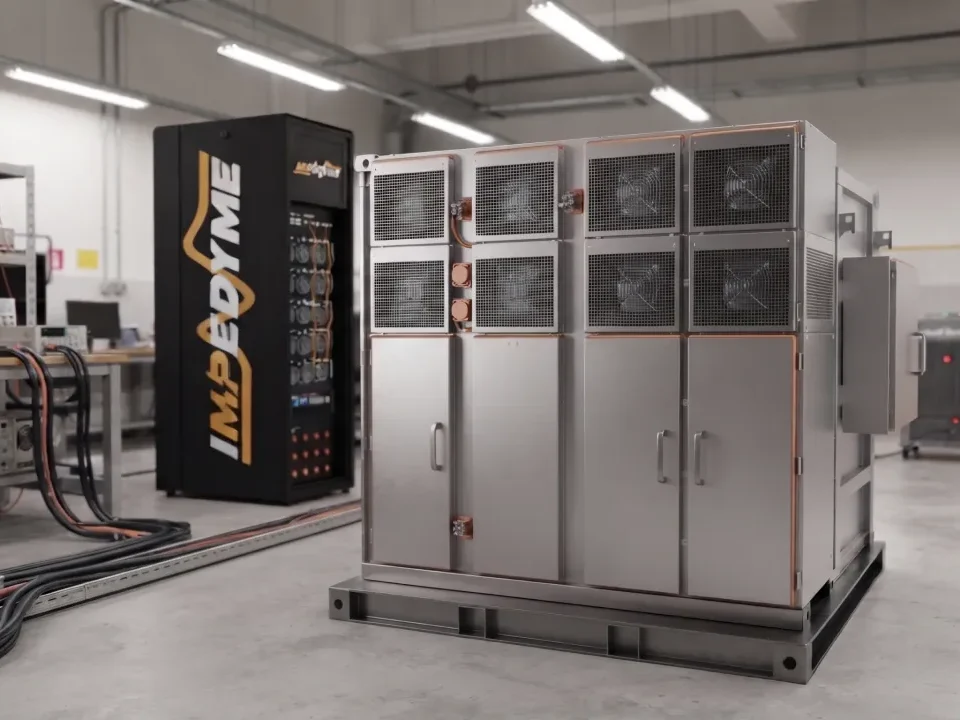
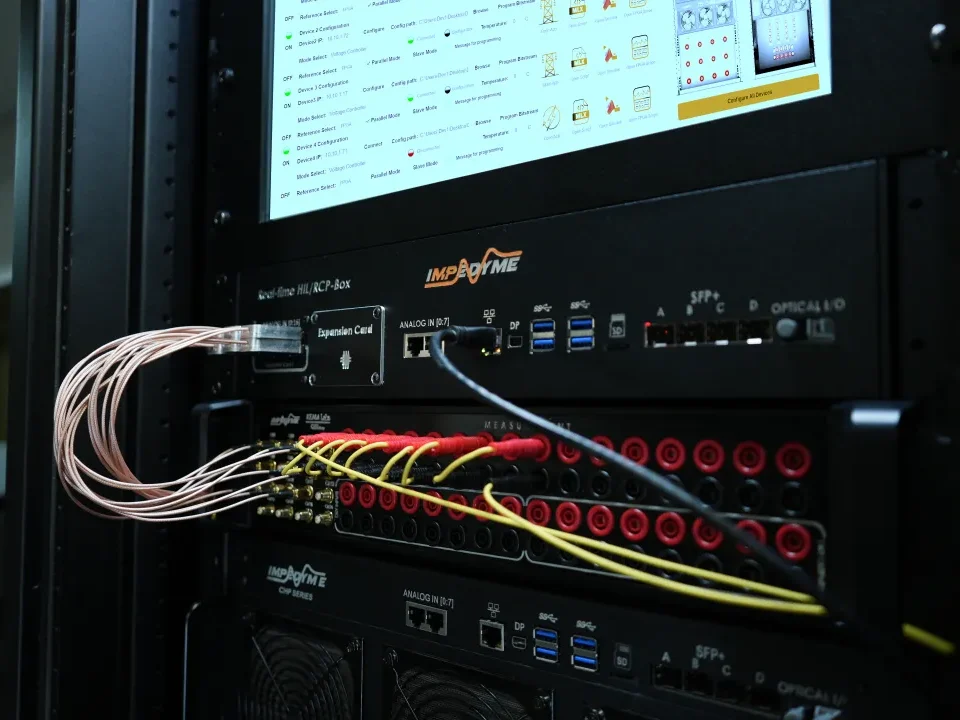
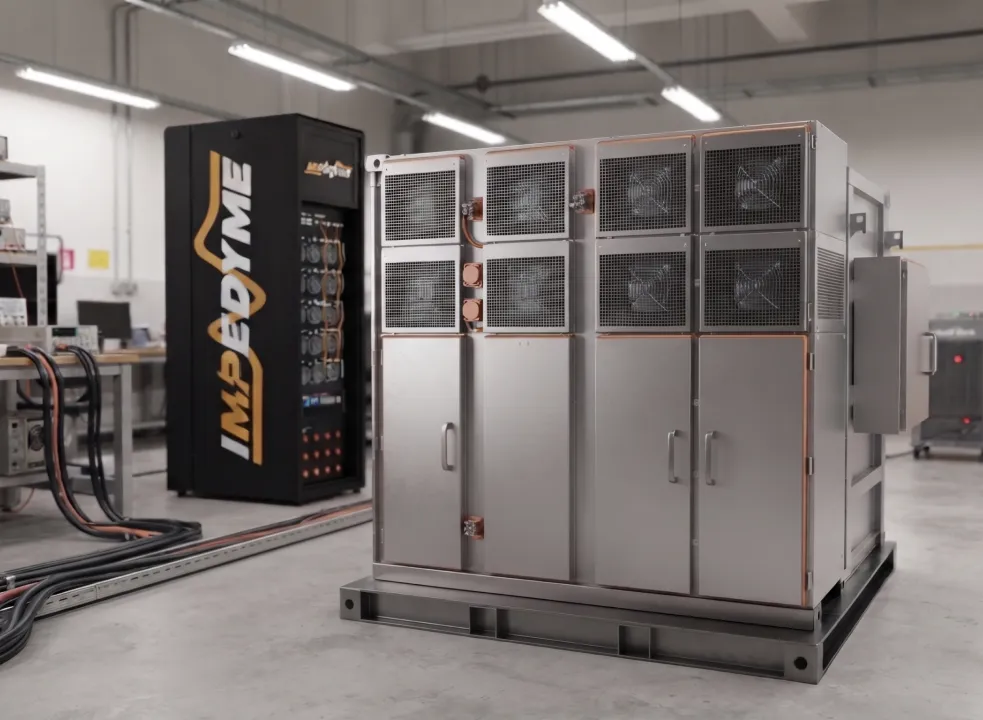
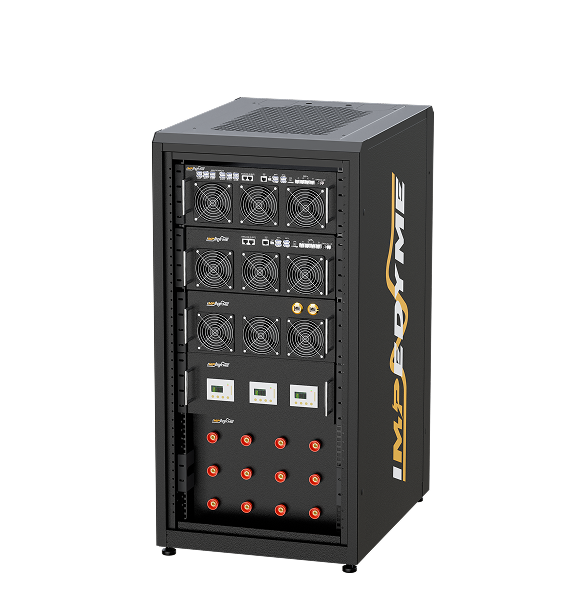
The Combined HIL and Power (CHP) testbench bridges Simulink models and the full-power behavior of a real dc fast charger in the field. Here’s why a simulation-first workflow has become standard for serious dc fast charger for ev programs.

What the CHP Testbench Combines

  • High-speed real-time simulator — FPGA-based, executes digital models of the grid, EV battery, and system under test in nanosecond time steps, fast enough to capture microsecond switching events.
  • Direct MATLAB/Simulink integration — a dedicated blockset lets engineers design in Simulink and deploy to the simulator with no code rewriting.
  • Bidirectional regenerative power hardware — reproduces exact grid voltage and frequency at full charger-rated power, measures the charger’s current draw, and closes the loop in real time.

The charger under test can’t tell the emulated grid from a real utility connection — even during voltage drops, frequency excursions, or phase imbalance no real utility would produce on demand.

Why Regenerative Power Matters

  • Energy flowing into the charger is recovered and recirculated, not dumped as heat or wasted.
  • A megawatt-class test consumes only system losses from the wall — not a full megawatt.
  • Enables long-duration stability sweeps and repeated fault-injection scenarios at low operating cost.

The Practical Workflow

  1. Early control-loop design in Simulink alone, using the average-fidelity rectifier for fast iteration.
  2. Controller-in-the-Loop — move the model to the real-time simulator, connect actual controller hardware, validate firmware.
  3. Power Hardware-in-the-Loop — connect the full power stage; the CHP testbench emulates the grid (and optionally the battery).

Every layer is validated against a realistic, full-power environment — no physical battery, no megawatt utility feed, and no risk of destroying prototype hardware.

The Charger Box and Battery Emulator: Completing the Validation Picture

A complete dc fast charger for electric vehicle validation campaign also addresses the vehicle side — the battery and the digital communication between charger and car.

Bidirectional Battery Emulator

  • Replaces the physical pack with a regenerative power source that reproduces real battery behavior in real time.
  • Eliminates the risk of thermal runaway, toxic gas, and fire from testing against a real lithium-ion pack.
  • No waiting for recharge between runs — what could take a week happens in a day.
  • Simulates dynamic voltage, current, internal resistance, state-of-charge progression, and behavior across temperatures and states of health.
  • Real-time Electrochemical Impedance Spectroscopy (EIS) — wideband measurements with micro-ohm accuracy above 1000 V while the charger operates, using multisine and Pseudo-Random Binary Sequence techniques. Lets engineers watch pack impedance evolve during the fast-charging session itself.

The Charger Box

Emulates the vehicle’s communication interface and handles protocol and compliance testing:

  • ISO 15118 communication over CCS and NACS connectors, including the Plug & Charge handshake required by European AFIR regulation and the US NEVI program.
  • CAN bus communication for CHAdeMO — useful for chargers supporting both standards.
  • Characterizes bidirectional power flow for vehicle-to-grid operation and validates source-to-sink transitions.
  • Simulates the BMS signals the charger expects from a real vehicle.

The charger under test sees a realistic, full-power, fully communicative environment — but no real utility connection, no real battery, and no real vehicle is required. For teams bringing a dc fast charger for ev product to market under tight schedule and cost constraints, this is what separates a successful program from one stuck in the lab.


The Future of DC Fast Charging Runs Through Simulation

The story of the DC fast charger has come a long way from the early days of electric mobility, when a fifty-kilowatt unit at a highway service area felt like science fiction. Today, a modern dc fast charger for ev use is a sophisticated power-electronics system that draws hundreds of kilowatts from the grid, transforms it through multiple conversion stages, and delivers it to the vehicle in a way that is both fast and respectful of the battery, the user, and the utility connection behind the wall. Tomorrow’s chargers, built around megawatt-class architectures, silicon-carbide semiconductors, and bidirectional vehicle-to-grid capability, will push that complexity even further. What ties the whole picture together is the realization that the hardest part of fast charging is no longer moving energy, it is proving that the system can do so reliably under every condition the real world will throw at it. Grid disturbances, battery faults, communication errors, compliance audits, and edge cases that only appear once in a thousand sessions all have to be addressed before a charger can be deployed at scale. This is the reason simulation-based validation has become not just a convenience but a competitive necessity: the teams that learn to design their dc fast charger systems in Simulink, validate them on a real-time Power Hardware-in-the-Loop platform like Impedyme’s CHP testbench, and round out the picture with a bidirectional battery emulator and a Charger Box for protocol testing are the teams that ship faster, with fewer surprises in the field and a clearer path to ISO 15118 compliance, megawatt charging, and the bidirectional grid services coming next.

If you are developing a dc fast charger for electric vehicle application — whether building a new charging product, integrating an existing one into a fleet depot, or qualifying a station for public deployment — Impedyme’s simulation-first ecosystem is built to take you from concept to production-ready hardware in the shortest practical path. The CHP testbench provides the real-time grid and the regenerative power interface, the battery emulator replaces the physical pack with a safer and more flexible substitute, and the Charger Box completes the loop with full protocol and compliance testing. Together they form the engineering foundation that the next generation of fast-charging infrastructure will be built on. To see how that foundation can fit into your own development workflow, or to discuss a specific project, the team at Impedyme is ready to help.