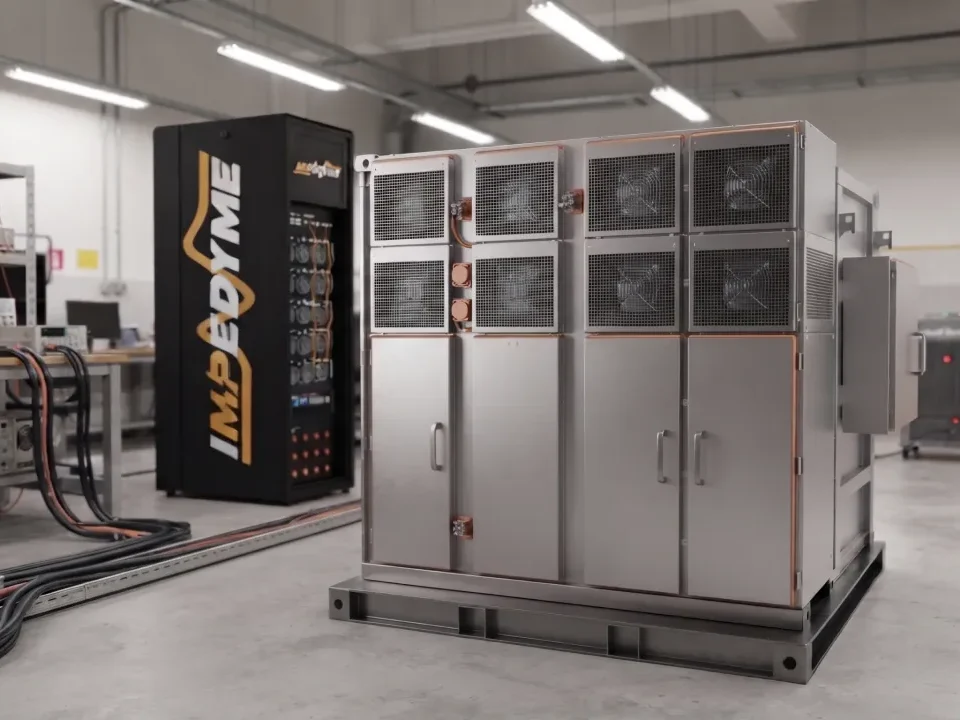

A DC fast charger for EV applications is a high-power charging station that converts grid alternating current into regulated direct current right inside the station, then sends that DC straight to the vehicle’s battery. The reason this matters is simple but important: a battery can only store DC, so the conversion from AC to DC has to happen somewhere. In ordinary AC charging at home or at the office, that conversion happens inside the car itself, using a small onboard charger limited by space, weight, and cooling. A dc fast charger moves the conversion job out of the car and into a much larger cabinet on the ground, where there is room for serious power electronics, copper, and cooling. The result is a dramatic jump in charging speed — from 3 to 22 kilowatts at home up to 50, 150, 350 kilowatts, and even into the megawatt range for heavy-duty vehicles.
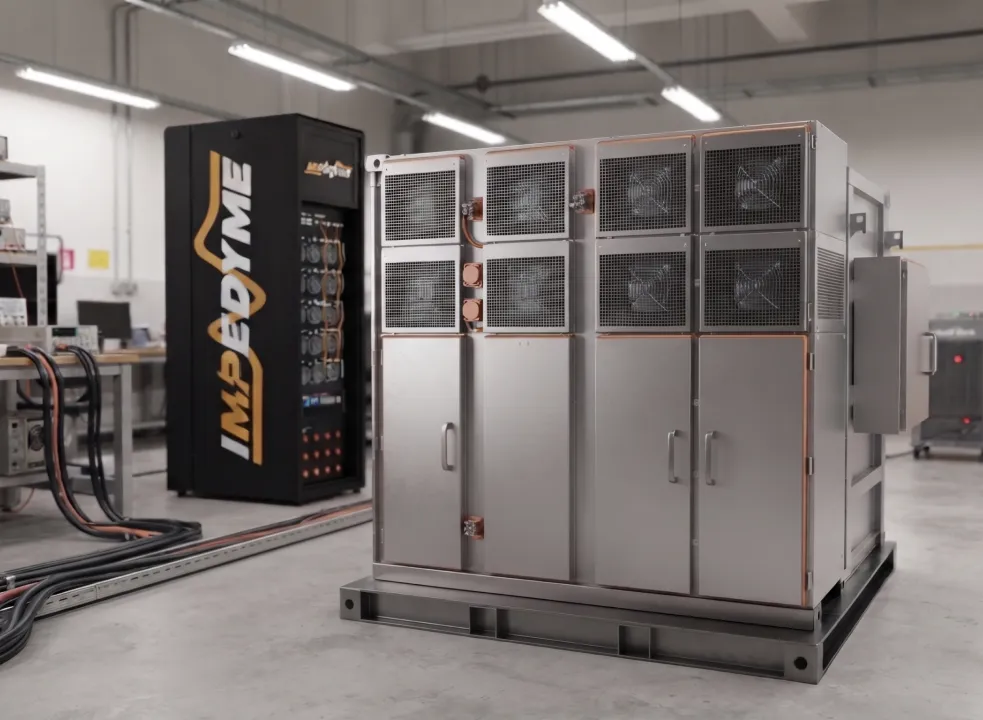
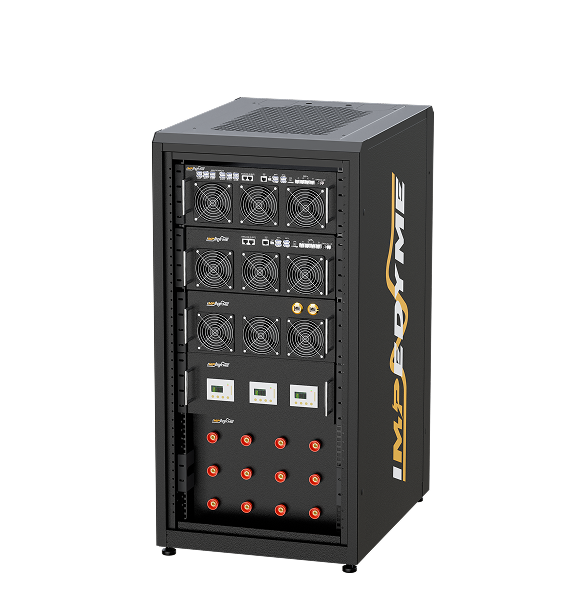
That jump is what makes long-distance electric driving practical. A modern dc fast charger for electric vehicle use can bring a typical passenger EV from 20 percent to 80 percent state of charge in roughly fifteen to thirty minutes, depending on the vehicle and the station. But behind that simple promise sits a genuinely sophisticated piece of engineering: three-phase active rectifiers, isolated DC-DC converters, high-frequency transformers, cascaded control loops, and strict grid-compliance standards. In the sections that follow, this guide walks through how a DC fast charger actually works, which standards govern it, how engineers design and tune it, and how Impedyme’s CHP testbench 与 Power Hardware-in-the-Loop platform are used to validate it safely — at full power, but without putting an actual lithium-ion battery on the lab floor.
When people start researching electric vehicle charging, one of the first sources of confusion is the terminology. You will hear many different words used as if they all mean different things:
They are not really different concepts. They are different lenses on the same underlying question: how much power can be delivered to the battery, and where does the AC-to-DC conversion take place? Understanding this distinction is the easiest way to see why a dc fast charger for ev use is in a completely different league from the charger most people have at home.
Every EV charging method works on two simple facts:
Somewhere between the wall socket and the battery, that AC has to be converted into DC. The only real question is where that conversion happens — and that answer determines everything else: the charging speed, the cost, the size of the equipment, and even which engineering standards apply.
Level 1 is the slowest option, designed for ordinary household outlets:
This is why almost no one uses Level 1 as their main charging method.
Level 2 is what most EV owners actually use at home or at work:
The key limitation of Level 2 is the size of the onboard charger inside the vehicle. Automakers cannot fit unlimited conversion hardware into a car because every kilogram and cubic centimeter has to be justified against:
This is the fundamental ceiling on AC charging speed — and it is the exact bottleneck that DC fast charging is designed to break.
A dc fast charger solves the bottleneck by moving the AC-to-DC conversion out of the car and into the station.
Here is what changes when you do that:
These are all names for the same thing:
Typical performance numbers for today’s passenger DC fast chargers:
This is the difference between an overnight commitment and a coffee break.
Beyond the passenger-car space, an even higher tier is emerging for trucks and buses:
The difference between AC charging and DC fast charging is not just a matter of “more kilowatts” — it is a matter of architecture.
A quick comparison:
Those new engineering challenges include:
To understand how a dc fast charger works, it helps to follow the energy on its journey — from the utility line all the way to your EV battery. The whole system is really a chain of four stages, and each one solves a problem that the previous stage created.
The journey starts at the three-phase grid input, usually 400 to 600 volts AC. Power enters through a circuit breaker and a small filter that keeps electrical “noise” from leaking back onto the public grid. Think of this stage as a polite handshake between the charger and the utility, making sure the energy flows in cleanly.
Next comes the active rectifier, where AC is converted into DC. Instead of a simple diode bridge (which would dump messy, distorted current onto the grid), a modern dc fast charger for ev use relies on a smart rectifier built from fast electronic switches. It actively shapes the incoming grid current so that it is clean, sinusoidal, and in step with the voltage. The result is a near-perfect power factor, which is the technical way of saying the charger behaves as a well-mannered guest on the electrical grid.
The rectifier’s output feeds the DC link, a large capacitor bank typically held at 800 to 1000 volts. The DC link acts like a shock absorber. Whenever the power coming from the grid does not exactly match the power demanded by the battery, this capacitor absorbs the difference. Sized correctly, it keeps the voltage stable; sized poorly, the whole charger becomes either unstable or unnecessarily expensive.
From the DC link, energy moves into the isolated DC-DC converter, the second major conversion stage. It exists for two reasons. First, safety: since users physically touch the cable and connector, there must be no direct electrical path between the grid and the vehicle. A high-frequency transformer (running at 20 to 100 kHz) provides that isolation while staying compact. Second, flexibility: this stage adjusts the output voltage to match whatever battery is plugged in — anywhere from 150 to 1000 volts. That is how the same charger can serve both an older 400-volt EV and a modern 800-volt platform without any rewiring.
Finally, the regulated DC current passes through an output filter, safety monitoring, and contactors before reaching the connector — CCS, NACS, or MCS — that plugs into the car. Once connected, the charger and the vehicle’s battery management system (BMS) negotiate the charging profile through a digital protocol like ISO 15118. The current and voltage you see on the screen are the result of this whole chain working together in real time.
In short, a dc fast charger for electric vehicle use is more than just a “big plug.” It is a sophisticated power-electronics system that transforms raw grid energy into precisely controlled DC power — safely, efficiently, and in a way that respects both the vehicle and the electrical grid.
A dc fast charger is only useful if it can speak the same physical and digital language as the vehicle plugged into it, and that language is defined by a handful of regional and global standards. Understanding them matters because the choice of connector affects three things at once:
There are four main standards in use today: CCS, NACS, CHAdeMO, and the newer Megawatt Charging System (MCS). Each one is explained below.
CCS is the most widely deployed DC fast charging standard outside of Tesla’s network. It comes in two regional variants:
Key technical points:
NACS began as Tesla’s proprietary connector and has now been adopted by virtually every major automaker selling in North America from model year 2025 onward.
What makes NACS notable:
CHAdeMO is the Japanese standard, historically used on vehicles like the Nissan Leaf and still widely deployed in Japan and as a legacy installation across Europe.
How it differs from CCS:
At the top of the power scale sits MCS, defined under SAE J3271 (issued March 2025) and the complementary IEC 63379 (released early 2026). MCS is built for heavy-duty commercial vehicles where even a 350 kW CCS station would take hours per fueling.
MCS at a glance:
Two practical takeaways follow from the standards landscape:
The 560 kW dc fast charger reference model is structured as a tightly coupled, multi-stage power conversion chain. Each stage features its own dedicated closed-loop controller, coordinating to ensure grid compliance, high efficiency, and safe battery charging.
These design targets serve as the tuning objectives for the controller loops. They map directly to the standards a commercial dc fast charger installation must meet for grid integration, billing accuracy, and customer satisfaction.
| Key Performance Indicator | Target Value | Engineering Significance |
|---|---|---|
| DC-Link Voltage | 800 V ± 5% regulation band | Ensures voltage stability for the downstream isolated DC-DC stage, preventing overvoltage trips during grid transients. |
| Rated Output Power | 560 kW | Calculated as 800 V DC bus output × 700 A current draw, matching modern high-power EV platforms. |
| Power Factor | >0.95 (Unity Power Factor) | Minimizes reactive power draw from the grid, reducing utility penalties and system thermal loading. |
| Total Harmonic Distortion (THD) | <5% line current THD | Meets strict IEEE 519 grid compliance standards, preventing high-frequency noise injection into the local distribution grid. |
| Charge Time (20% to 80% SOC) | ≈20 minutes | Achieved using a regulated Constant Current Constant Voltage (CCCV) profile, balancing speed with cell degradation limits. |
Rather than organizing the MATLAB setup as a single long file, the model’s parameters are divided into six logical blocks within the script rectifier_params.m. This modular structure allows engineers to easily tune, scale, and compile the model for real-time HIL platforms.
This block converts the standard line-to-line RMS grid voltage into peak per-phase values required by the sinusoidal pulse-width modulator (PWM).
% RMS line-to-line voltage of a standard EU 3-phase grid
rectifier.ACVoltagePP = 415;
% Convert L-L RMS → L-N RMS
rectifier.ACVoltagePN = rectifier.ACVoltagePP/sqrt(3);
% Convert RMS → peak (used by the PWM modulator)
rectifier.ACVoltagePeak = rectifier.ACVoltagePN * sqrt(2);
Standard electrical grids are defined by their RMS line-to-line voltage (VPPV_{PP} VPP), but the inner control loops and PWM generation require the per-phase peak amplitude (VpeakV_{peak} Vpeak). This is derived using the relation:
$$V_{\text{peak}} = \frac{V_{\text{PP}}}{\sqrt{3}} \times \sqrt{2}$$
This block defines the primary design point for the charger’s power conversion stages.
% DC-side operating point – the entire model scales from here
rectifier.DCCurrent = 700; % A
rectifier.DCVoltage = 800; % V
% Implied design power:
% P = V × I = 800 V × 700 A = 560 kW
These values define the operating limits of the power converters. An 800 V DC bus matches modern 800 V battery architectures , while a 700 A charging current represents the upper limit for liquid-cooled CCS2 charging connectors. The nominal rated power is calculated as:
All downstream calculations, including line currents, line filter chokes, and DC capacitor sizing, scale dynamically based on this design point.
This block uses instantaneous active power balance to calculate the required line current from the grid.
% Peak line current required to deliver the DC-side power,
% derived from instantaneous power balance.
rectifier.acCurrent =...
sqrt(2) * rectifier.DCCurrent * rectifier.DCVoltage /...
(sqrt(3) * rectifier.ACVoltagePP);
Assuming a near-unity power factor and neglecting converter losses, the active power balance between the grid AC input and the DC output is defined as:
This block defines the passive impedance of the line filter connected between the grid and the active rectifier.
% Grid-side line impedance (per phase)
rectifier.lineInductance = 0.1e-3; % H (100 µH)
rectifier.lineResistance = 20e-3; % Ω (20 mΩ)
% Effective electrical time constant
rectifier.lineT = rectifier.lineInductance /...
rectifier.lineResistance;
The grid-side line inductance (Lₗᵢₙₑ) acts as the physical energy storage element that the active front end controls against. This inductance:
Filters out high-frequency switching harmonics generated by the 10 kHz PWM carrier.
Establishes the plant pole for the inner current PI controller.
Defines the maximum rate of current change (di/dt), which dictates the current loop’s transient response.
The ratio of inductance to resistance defines the natural electrical time constant of the grid filter (t= L/R = 5). To maintain system stability, the inner current control loop’s bandwidth must be designed to be at least five times faster than this time constant.
This block sizes the energy storage capacity of the intermediate DC-link bus.
% DC-link energy storage
rectifier.OutputCapacitance = 20e-3; % F (20 mF)
% Stores ~6.4 kJ at 800 V:
% E = ½ · C · V² = 0.5 × 0.02 × 800² = 6,400 J
The DC-link capacitor (Cₒᵤₜ) serves as an energy buffer, decoupling the AC grid from the battery-charging DC stage. The electrostatic energy stored in the capacitor bank is:
This energy buffer absorbs grid voltage perturbations and protects the downstream battery pack from high-frequency ripple.
Under-sizing the capacitor results in large voltage ripple on the DC bus, causing control loop oscillations and accelerated battery aging.
Over-sizing the capacitor reduces the voltage loop’s response time and increases the physical footprint, cost, and inrush current of the charger cabinet.
This block dynamically calculates the proportional and integral gains for the cascaded controllers based on the physical parameters of the system.
% Inner current loop – proportional gain
rectifier.controller.CurrentG = rectifier.lineInductance /...
(2 * rectifier.G * rectifier.CurrentSensorG * rectifier.Tphi);
% Outer voltage loop – proportional gain
rectifier.controller.VoltageG =...
(rectifier.OutputCapacitance * rectifier.CurrentSensorG) /...
(rectifier.K * 2 * rectifier.VoltageSensorG * rectifier.Tdel);
Rather than using static or manually tuned PI gains, the script calculates control parameters dynamically using the Symmetrical Optimum tuning criterion.
This dynamic auto-tuning capability is crucial when deploying the Simulink model onto real-time HIL platforms. If physical components are changed on the testbench, the control loops automatically retune to preserve system stability and transient response.
The following reference tables detail the remaining sub-systems, sensor characteristics, and simulation settings used within the model.
This stage provides galvanic isolation and regulates output power.
| Variable | 数值 | Role |
|---|---|---|
| inverter.SwitchFrequency | 10 kHz | Carrier frequency for the high-frequency switching bridge. |
| inverter.controller.kp | 2 | Proportional gain for the output current loop. |
| inverter.controller.ki | 1 | Integral gain for the output current loop. |
| inverter.inductance | 10 µH | High-frequency output filter choke. |
| transformer.magnetizingL | 1 H | Magnetizing inductance of the high-frequency isolation transformer. |
| transformer.windingFactor | 0.5 | Transformer turns ratio (N₂/N₁), stepping down the 800 V DC-link. |
Models the electrochemical load representing an 800 V class EV battery pack.
| Variable | 数值 | Role |
|---|---|---|
| battery.currentReference | 100 A | Constant Current (CC) charging setpoint sent from the virtual BMS. |
| battery.initialSOC | 0.20 | Standard 20% initial State of Charge for charging validation. |
| battery.AHRating | 50 Ah | Cell capacity rating defining the charging speed (C-rate}. |
| battery.inductance | 5 mH | Equivalent series inductance of the battery pack cabling. |
| battery.cellsInSeries | 100 | Series count, establishing a nominal pack voltage of 370 V to 420 V. |
| battery.batteryStringsInParallel | 1 | Single-parallel string configuration. |
Determines the temporal parameters of the simulation.
| Variable | 数值 | Role |
|---|---|---|
| simulation.numberOfCycles | 10 | The number of utility grid cycles simulated. |
| simulation.simTime | 0.2 s | Total run duration (10 cycles / 50 Hz grid frequency). |
To balance simulation speed with model fidelity, the front-end active rectifier is implemented using three interchangeable Simulink variants. This allows engineers to swap the power circuit topology without changing the surrounding controllers or the grid-facing test harness.
Technical Modeling: Models a Neutral-Point-Clamped (NPC) three-level converter topology.
When to Use: NPC topologies are standard in high-power systems (≥ 800 V) because they halve the voltage stress across each semiconductor switch. This variant is used to design high-voltage systems, verify NPC-specific clamping diode balance, and confirm compliance with strict grid harmonics limits.
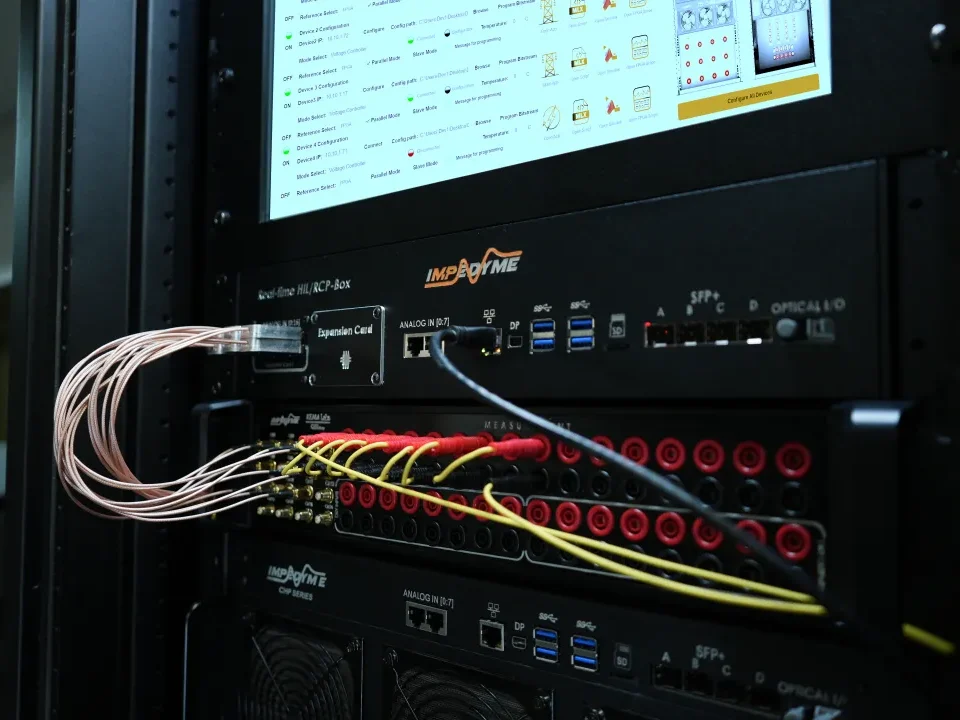
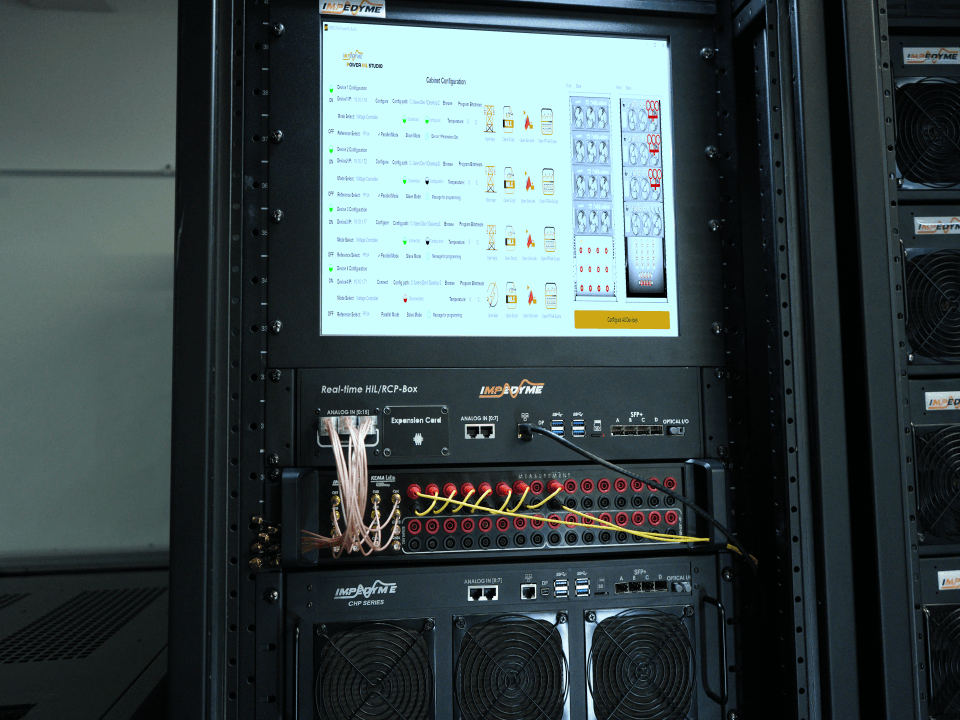
The Combined HIL and Power (CHP) testbench bridges Simulink models and the full-power behavior of a real dc fast charger in the field. Here’s why a simulation-first workflow has become standard for serious dc fast charger for ev programs.
The charger under test can’t tell the emulated grid from a real utility connection — even during voltage drops, frequency excursions, or phase imbalance no real utility would produce on demand.
Every layer is validated against a realistic, full-power environment — no physical battery, no megawatt utility feed, and no risk of destroying prototype hardware.
A complete dc fast charger for electric vehicle validation campaign also addresses the vehicle side — the battery and the digital communication between charger and car.
Emulates the vehicle’s communication interface and handles protocol and compliance testing:
The charger under test sees a realistic, full-power, fully communicative environment — but no real utility connection, no real battery, and no real vehicle is required. For teams bringing a dc fast charger for ev product to market under tight schedule and cost constraints, this is what separates a successful program from one stuck in the lab.
The story of the DC fast charger has come a long way from the early days of electric mobility, when a fifty-kilowatt unit at a highway service area felt like science fiction. Today, a modern dc fast charger for ev use is a sophisticated power-electronics system that draws hundreds of kilowatts from the grid, transforms it through multiple conversion stages, and delivers it to the vehicle in a way that is both fast and respectful of the battery, the user, and the utility connection behind the wall. Tomorrow’s chargers, built around megawatt-class architectures, silicon-carbide semiconductors, and bidirectional vehicle-to-grid capability, will push that complexity even further. What ties the whole picture together is the realization that the hardest part of fast charging is no longer moving energy, it is proving that the system can do so reliably under every condition the real world will throw at it. Grid disturbances, battery faults, communication errors, compliance audits, and edge cases that only appear once in a thousand sessions all have to be addressed before a charger can be deployed at scale. This is the reason simulation-based validation has become not just a convenience but a competitive necessity: the teams that learn to design their dc fast charger systems in Simulink, validate them on a real-time Power Hardware-in-the-Loop platform like Impedyme’s CHP testbench, and round out the picture with a bidirectional battery emulator and a Charger Box for protocol testing are the teams that ship faster, with fewer surprises in the field and a clearer path to ISO 15118 compliance, megawatt charging, and the bidirectional grid services coming next.
If you are developing a dc fast charger for electric vehicle application — whether building a new charging product, integrating an existing one into a fleet depot, or qualifying a station for public deployment — Impedyme’s simulation-first ecosystem is built to take you from concept to production-ready hardware in the shortest practical path. The CHP testbench provides the real-time grid and the regenerative power interface, the battery emulator replaces the physical pack with a safer and more flexible substitute, and the Charger Box completes the loop with full protocol and compliance testing. Together they form the engineering foundation that the next generation of fast-charging infrastructure will be built on. To see how that foundation can fit into your own development workflow, or to discuss a specific project, the team at Impedyme is ready to help.