
The HVDC power grid has moved from a niche solution for a handful of long submarine cables to one of the central technologies of the global energy transition. As utilities race to move bulk renewable energy across continents, connect offshore wind farms, and tie together electrical regions that were never designed to work in step with one another, 广泛应用于高压直流输电(HVDC)、 has become the backbone that makes those connections possible. This guide explains what an HVDC power grid actually is, how the underlying HVDC power system works, the role of HVDC power electronics, and — critically — how engineers verify that these enormously complex converter systems behave correctly before they are ever energized on a live network. That last step, validation through 电力硬件在环(PHIL) testing, is where Impedyme’s platform plays a decisive role.
An HVDC power grid uses direct current at very high voltages — typically anywhere from 100 kV to 800 kV, and increasingly above 1,000 kV for ultra-high-voltage links — to transmit large amounts of electrical power over long distances. This stands in contrast to the alternating current (AC) systems that dominate distribution and most regional transmission. In a conventional AC grid, voltage and current reverse polarity many times per second (50 or 60 times, depending on the region). In an HVDC power system, the transmitted power flows as a steady, unidirectional current at a controlled voltage.
The core idea is simple to state and surprisingly deep in its consequences: by converting AC to DC at one end of a transmission corridor, sending that DC power over a line or cable, and converting it back to AC at the far end, you can move more power, more efficiently, over greater distances, and with far more precise control than an equivalent AC line could ever achieve. The “grid” part of the term has two meanings today. In its established sense, it refers to the AC grids that an HVDC link interconnects. In its emerging sense — multi-terminal HVDC and meshed DC networks — it refers to genuine DC grids in their own right, where several converter stations exchange power across a shared DC backbone.
Understanding why direct current returns to the heart of modern transmission, after AC won the so-called “war of the currents” more than a century ago, requires looking at the physics.
When the first power networks were built, AC prevailed for one decisive reason: the transformer. Transformers can step AC voltage up for efficient transmission and back down for safe distribution, and they do so cheaply and reliably. Early DC systems had no equivalent, so they were locked to low voltages and short distances. For most of the twentieth century, that settled the matter.
The physics that originally favored DC for efficiency never went away, however. Transmission losses are dominated by resistive heating, which scales with the square of the current. Doubling the transmission voltage halves the current for the same power and cuts those resistive losses by a factor of four. High voltage is therefore essential to efficient long-distance transmission regardless of whether the current is AC or DC. What changed — and what made the HVDC power grid practical — was power electronics: the ability to convert between AC and DC at high voltage and high power, efficiently and reliably. Once that conversion became economical, several intrinsic advantages of DC came into play.
Lower line losses. A DC line carries only active power. An AC line, by contrast, also pushes reactive power back and forth and suffers from the skin effect, which forces current toward the outer surface of the conductor and effectively wastes the conductor’s cross-section. Over a long corridor, an HVDC link typically loses substantially less power per thousand kilometers than a comparable AC line at the same voltage. Those savings compound over the decades-long life of a transmission asset.
Fewer conductors, lighter towers. A three-phase AC line needs three conductors. A bipolar HVDC line moves comparable or greater power with two. That means narrower rights-of-way, lighter towers, and lower construction costs per kilometer — savings that eventually outweigh the cost of the converter stations at each end.
No cable-length limit from charging current. This is the decisive factor for submarine and long underground cables. A long AC cable behaves like a distributed capacitor; a large fraction of its current-carrying capacity is consumed simply charging and discharging that capacitance every cycle. Beyond a few tens of kilometers, an AC cable can spend nearly all of its capacity on charging current and deliver almost no useful power. A DC cable charges once, at energization, and then carries useful power for its entire length. This is why essentially every long submarine power link in the world is HVDC.
Controllability. Because the converters actively set the magnitude and direction of power flow, an HVDC link is a fully dispatchable element of the grid. Operators can command exactly how much power flows and which way, respond to disturbances in milliseconds, and prevent a fault in one network from cascading into another.
Connecting asynchronous systems. Two AC grids can only be hard-wired together if they run at the same frequency and stay in phase. Many neighboring grids do not. An HVDC link decouples the two sides entirely, so it can tie together grids running at 50 Hz and 60 Hz, or two 60 Hz grids that are simply out of step. In several large countries the major electrical regions are asynchronous, and DC links are the only way to trade power between them.
The trade-off is the converter station. HVDC conversion equipment is expensive and adds complexity, so HVDC only pays off beyond a “break-even distance” — roughly several tens of kilometers for submarine cables and several hundred kilometers for overhead lines. Below that, AC remains the better choice. Above it, the HVDC power grid wins on cost, efficiency, and capability.
The arrangement of poles and return paths determines the reliability, flexibility, and operating characteristics of an HVDC link.
功 monopolar configuration uses a single high-voltage conductor and a return path. The return current can flow through an earth or sea electrode, which reduces cost and losses but introduces environmental and corrosion concerns, or through a dedicated metallic return conductor. A common variation is the symmetric monopole, which employs two conductors operating at ±Vdc/2, with the neutral point grounded at the midpoint of the DC-link capacitors. This configuration is widely used in MMC-based systems connected via extruded cable technology.
功 bipolar configuration consists of two poles, one operating at +Vdc and the other at −Vdc, along with a neutral connection. Because the pole-to-pole voltage is twice the pole-to-ground voltage, a bipole can transmit approximately twice the power of an equivalent monopole using the same insulation level. Under normal operating conditions, only a small unbalance current flows through the earth or neutral path. If one pole is unavailable, the remaining pole can continue operating at roughly half capacity, with the return current flowing through either an earth return or a metallic-return conductor connected by a metallic-return transfer breaker. This inherent redundancy makes the bipolar arrangement the preferred choice for large-scale bulk power transmission projects.
功 back-to-back HVDC station places both the rectifier and inverter within the same facility, eliminating the need for a DC transmission line. Its primary purpose is to interconnect asynchronous AC networks, such as systems operating at different frequencies (50 Hz and 60 Hz) or grids that are not phase-synchronized.
The most advanced configuration is the multi-terminal HVDC grid, where three or more converter stations share a common DC network. Meshed VSC/MMC-based grids operating at voltage levels around ±500 kV and transferring several gigawatts of power are already in service. Future offshore transmission networks are expected to be built around standardized ±525 kV, 2 GW building blocks that can eventually be interconnected into large-scale DC supergrids. Multi-terminal operation highlights one of the MMC’s key advantages: its ability to reverse power flow without changing DC voltage polarity. In these networks, DC circuit breakers become an essential requirement rather than an optional component.
HVDC control is organized as a hierarchy. At the bottom, valve firing control generates the gate pulses — PWM or nearest-level modulation. Above it, an inner current-control loop regulates the converter dq currents. Above that, an outer loop holds DC voltage and commands real and reactive power. At the top, a master controller coordinates both stations and, in a bipole, both poles. A classic LCC link runs the rectifier on constant current and the inverter on constant extinction angle or constant DC voltage, with a voltage-dependent current-order limit that backs off the current command during AC faults.
In a multi-terminal HVDC power system, terminals must agree on who regulates the shared DC voltage. Master-slave control assigns one terminal to fix V_dc while the others hold constant power; voltage-droop control distributes the balancing duty across several terminals through a droop constant relating DC power to DC voltage, so the grid survives the loss of any single voltage-regulating station.
Protection is where DC grids are hardest. A DC network has very low impedance and no natural current zero crossing, so a fault current rises extremely fast — di/dt driving the current to several times rated within a few milliseconds — and there is no zero crossing to extinguish an arc the way there is in AC. Detection relies on rate-of-change measures: dv/dt, di/dt, and rate of change of voltage. A series DC reactor limits the initial di/dt and buys the protection system time.
The interrupting device itself has evolved through three generations. Mechanical DC breakers clear in tens of milliseconds — far too slow for a meshed grid. Solid-state breakers, built from hundreds of series IGBTs, are extremely fast but dissipate continuous conduction losses that make them uneconomic in series with a transmission line. The hybrid DC circuit breaker resolves the conflict: a fast mechanical disconnector carries normal load current at low loss, while a parallel power-electronic branch and a metal-oxide varistor take over to interrupt and absorb the fault energy. Hybrid breakers have demonstrated interruption of fault currents in the range of 9 to 25 kA at 320 to 535 kV in roughly 2 to 3 milliseconds, absorbing on the order of 10 MJ — the enabling technology that makes a true multi-terminal HVDC grid feasible.
The semiconductor is the atom of every HVDC power system. LCC valves use large-diameter, high-blocking-voltage thyristors — on the order of 8.5 kV per device, hundreds in series per valve — chosen for their very high power handling and low switching loss. VSC and MMC stations use IGBT, typically 3.3 kV class in pressed-pack housings that fail to a short circuit so a string keeps conducting, switched about once per cycle in an MMC or at PWM frequency in a two-level converter. In every case, devices are stacked in series to reach hundreds of kilovolts, and managing voltage sharing across that stack — through snubbers and precise gate timing — is one of the defining design challenges of HVDC power electronics.
The frontier is wide-bandgap silicon carbide. With a bandgap near 3.26 eV and a breakdown field roughly ten times that of silicon, SiC permits a thinner drift region for a given blocking voltage, higher operating temperature, faster switching, and lower conduction and switching losses. Research SiC devices have reached blocking voltages well above what silicon practically allows, which raises the prospect of eliminating much of the series stacking that silicon HVDC valves require, cutting MMC switching losses, and enabling high-voltage DC-DC converters and solid-state transformers for future DC collector grids. SiC is what will let the next generation of HVDC converters switch faster and run cooler than anything built on silicon alone.
The mechanical design, thermal limits, and electrical performance of an HVDC power grid are heavily dependent on the insulation materials and topology of the transmission cables. Modern HVDC underground and submarine installations rely on two primary cable technologies: Mass Impregnated (MI) paper-insulated cables and Crosslinked Polyethylene (XLPE) extruded polymer-insulated cables.
Mass Impregnated (MI) cables represent a mature technology that has been utilized in commercial HVDC systems since the mid-twentieth century. The insulation layer of an MI cable consists of high-quality paper tapes wrapped helically around a conductor and subsequently impregnated with a highly viscous, non-draining oil compound. This combination provides excellent dielectric strength, thermal stability, and resistance to partial discharges under continuous high-voltage DC stress. MI cables are capable of operating at voltages exceeding $\pm$500 kV and are widely used in long-distance submarine links, such as those interconnecting asynchronous national grids across deep sea channels.
Crosslinked Polyethylene (XLPE) cables represent a modern insulation technology that utilizes an extruded thermoset polymer layer. XLPE insulation is lighter, easier to handle, and has a higher continuous operating temperature limit (typically up to 90°C compared to 55°C to 70°C for MI cables), enabling higher current ratings and power transfer capacities.
However, under continuous DC electrical stress, XLPE cables are subject to space charge accumulation, where physical charges become trapped within the polymer dielectric. This space charge distorts the internal electric field distribution, potentially leading to local electric field enhancement that exceeds the dielectric breakdown strength of the material and triggers premature insulation failure. To mitigate this, advanced chemical additives and precise manufacturing controls are required to produce specialized “DC-grade” XLPE compounds.
The physical construction of a typical HVDC cable consists of several highly specialized layers :
A monopolar grid configuration utilizes a single high-voltage conductor (typically of negative polarity to minimize corona discharges) and a low-voltage return path. The return path can be a lightly insulated return cable or can utilize the Earth or seawater via dedicated electrode stations.
While using the Earth or sea as a conductor is highly economical, it introduces significant environmental and technical challenges. Continuous direct current flowing through the ground can cause electrolytic corrosion of nearby buried metallic infrastructure, such as natural gas pipelines, water mains, and grounding grids of nearby AC substations. It can also generate local magnetic disturbances that interfere with magnetic compasses and marine navigation. Consequently, regulatory restrictions often limit or prohibit continuous ground-return operation, forcing operators to install a dedicated metallic return conductor.
A bipolar grid configuration utilizes two fully insulated high-voltage conductors of opposite polarities (one positive, one negative) operating at equal voltage magnitudes relative to ground. Under balanced steady-state operating conditions, the currents flowing through the two poles are identical, and the net current returning through the ground is zero. This eliminates ground-current corrosion and environmental issues.
Additionally, a bipolar configuration provides high operational redundancy. If a fault occurs on one pole (such as a cable insulation failure or transformer breakdown), the healthy pole can continue to operate in monopolar mode using the ground or a neutral cable as a temporary return path, maintaining up to 50% of the total transmission capacity until the fault is resolved.
The performance of an HVDC power system is governed by the topology and control of its terminal converter stations. Commercially, converters are divided into two primary categories: Line-Commutated Converters (LCCs) and Voltage-Source Converters (VSCs).
Line-Commutated Converters, also referred to as Classic or Current-Source Converters (CSCs), have been in commercial operation since the mid-twentieth century and remain the standard for ultra-high-voltage direct current (UHVDC) transmission links operating at voltages up to ±1100 kV and power capacities exceeding 10 GW. LCCs utilize high-power silicon thyristor valves arranged in a three-phase 12-pulse bridge configuration to suppress lower-order harmonics.
Thyristors are semi-controlled semiconductor devices; they can be turned on by a gate trigger pulse but cannot be turned off via control commands. Instead, they rely on the natural zero-crossing of the AC grid current to turn off, a process known as line commutation.
This reliance on the AC grid voltage for commutation makes LCCs highly vulnerable to commutation failures during AC grid disturbances. A sudden voltage sag or phase jump in the AC grid can prevent the thyristors from recovering their forward-blocking state before the anode-to-cathode voltage reverses, leading to a short-circuit across the DC bus and a temporary interruption of power transmission.
Furthermore, LCCs cannot operate with weak or dead AC grids that lack a strong voltage reference and must always absorb substantial reactive power (typically 50% to 60% of the active power rating), requiring massive switchable capacitor banks and passive AC harmonic filters at the converter stations.
Voltage-Source Converters, which emerged commercially in the late 1990s, utilize fully controlled, high-speed semiconductor switches, such as Insulated-Gate Bipolar Transistors (IGBTs) or Silicon Carbide (SiC) MOSFETs, with anti-parallel diodes. Because these devices can be turned on and off independently of the AC grid state, VSCs can establish a local voltage vector with arbitrary amplitude and phase angle.
This self-commutation capability enables VSCs to control active and reactive power independently, provide black-start capabilities to dead networks, and interface with weak grids without requiring reactive power support.
The primary solid-state devices in modern VSC-HVDC systems are high-voltage IGBTs. Because these devices incorporate a short-circuit failure mode—where an IGBT failure results in a mechanical short-circuit rather than an open circuit—modern VSC converter stations are designed with sufficient submodule redundancy to guarantee operation over their entire service lives.
The standard for high-power VSC-HVDC is the Modular Multilevel Converter (MMC). Unlike early two-level or three-level VSCs that utilize high-frequency pulse-width modulation (PWM) to switch the entire DC bus voltage simultaneously, MMCs stack dozens or hundreds of independent power submodules (SMs) in series per converter arm.
Beyond grid-scale transmission applications, high-voltage direct current (HVDC) power supplies are essential in a wide range of industrial, scientific, and high-performance computing systems. An HVDC power supply is defined as an electrical device that converts standard AC utility power or low-voltage DC into a regulated, high-voltage DC output, generally ranging from several hundred volts to hundreds of kilovolts.
Modern programmable HVDC power supplies utilize high-frequency switching conversion topologies rather than bulky, line-frequency transformers.
Modern high-voltage supplies run their main power conversion inverter at switching frequencies between 30 kHz and 70 kHz, utilizing high-speed MOSFETs or IGBTs as the switching elements. Operating at these high frequencies reduces the required physical size and weight of magnetic components (such as transformers and inductors) and filtering capacitors.
The stepped-up high-frequency AC is then rectified and further multiplied utilizing a Cockcroft-Walton diode-capacitor voltage multiplier network. This allows the secondary transformer winding to operate at a fraction of the total output voltage, minimizing insulation stress and transformer parasitics. Conversion efficiencies exceeding 90% are typically achieved.
To support diverse applications, programmable HVDC power supplies are classified by their operational voltage and current ranges :
These supplies are critical components across commercial, defense, and academic sectors. In healthcare and scientific fields, they power mass spectrometers, capillary electrophoresis systems, X-ray fluorescence devices, and detector arrays, where high voltage stability, fast recovery, and low output ripple are essential.
In the semiconductor manufacturing industry, they provide the electrostatic chuck voltages and high-energy ion beams required for nanometer-scale wafer processing. Furthermore, research facilities rely on these high-voltage structures to power particle accelerators, free-electron lasers, neutron sources, and high-frequency cyclotrons.
The HVDC power grid earns its place wherever AC physics runs out. Long-distance bulk transmission moves the output of remote hydro, solar, and wind resources thousands of kilometers to load centers with a fraction of the loss of an equivalent AC corridor. Submarine cables and interconnectors tie islands, offshore platforms, and neighboring countries across distances where AC cables cannot function at all. Offshore wind integration uses VSC/MMC HVDC to collect generation far out at sea and bring it ashore, with the standardized 2 GW building block now becoming the template. Asynchronous interconnection lets grids of different frequencies or phases trade power through a back-to-back or point-to-point link. And the controllability of a VSC link adds grid services that AC lines cannot — synthetic inertia, power-oscillation damping, voltage support, and black-start capability for a collapsed network.
Here is the part of the HVDC story that the textbooks and product brochures skip, and the part that matters most to the engineers who actually build these systems. An HVDC converter is a multi-gigawatt, multi-hundred-million-dollar asset whose control and protection firmware must handle commutation failure, DC faults, weak-grid interaction, fault ride-through, and grid-forming stability — and it must handle all of them correctly the first time. You cannot debug a control bug by energizing a 12 GW link and watching what happens. Field commissioning is the wrong place to discover that a circulating-current controller goes unstable at low SCR, or that the protection mis-coordinates with a DC breaker.
The answer is hardware-in-the-loop testing. In Controller Hardware-in-the-Loop (C-HIL), the real converter controller — the actual production hardware and firmware — is connected at signal level to a real-time digital model of the converter and grid. The controller believes it is driving a real MMC. Every protection trip, every modulation strategy, every fault scenario is exercised against a model that responds exactly as the physical plant would, with zero risk and complete repeatability. In 电力硬件在环(PHIL), the loop is closed at power level: a four-quadrant power amplifier exchanges real power with a physical device under test while a real-time model emulates the rest of the system, capturing the genuine closed-loop dynamics that a signal-level test cannot.
The technical obstacle is speed. An electromagnetic-transient model of an MMC has to resolve switching events across hundreds of submodules per arm, updating a nodal admittance matrix every time a device changes state. To capture those transients faithfully, the model must run at a time step far smaller than the fastest dynamic of interest — on the order of nanoseconds to a few microseconds, not the tens of microseconds a CPU-based simulator can sustain. A general-purpose processor solves these equations sequentially and simply cannot keep pace with power-electronic switching at that resolution.
A field-programmable gate array can. An FPGA executes the submodule models and the matrix solution in massively parallel, deterministic, reconfigurable hardware, hitting the sub-microsecond time steps that a faithful MMC model requires. This is not a nice-to-have for HVDC validation — it is the enabling requirement. Without nanosecond-class FPGA execution, you cannot model an MMC converter in real time at all.
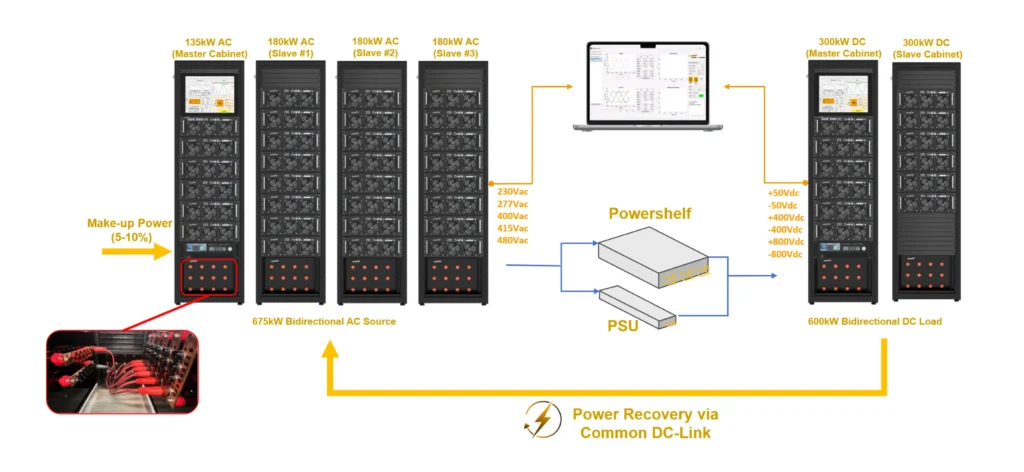
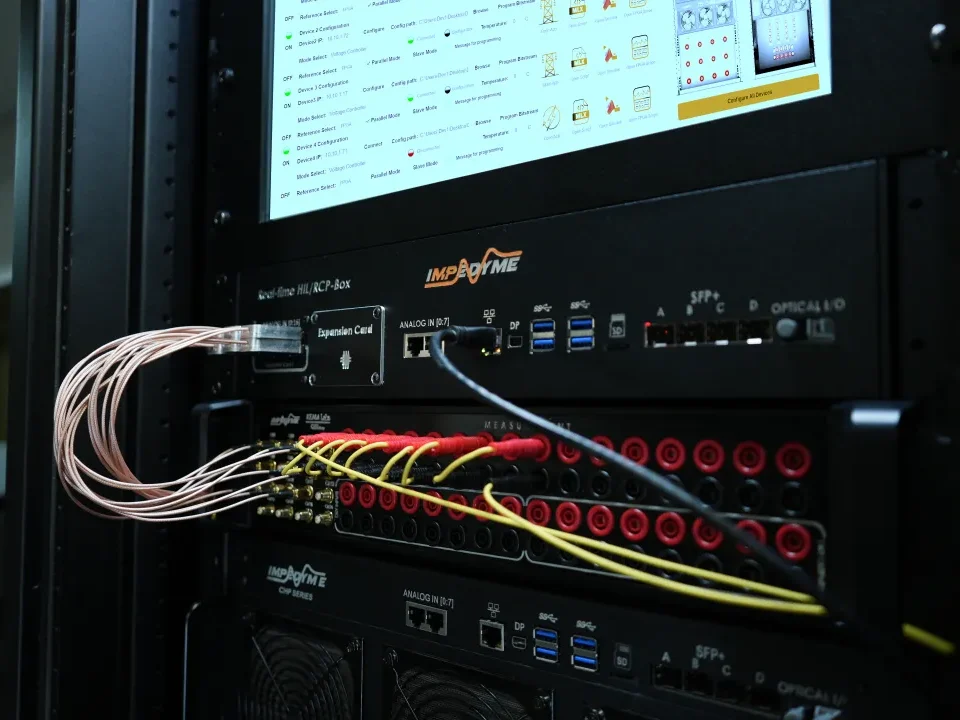
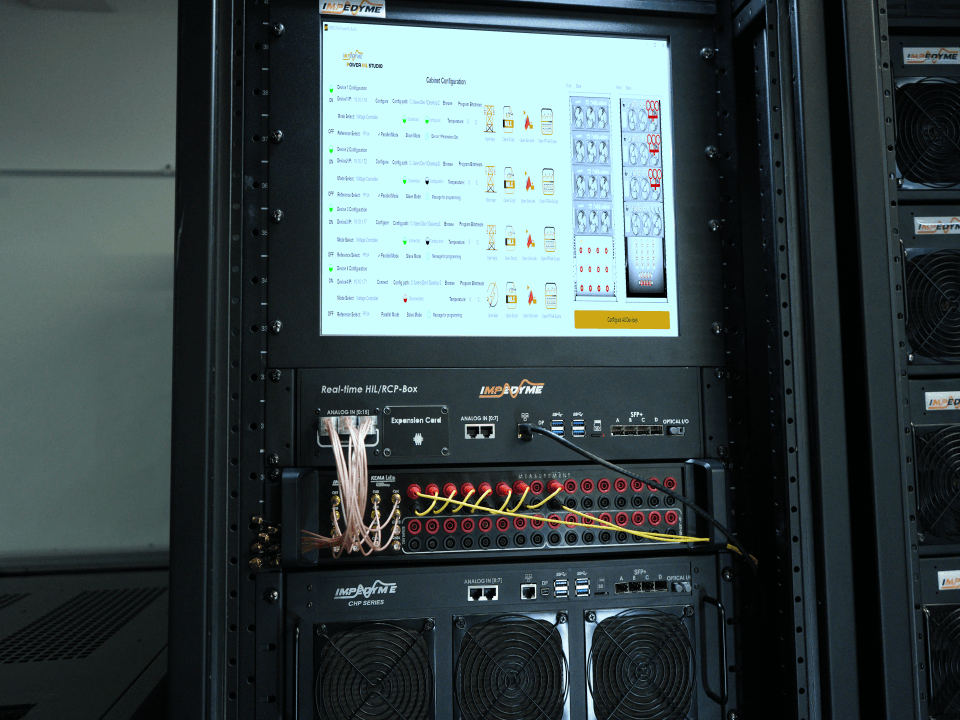
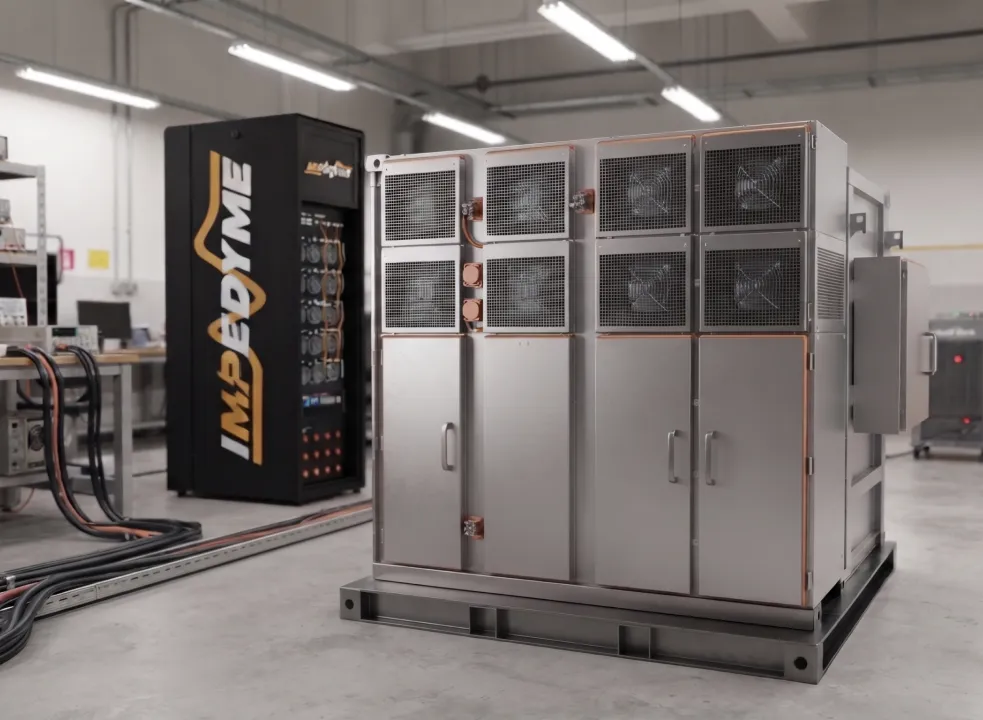
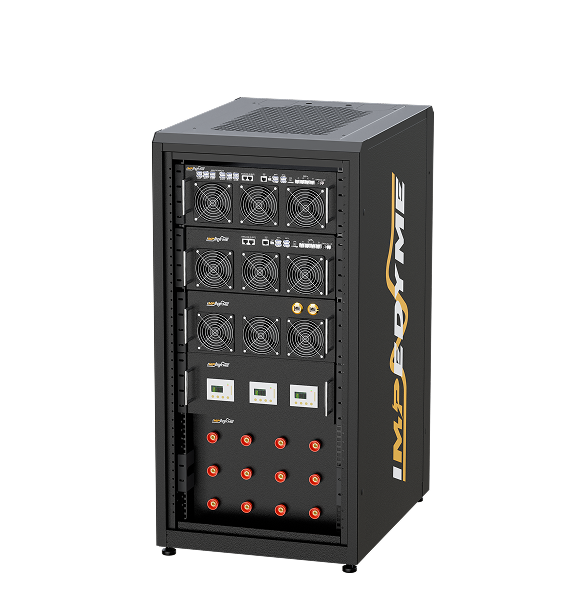
This is precisely the gap that Impedyme’s platform is built to close. The CHP Series combines C-HIL and PHIL in a single system, pairing the 型测试。 real-time engine with regenerative four-quadrant power amplifiers and reaching simulation time steps as low as 90 ns — fast enough to resolve MMC submodule switching dynamics while still spanning the slower electromechanical behavior of the surrounding grid. That real-time execution runs on AMD/Xilinx Zynq UltraScale+ MPSoC FPGA fabric, with the converter and grid models updated every 90 ns, roughly 11 million times per second.
For the grid side of HVDC validation, GridSim Studio models grid impedance in real time — weak grids, resonances, harmonics, and faults — with AC and DC modes and FPGA-speed time steps. That maps directly onto the hardest HVDC test cases: validating converter behavior at low short-circuit ratio, exercising grid-forming and grid-following control, injecting harmonics to probe sub-synchronous and impedance-interaction instabilities, and running fault-ride-through sequences for offshore-wind VSC-HVDC. PowerHIL Studio, orchestrates the test campaign itself — scenario and sequence editing, automated pass/fail criteria, safety and limit management, and integration with MATLAB and Simulink so that the same model-based design used to develop the controller drives the validation.
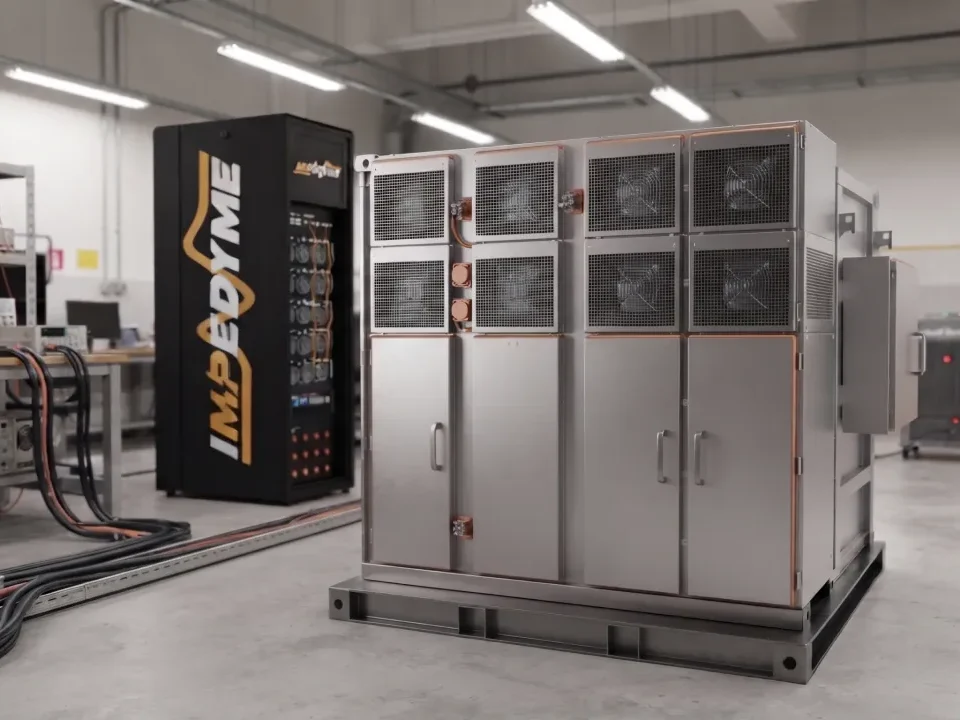
The hardware spans the range an HVDC program needs, from the CHP 300 与 CHP-150 power platforms for power-level testing to the RCP-Box rapid-control-prototyping unit — a dual-core ARM processor paired with an UltraScale+ FPGA, closed-loop control to 250 kHz, stackable to 64 synchronized units — for prototyping MMC controllers and SiC/GaN converter stages before committing to production silicon. The FPGA Scope diagnostic captures waveforms at megahertz resolution with deterministic multi-unit synchronization, so the internal dynamics of a converter under test — circulating currents, capacitor balancing, arm currents — are fully observable. And because the amplifiers are regenerative, power circulates internally and the mains supplies only the losses, making it practical to test high-power converters on a modest grid feed.
Tied together, these tools let an engineering team validate the things that actually cause HVDC commissioning failures: MMC and LCC controller logic including commutation-failure handling and voltage-dependent current limiting, droop control across a multi-terminal grid, DC-breaker coordination, weak-grid stability, harmonic and impedance interaction, fault ride-through, and black-start sequencing — all at FPGA time steps that resolve switching-level detail, and all before the converter is connected to a live grid. The converter physics described earlier in this article and the validation platform described here are two halves of the same engineering discipline: you design to the equations, and then you prove the firmware against a real-time model that obeys them.
Why is an HVDC power system more efficient than AC over long distances?
A long HVDC link loses substantially less power per thousand kilometres than a comparable AC line at the same voltage, for three main reasons:
HVDC only pays off beyond a break-even distance, after which it wins on loss, cost, and controllability.
What is the break-even distance for HVDC versus AC?
HVDC becomes economical beyond roughly a few tens of kilometres for submarine cables and several hundred kilometres for overhead lines. Below that threshold, the cost and complexity of the converter station at each end outweigh the transmission savings, and AC remains the better choice. Above it, lower line losses, fewer conductors, and full controllability of power flow tip the balance decisively toward HVDC.
What is a multi-terminal HVDC grid?
A multi-terminal HVDC grid connects three or more converter stations to a shared DC network, rather than linking only two points. Meshed VSC/MMC grids operating around ±500 kV already exist, and offshore wind plans are built on standardized 2 GW, ±525 kV building blocks intended to interconnect into a DC supergrid. Multi-terminal operation depends on DC-voltage coordination — master-slave or voltage-droop control — and on fast DC circuit breakers, which shift from optional to mandatory once several terminals share one DC backbone.
What is an HVDC power supply?
In the device sense, an HVDC power supply is an electrical unit that converts standard AC utility power or low-voltage DC into a regulated high-voltage DC output, generally ranging from several hundred volts to hundreds of kilovolts. Modern programmable units use high-frequency switching topologies — often followed by a Cockcroft-Walton diode-capacitor voltage multiplier — rather than bulky line-frequency transformers, achieving conversion efficiencies above 90%. They are classified by voltage range, from under 1 kV for PCB and electronics testing up to 500 kV+ for insulation validation, ion implantation, e-beam welding, and physics research.
Can an HVDC link connect AC grids that run at different frequencies?
Yes. Two AC grids can only be hard-wired together if they share the same frequency and stay in phase, which many neighbouring grids do not. An HVDC link decouples the two sides completely, so it can tie a 50 Hz grid to a 60 Hz grid, or two 60 Hz grids that are simply out of step. A back-to-back station places the rectifier and inverter in the same building with no DC line at all, purely to interconnect two asynchronous AC systems and trade power between them.