
Data Center Power Stability header card

Application knowledgeGridMotorProduct knowledgeWebinars

Data Center Power Stability header

AI Data Center Power Stability: Power Capacitor Shelves, PCS Module Design

As AI workloads surge, data centers are now driving explosive growth in power demand. In 2024 data centers consumed about 415 TWh (≈1.5% of global electricity), with projections showing U.S. demand nearly doubling (from 176 TWh in 2023 to 325–580 TWh by 2028) under AI growth. This unprecedented scale makes stable power delivery an operational imperative. High rack densities (tens of kW per rack) and synchronous GPU clusters create extremely dynamic, bursty loads. During training runs, data center power can swing rapidly between compute and communication phases, causing large voltage and frequency transients. In effect, AI shifts the problem from capacity (how much power) to control (how fast power changes). Traditional UPS and generator schemes – designed for predictable loads – are strained. Industry experts warn that “power stability and efficiency are no longer background engineering topics; they are operational risks” in next-gen AI facilities.

What Is Data Center Power Stability?

Data center power stability is the ability of a facility to maintain clean, continuous, within-specification electrical power to its IT load while neither being disrupted by external grid disturbances nor disrupting the grid it draws from. It spans everything from millisecond voltage transients on an internal busbar to multi-megawatt load swings that ripple outward to a regional transmission network.

The stakes are easy to underestimate until something fails. Power-related issues remain the single largest cause of significant data center outages, accounting for roughly 45 percent of impactful incidents, the majority of them tied to power infrastructure such as uninterruptible power supplies. The financial consequences are severe: large-enterprise downtime can run on the order of thousands of dollars per minute, and roughly one in five financially consequential outages now costs more than three million dollars. When a facility’s entire purpose is to run continuously, instability is not a nuisance—it is an existential risk.

What has changed is the scale and the character of the load. Global data center electricity consumption sat at around 415 terawatt-hours in 2024, about 1.5 percent of the world’s electricity, and is set to more than double to roughly 945 terawatt-hours by 2030, with AI-optimized capacity expanding fastest of all. That growth alone would strain any grid. But it is not the average consumption that threatens stability—it is the way AI workloads consume.

Why AI Data Centers Create a New Power Stability Problem

The grid’s century-old design rests on a quiet assumption called load diversity. In a traditional facility, individual servers ramp up and down at different moments, so their fluctuations cancel out and the aggregate draw stays smooth. AI training clusters destroy that assumption.

In a large training run, tens of thousands—sometimes more than a hundred thousand—GPUs work in lockstep on the same iterative job. They surge to near their thermal design power during the compute phase, then drop close to idle during the communication phase, when results are synchronized across the cluster in operations such as all-reduce or checkpointing. Because every processor flips at the same instant, the swings do not average out. They stack. The result is a coordinated power oscillation that can shift tens to hundreds of megawatts within seconds, and sometimes within a fraction of a second

The Synchronized GPU “Flip” and Harmonic Resonance

The most insidious aspect of this behavior is not its size but its rhythm. When researchers from several leading AI and chip companies analyzed production power traces from large GPU clusters in a 2025 study, they found the oscillation energy concentrated between roughly 0.2 and 3 hertz. That band sits dangerously close to the natural resonant modes of turbine-generator shafts and long transmission lines, which span from about 0.16 hertz to well above 60 hertz. When a forcing frequency lands near a mechanical or electrical resonance, energy accumulates rather than dissipates, and the consequences include sub-synchronous resonance, voltage flicker, and mechanical fatigue in generator shafts hundreds of miles away. A combined-cycle plant in Florida experienced exactly this kind of oscillation in 2019, driven by a roughly 200-megawatt source; the synchronized AI loads now coming online can be far larger.

Ramp Rates, Sudden Load Steps, and Turbine Fatigue

Beyond resonance, there is the sheer speed of change. When a training job starts, pauses, or ends, the load can step up or collapse faster than on-site generators can follow. Grid reliability authorities have flagged extreme AI training fluctuations as a high-likelihood, high-impact risk, noting that demand can plunge hundreds of megawatts in moments and ramp back just as fast. GPUs compound the challenge with brief overshoots above their rated power—electrical design power peaks lasting around fifty milliseconds—that, if visible at the facility’s connection point, tighten every compliance margin. The engineering reality is that software, firmware, and GPU-level tricks can soften these transients, but none fully eliminates them. A complete answer requires hardware that can absorb and release energy at the speed the GPUs demand.


Mechanics of AI-Induced Power Volatility and Grid Interdependence

As the power demands of AI factories grow, the relationship between data center operators and utility providers must shift from a passive connection to a model of grid interdependence. Under this cooperative framework, data centers utilize their on-site energy storage and power conditioning assets to support the local grid during periods of peak demand or system emergencies.

Parameter / MetricTraditional Rack Power ArchitectureModern PCS-Enabled Rack Architecture
Dynamic Response Speed> 10 (software-based ramp control)< 10 us (hardware-based autonomous discharge)
Grid Power Connection DemandDimensioned for peak GPU workloads (150% of nominal)Shaved peak; connection requirement reduced by up to 44%
Artificial / Dummy LoadsRequired to smooth grid load profile (wastes energy)Eliminated entirely; direct physical buffering
System Energy EfficiencyHigh thermal losses and cooling overheadUp to 45% improvement in total rack power efficiency
Heat Dissipation (Rack-Level)Elevated due to continuous dummy load burningReduced by up to 45%, lowering cooling OPEX
CAPEX Implications (400MW Facility)High utility connection charges and transformer ratingsUp to $40M saved in grid connection/infrastructure costs

Fault Ride-Through (FRT) Compliance

During a localized fault on a transmission line, voltage levels can drop precipitously before protective relays isolate the fault. Historically, data centers responded to these voltage drops by immediately disconnecting from the grid and transferring their entire load to backup diesel generators.

However, as data center loads grow to represent a substantial share of regional demand, the simultaneous disconnection of several hundred megawatts of load can trigger a catastrophic grid blackout. Consequently, Transmission System Operators (TSOs) globally enforce strict Fault Ride-Through (FRT) codes. These regulations mandate that data centers remain connected to the utility grid during transient faults, actively supporting grid recovery rather than disconnecting.

Implementing FRT-compliant architectures requires advanced UPS control algorithms and robust inverter hardware designed to handle transient overcurrents. By utilizing real-time digital twin simulations, engineers can validate that these control systems coordinate effectively with utility protection schemes, ensuring seamless operation during dynamic faults.

Fast Frequency Reserve (FFR)

With the reduction of physical grid inertia due to renewable energy integration, grid frequency is more susceptible to rapid drops during generator outages. Fast Frequency Reserve (FFR) is an active grid support mechanism that helps mitigate these frequency drops.

Under this model, data centers configure their UPS and battery energy storage systems (BESS) to detect grid frequency deviations. In response, the data center can temporarily reduce its grid power consumption—or inject stored energy back into the grid—for up to 30 seconds. This rapid response provides the utility with the critical window needed to ramp up secondary generation sources (such as hydroelectric or gas turbine reserves) without interrupting the data center’s critical IT workloads.

These grid-balancing models present a clear commercial opportunity for data center operators. By leveraging existing, often underutilized energy storage assets, operators can participate in utility demand-response programs, generating additional revenue streams to offset operational costs.

Energy Storage and Power Buffering

At the heart of many stability solutions is energy storage – buffering power during peaks and releasing it as needed. Data center operators are increasingly treating batteries and supercapacitors not just as backup, but as active grid assets. Industry research predicts global data center battery demand will soar (from ~20 GWh today to ~70 GWh by 2030) as more sites adopt storage for load management. Storage can serve multiple roles: lengthening uptime during grid outages, storing renewables, replacing diesel gensets for cleaner backup – and critically, smoothing internal load variations.

While software-level tricks (like staggering job starts) offer partial relief, they often incur efficiency losses. Hardware storage provides a more direct fix. Lithium-ion or advanced lead-acid UPS batteries can quickly absorb a power surge or supply a valley. For example, EnerSys notes that their thin-plate pure-lead (TPPL) batteries have “exceptional fast charge and cycling capabilities necessary for grid balancing.” These batteries are engineered for high power density and can replenish rapidly to shave peaks. By integrating such high-performance UPS batteries, a data center can support more aggressive load following and even participate in utility grid services. Crucially, operators must ensure storage participation does not compromise core uptime: they must size and manage the reserve so that primary mission loads remain protected.

The Power Capacitor Shelf: Engineering Peak Shaving and Valley Filling

To bridge the gap between volatile GPU demand and rigid grid limitations, operators are deploying local, rack-integrated energy storage systems. While standard battery energy storage systems (BESS) are well-suited for long-duration backup, their response times and cycle lifetimes are insufficient for millisecond-level peak shaving. This gap has driven the adoption of the Power Capacitor Shelf (PCS) as a critical component in contemporary AI Data Center Power Stability architectures.

Operating directly at the rack level (often designed to comply with Open Rack V3 or ORV3 standards), a Power Capacitor Shelf utilizes high-capacity Electric Double-Layer Capacitors (EDLCs), also known as supercapacitors, to provide rapid charge and discharge capabilities.

The primary function of a PCS is to execute “peak shaving and valley filling”. When the GPUs transition to peak computational states, demanding instantaneous currents that exceed the safe operating limits of the upstream Power Distribution Units (PDUs), the PCS discharges its stored energy in under 10 us. Conversely, when the GPUs enter idle or communication states, the PCS recharges, smoothing the power demand profile seen by the grid.

These units are typically developed in standardized form factors designed for seamless integration. The electrical performance of these modules is optimized for rapid power delivery, as summarized in the specifications of modern high-density capacitor platforms:

Parameter / Specification48VDC Interface Module400VDC Interface Module
Form Factor / CompatibilityORV3 Compatible, 1OU HighORV3 Compatible, 3OU / 4OU High
Peak Power Rating60 kW160 kW
Peak Current Capability1250 A400 A
Continuous Current Rating830 A300 A
Cooling Method OptionsAir-cooled and liquid-cooled optionsAir-cooled and liquid-cooled options
Core Storage TechnologyCurved Graphene SupercapacitorsCurved Graphene Supercapacitors

By physically decoupling the instantaneous silicon demand from the upstream electrical distribution, a Power Capacitor Shelf eliminates the need for software-based “dummy loads” that operators historically used to maintain a flat load profile. This physical buffering reduces total heat generation within the server chassis, lowering the cooling overhead and significantly enhancing the overall Power Usage Effectiveness (PUE) of the facility. 

Power Delivery Network (PDN) Design and Components

Ensuring stable power delivery also starts at the hardware level – from the plant down to the rack. Modern AI servers and racks often use higher bus voltages and denser PCB layouts than before. A recent technology guide emphasizes that PDN architecture must evolve to reduce losses and maintain voltage under heavy draw. For example, newer server designs may use distributed DC buses (e.g. ±400V or higher) and beefed-up decoupling capacitors. Component selection is critical: high-quality multilayer ceramic capacitors (MLCCs), film capacitors, low-ESR electrolytics and silicon capacitors all help stiffen the voltage rails. As Murata notes, data center PDNs should use advanced passive components and optimized placement to absorb transients and minimize drop. In a noisy, high-frequency world, every nanofarad of bypassing counts.

The board-level design also impacts stability. Minimizing loop inductance and avoiding resonances reduces voltage overshoots. Power stages for AI accelerators are essentially MHz-class DC-DC converters – they can inject noise and harmonics into the line. PDN designers now routinely simulate full electro-thermal models of servers and racks under dynamic loading, verifying that no part of the supply network saturates or oscillates during fast events. In short, optimized PDN design is a frontline defense: it sets a robust baseline so that when an AI surge hits, the voltage droop is manageable. This aligns with industry guidance that “evolving power placement architectures” – from heavy copper planes to distributed bypass networks – are needed to stabilize AI server power and reduce losses.

AI Data Center Power Stability

PCS Module Design: The Engineering Behind Stable Peak Shaving

Building a Power Capacitor Shelf that performs in the field is far harder than wiring capacitors in series and parallel. The discipline of PCS module design turns on one dominant parameter — equivalent series resistance, or ESR — a small internal resistance that governs four coupled outcomes:

  • Maximum power is inversely proportional to ESR. The lower the resistance, the more instantaneous power the module can deliver into a transient.
  • Runtime shrinks as ESR rises, because higher resistance produces a larger voltage drop under load, pushing the module to its cutoff voltage sooner and shortening its effective hold-up.
  • Self-heating comes from current flowing through that resistance, dissipating power as heat in proportion to the square of the current — often the dominant thermal load the module’s cooling must manage.
  • Lifetime is eroded by that heat, which accelerates cell degradation. As cells age, ESR rises and capacitance falls — a self-reinforcing loop that typically defines end of life at a 20% loss of capacitance or a doubling of ESR.

These effects compound at the module level in ways that catch inexperienced designers off guard:

  • Small ESR deviations between individual cells do not simply add — they interact non-linearly once cells are assembled, amplifying both power loss and thermal hot spots.
  • As a result, cell matching and the impedance of busbars and interconnects become first-order design concerns rather than details.
  • A well-known design rule illustrates the precision required: to hold the transient voltage dip from a sudden load dump below one volt, a design may target on the order of 50,000 µF with an ESR below roughly 2.5 mΩ — while keeping the capacitor bank’s impedance below both the busbar’s characteristic impedance and the converter’s negative input resistance to avoid oscillation.

Measuring ESR correctly is its own challenge, and getting it wrong undermines the whole design:

  • Established standards define how to extract capacitance and resistance from a controlled discharge.
  • A common pitfall is over-aggressive smoothing of the measured waveform, which under-estimates the transient ESR.
  • That produces a gap between the nominal specification and the real behavior the customer’s machine ultimately exposes — and in a component destined to protect a multi-million-dollar GPU rack, that gap is unacceptable. Which leads directly to the question every honest engineer must ask before deployment.

You Cannot Assume Stability — You Have to Prove It

A Power Capacitor Shelf, a supercapacitor module, a grid-friendly UPS, an 800-volt DC power architecture: each introduces fast control loops and new failure modes that do not reveal themselves on a datasheet or a benign bench test. These problems hide until the worst possible moment unless they are deliberately provoked beforehand:

  • Parallel UPS units can interact and oscillate against one another.
  • Over-sensitive protection can trip on a disturbance the facility should have ridden through.
  • Backup transitions can misbehave in the precise sequence of events that occurs only during a real fault.
  • A PCS module’s control loop, perfectly stable in isolation, can destabilize when it meets a weak grid, a voltage sag, and a synchronized GPU ramp all at once.

This is the part of the stability story the rest of the industry tends to skip, and it is where the real assurance lives. Power stability must not only be engineered — it must be verified under realistic grid and load conditions before a facility connects to the live network:

  • The method is Power Hardware-in-the-Loop and Controller Hardware-in-the-Loop testing, in which a real-time simulator emulates the grid and the workload while the actual hardware under test responds in a closed loop.
  • Every fault, sag, swell, frequency excursion, and AI load step can be rehearsed virtually, against real hardware, before any of it touches the grid.
  • As the principle is sometimes put: if a data center cannot maintain stability in a Power Hardware-in-the-Loop environment, it is not ready to connect to the real grid.

This is precisely the role Impedyme plays. Rather than manufacturing capacitor shelves or UPS systems, Impedyme builds the test and emulation platforms that prove those systems work — making it a neutral authority able to validate any vendor’s powershelf, PCS module, HVDC converter, or full rack:

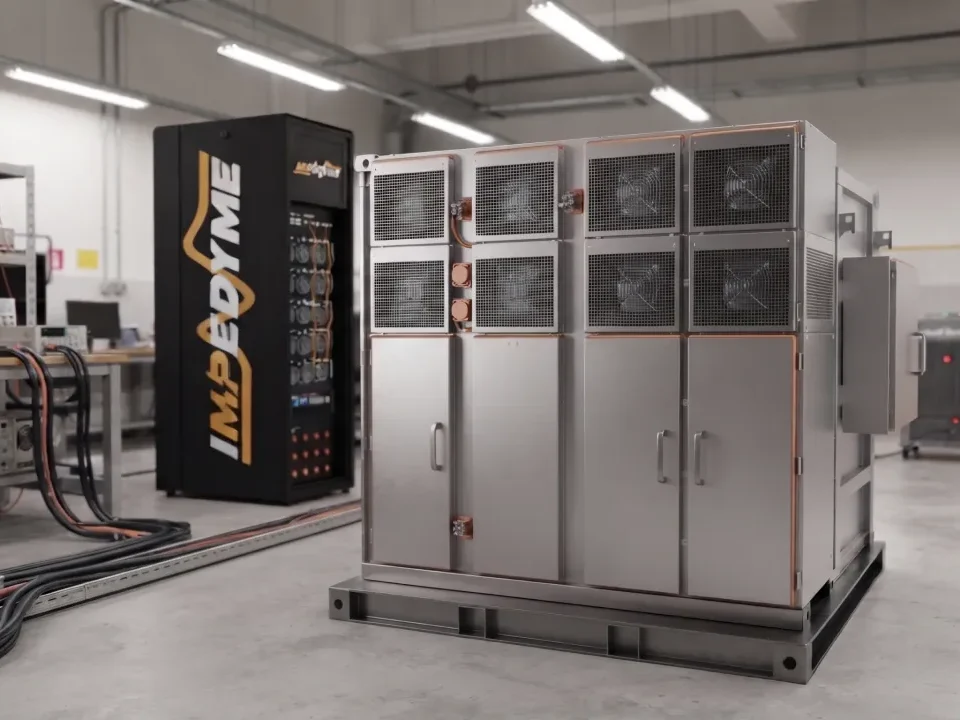
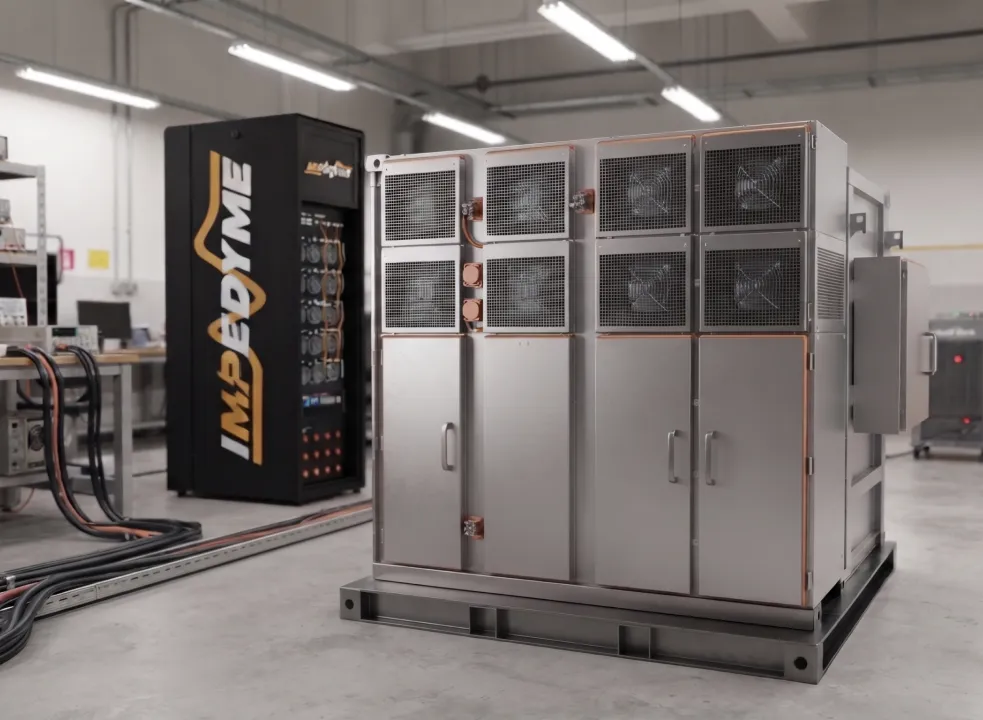
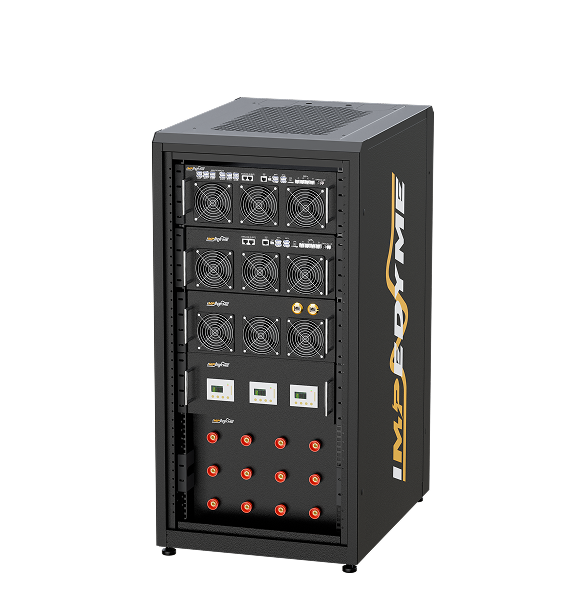
  • CHP Series (flagship): combines a real-time simulator with a regenerative, bidirectional grid emulator in one platform, scaling from a single cabinet to custom configurations beyond one megawatt, sourcing or sinking full rated power while injecting harmonics, sags, swells, and flicker.
  • Programmable grid emulator: reproduces grid conditions worldwide and injects faults on demand, enabling fault-ride-through and weak-grid testing against standards such as IEEE 1547, IEC 61000, and IEEE 519.
  • Real-time AC and DC loads: reproduce the idle-to-full-load steps and burst cycles of GPU workloads at voltages up to 800 volts DC.
  • High-bandwidth measurement tools: capture power factor, total harmonic distortion, ripple, efficiency, and inrush with the fidelity that ESR and transient verification demand.
  • Regenerative architecture: a 100 kW validation can draw only a few kilowatts from the wall, returning the rest — making it practical to test powershelves and PCS modules across their full range, from 25 kW up to a megawatt and beyond.

In an era when a single instability event can shed a thousand megawatts and trigger a regulatory alert, validating before energization is no longer optional diligence. It is the difference between a facility that strengthens the grid and one that threatens it.

High-Fidelity Validation: Accelerating Development with Combined HIL and Power HIL Platforms

Validating the interaction between a newly designed PCS module, the server power supply units (PSUs), and the dynamic utility grid requires a rigorous testing methodology. Historically, design engineers relied on numerical software simulations to model system behavior. However, software-only simulations cannot capture firmware-specific timing anomalies, non-linear high-power hardware behaviors, or control loop interactions between multiple parallel inverters. Conversely, live testing on physical grid connections or multi-megawatt operational loads is dangerous, economically prohibitive, and cannot replicate rare edge-case fault conditions safely.

To address this challenge, Impedyme provides a high-fidelity validation platform utilizing Combined Hardware-in-the-Loop (HIL) and Power Hardware-in-the-Loop (PHIL) technology. This platform allows developers to interface physical control hardware and real power assets (such as a physical PCS module or UPS) with a simulated, real-time virtual environment.

Through this closed-loop testing architecture, a physical device under test (DUT) exchanges real power with a simulated digital twin of the utility grid or data center power system. This validation methodology is critical for analyzing how physical power electronics respond to deep voltage sags, utility short circuits, transient grid harmonics, and sudden multi-megawatt load step changes.

Temporal Resolution and Latency Control

The primary engineering challenge in a PHIL simulation is maintaining interface stability and closed-loop synchronization between the physical hardware and the real-time simulation model. Any delay or latency in the feedback loop between the physical sensors, the real-time computer, and the power amplifiers can introduce artificial phase shifts, destabilizing the simulation.

To maintain numerical stability and accurately capture high-frequency transients, the real-time simulation time step  must scale in proportion to the frequency of the dynamics being analyzed. Mathematically, to maintain numerical stability, the time step must be at least one order of magnitude smaller than the fastest electrical period of interest:

$$\Delta t_{RTS} \le \frac{T_{\min}}{10}$$

Application / Dynamic PhenomenonTarget Frequency / PeriodRequired Time StepImpedyme Platform Capability
Grid Frequency Dynamics50 Hz / 60 Hz (16.6 ms)≈ 1.6 msFully Supported
50th Order Grid Harmonics3 kHz (333us)≤ 33 μsFully Supported
Inverter Control Loop Bandwidth2 kHz (500us)≤ 50 μsFully Supported
High-Speed PWM Ripple & Transients10 kHz-50 kHz (20us)≤ 2 μs to 5 μsSupported via FPGA execution
Nanosecond FPGA Real-Time Core> 1 MHz (1us)Nanosecond scaleNative FPGA Hardware Step

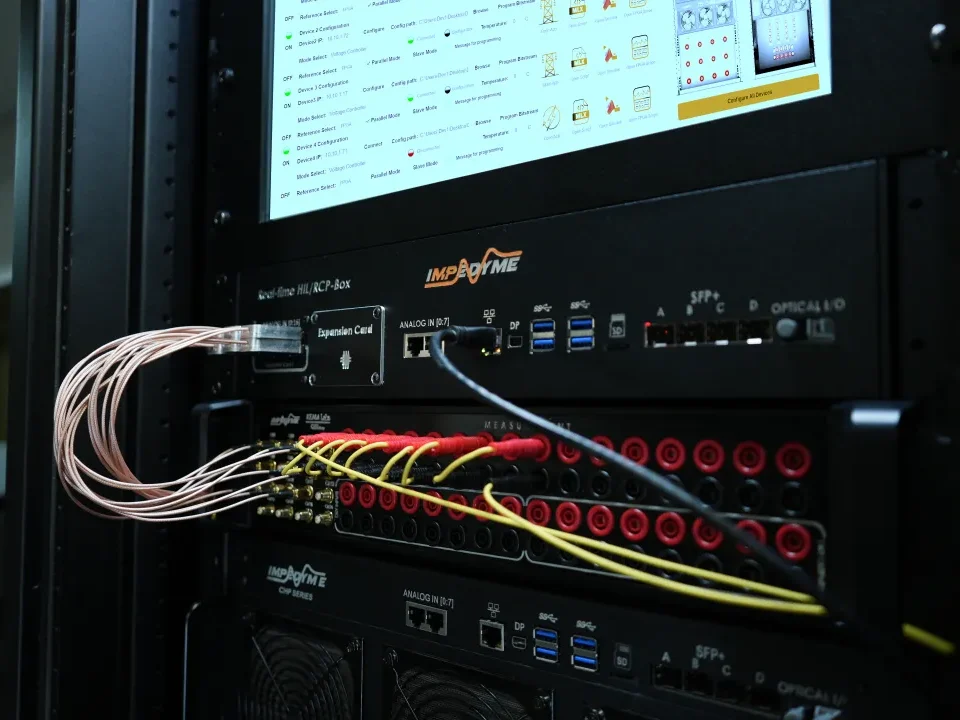
The Impedyme Combined HIL and Power HIL (CHP) platform addresses these ultra-fast timing requirements by utilizing dedicated FPGA-based real-time processors. This design enables nanosecond-scale execution steps, guaranteeing the microsecond-level precision required to test high-frequency converter topologies, active front-end (AFE) rectifiers, and high-speed controller logic.

The Impedyme CHP platform supports high-power testing up to the megawatt scale, utilizing an integrated liquid-and-air cooling system that does not require external chillers. This integrated thermal management enables continuous high-power emulation, allowing engineers to deploy Simulink models directly via optical links and execute real-time impedance spectroscopy to capture frequency response curves dynamically.

Advancing Battery Chemistries and On-Site Energy Storage Models

While supercapacitors provide the millisecond-level transient response required by server chassis, long-duration energy storage is necessary to support grid-interactive operations and facility backup. Selecting the appropriate battery chemistry is a fundamental design decision that dictates the space requirements, cycle life, and thermal management profile of the facility.

Historically, standard lead-acid batteries have dominated the data center standby market due to their cost-effectiveness and reliability. However, the high cyclic requirements of active grid balancing have driven the adoption of advanced alternative technologies.

Innovations in Thin Plate Pure Lead (TPPL) technology utilize thinner plates to maximize active surface area, significantly increasing power density and cyclic capabilities. This pure lead grid design prevents internal degradation, allowing the batteries to operate at elevated temperatures up to 30°C. This thermal resilience directly reduces the facility’s cooling energy consumption, lowering both PUE and operational carbon footprint.


Strategic Recommendations for Designing Resilient AI Data Centers

Achieving Data Center Power Stability in the high-density AI era requires a unified engineering approach that spans chip design down to high-voltage transmission systems. To navigate these challenges, operators and developers should prioritize several strategic actions:

Implement Localized Transients Buffering

Integrate rack-level Power Capacitor Shelves (PCS) with ultra-fast, microsecond-level response times to buffer high-frequency GPU load transitions locally. This approach minimizes downstream thermal loads, reduces peak utility connection requirements, and enhances overall power system efficiency.

Adopt High-Resolution Testing for PCS Modules

Move away from testing protocols that rely on moving average algorithms, which smooth out and underestimate ESR. Incorporate high-resolution transient capture and high-frequency sampling to identify micro-ohm ESR deviations before assembling individual cells into modules, preventing thermal imbalances and premature shelf failure.

Transition to Closed-Loop PHIL Validation

Replace static software simulations with real-time Hardware-in-the-Loop (HIL) and Power Hardware-in-the-Loop (PHIL) testing. Utilizing FPGA-based platforms with microsecond-level time steps allows engineers to validate the physical interaction between converters, UPS units, and the grid under realistic conditions, de-risking the commissioning process.

Leverage Regenerative Grid Emulation

Use programmable, bi-directional grid emulators to evaluate equipment performance under complex harmonic conditions. Emulating varying grid impedances and harmonic distortion profiles ensures compliance with international standards like IEEE 519-2014, while regenerative power recycling lowers testing energy consumption.

Design for Grid Interdependence

Invest in grid-interactive power systems capable of Fault Ride-Through (FRT) and Fast Frequency Reserve (FFR). Integrating these active grid-balancing capabilities helps stabilize local distribution networks while unlocking additional revenue streams through demand-response participation.

By applying these advanced validation methodologies and energy storage strategies, data center developers can build resilient, high-density AI facilities that actively support and integrate with the evolving utility grid. Utilizing high-fidelity real-time simulation platforms, such as those provided by Impedyme, allows operators to transition from passive consumers of electricity to active, grid-supportive partners.


Frequently Asked Questions

What is data center power stability?

It is a facility’s ability to maintain clean, uninterrupted, within-specification power to its IT load while neither being disrupted by grid disturbances nor disrupting the grid itself. It encompasses internal power quality, ride-through during faults, and the facility’s external impact on the wider network.

Why do AI workloads cause power instability?

Large AI training clusters run tens of thousands of GPUs in lockstep, so they all surge and idle at the same instant instead of averaging out. This produces synchronized power swings of tens to hundreds of megawatts within seconds, with oscillation frequencies that can resonate dangerously with turbine and transmission-line natural modes.

What is a Power Capacitor Shelf (PCS)?

A Power Capacitor Shelf is a rack-mounted bank of high-power capacitors that smooths a rack’s power draw through peak shaving and valley filling—charging during low-demand phases and discharging during demand spikes—so that power supplies, the UPS, and the grid never see the full transient, and without the energy waste of dummy loads.

What is PCS module design and why does ESR matter?

PCS module design is the engineering of capacitor modules for stable, high-power peak shaving. Equivalent series resistance is the master parameter because it simultaneously sets maximum power, hold-up runtime, self-heating, and lifetime; small per-cell deviations compound non-linearly across a module, making cell matching, interconnect impedance, and accurate ESR measurement decisive for real-world performance.

How do you test or validate data center power stability?

Through Power Hardware-in-the-Loop and Controller Hardware-in-the-Loop testing, in which a real-time simulator emulates the grid and workload while the real hardware responds in a closed loop. This lets engineers rehearse every fault, sag, ramp, and fault-ride-through scenario before connecting to the live grid.

What is fault ride-through?

Fault ride-through is the ability of a facility to remain connected and supportive during a grid disturbance instead of disconnecting. Regulators increasingly require it of large loads so that data centers help stabilize the grid through faults rather than worsening the imbalance by dropping offline en masse.