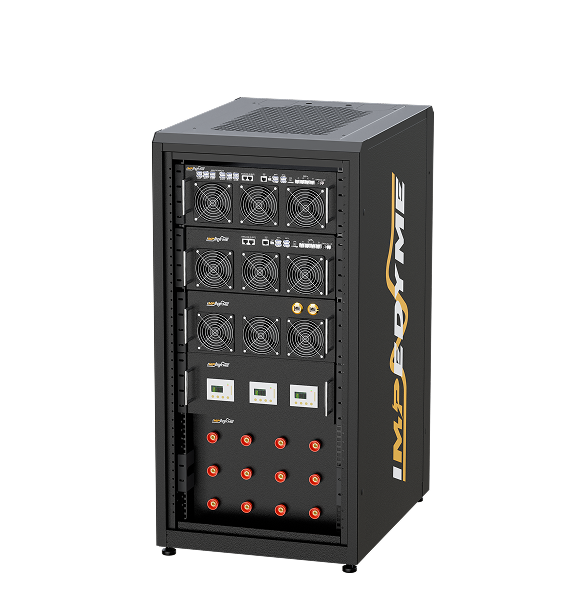

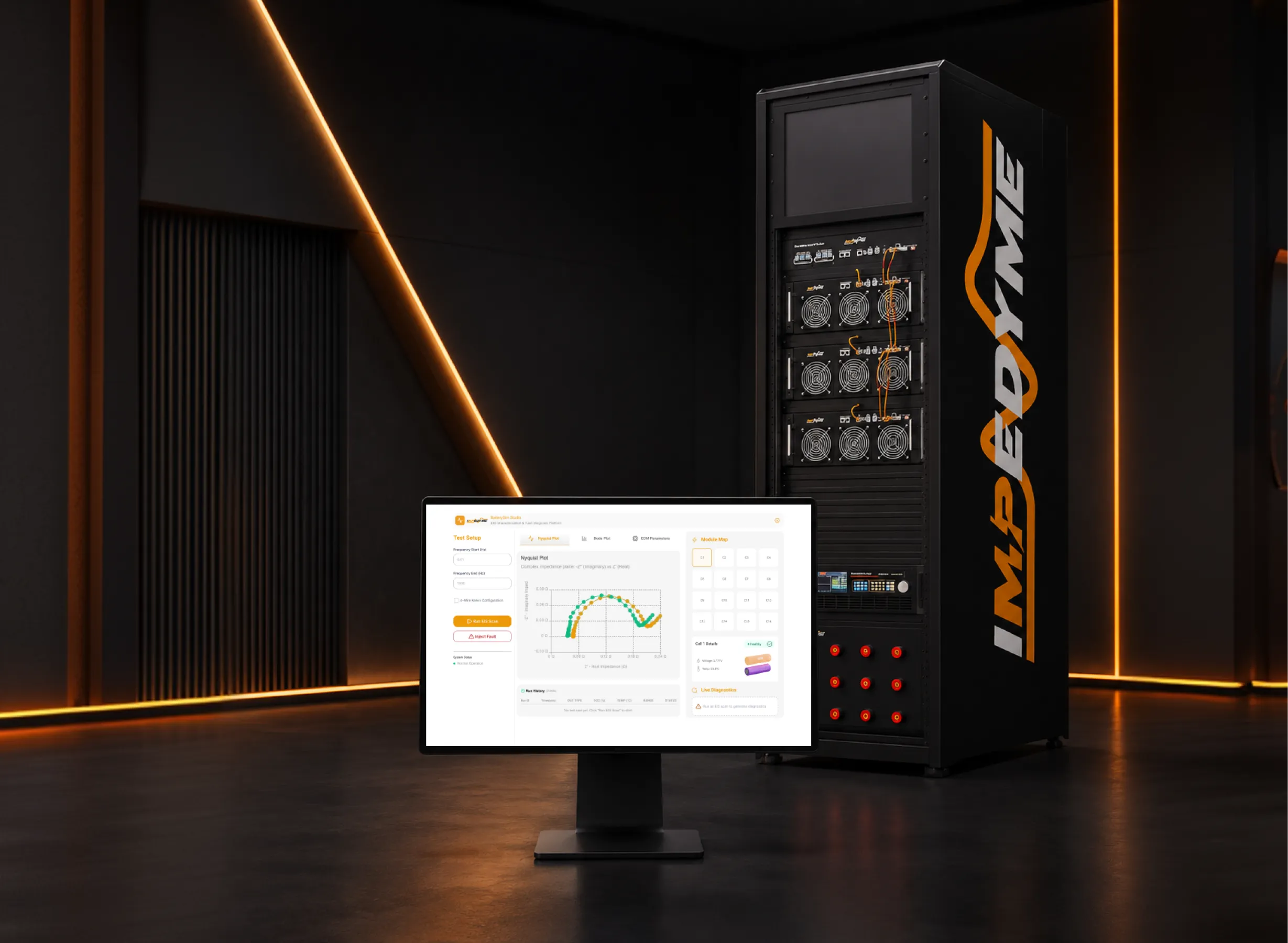
Battery management system testing card
Battery management system testing header

Battery Management System Testing: Ensuring Safe, Reliable Batteries

Why Battery Management System Testing Decides Whether a Battery Lives or Dies

Battery management system testing is the single most consequential gate in the development of any modern lithium-ion product. Whether you are building a 400 V electric-vehicle traction pack, an 800 V fast-charging architecture, a megawatt-scale stationary energy storage system (ESS), or a weight-critical aerospace battery, the battery management system (BMS) is the embedded intelligence standing between safe operation and catastrophic failure. A BMS that miscalculates state of charge, fails to detect a single failing cell, or reacts too slowly to an overvoltage event does not merely degrade performance—it can lead to thermal runaway, fire, and loss of life.

That is why a rigorous battery management system test program is non-negotiable. Yet testing a BMS against a real battery pack is slow, expensive, and dangerous: you cannot safely drive a real pack into overvoltage, deep discharge, cell imbalance, or thermal runaway hundreds of times a night, and you cannot rewind a real cell’s state of charge or aging on demand. This is the core problem that modern BMS validation solves through battery cell emulationhardware-in-the-loop (HIL) testing.

This guide is a comprehensive, engineering-grade reference on battery management system testing. It covers what a BMS does, why BMS testing is safety-critical, the regulatory standards that govern it, the testing methodologies (HIL, and Power-HIL), the difference between emulated and real cells, fault injection techniques, test-bench architecture, the battery models that run underneath, and the FPGA-based real-time execution that makes high-fidelity emulation possible. Throughout, we show how Impedyme’s BatterySim Studio and the FPGA-based CHP (Combined HIL and Power) platform deliver a single-workspace solution for the entire BMS validation workflow.

What Is a Battery Management System (BMS)?

A battery management system is the electronic hardware-and-software system that monitors, controls, and protects a rechargeable battery pack, keeping every cell inside its safe operating area. In a high-voltage traction battery, single lithium-ion cells of roughly 3.6–3.7 V are connected in long series strings to reach system voltages of 400 V to 800 V and beyond. A 400 V class pack typically uses around 96 cells in series (96S ≈ 403 V at 4.2 V/cell), while 800 V architectures stack more than 200 cells in series—and every one of those cells must be monitored to within a few millivolts while floating at hundreds of volts.

To do this, a BMS is usually distributed across two tiers: cell-monitoring controllers (often called cell management controllers, CMCs) that use multi-channel monitoring ICs to measure cell voltages and temperatures, and a master battery management controller (BMC) that runs the high-level estimation, control, and protection logic and communicates with the rest of the vehicle or system.

Core Functions of a BMS

  • Cell monitoring: Continuous measurement of individual cell voltage, pack current, and temperature—the raw signals on which every other function depends. Cell-voltage measurements typically require millivolt-level accuracy across long series stacks.
  • State estimation (SOC, SOH, SOE, SOP): The BMS estimates state of charge (how much usable energy remains), state of health (capacity fade and internal-resistance growth over the pack’s life), state of energy, and state of power. These quantities are not directly measurable; they are reconstructed online from voltage, current, and temperature, frequently using equivalent-circuit models combined with Kalman-filter-based observers. 
  • Cell balancing: Because cells naturally diverge in capacity and resistance over time, the BMS equalizes them—commonly through passive balancing, which bleeds excess charge from higher-SOC cells through resistors, or active balancing, which redistributes charge. Accurate SOC estimation is a prerequisite for effective balancing.
  • Thermal management: The BMS monitors temperature and commands cooling or heating (air, liquid, or other strategies) to keep cells in their optimal window and to prevent the conditions that precede thermal runaway.
  • Fault protection: Detection of and response to overvoltage, undervoltage, overcurrent, overtemperature, short circuit, and isolation faults—opening contactors and driving the pack to a safe state when limits are exceeded.
  • Communication: Reporting state and faults to the vehicle, charger, or energy management system, typically over CAN (and increasingly CAN FD), with related protocols such as RS-485, SMBus, and Ethernet in stationary and industrial systems.

Because these functions interact—an SOC error can trigger a false fault, a missed measurement can corrupt balancing—the BMS must be tested as an integrated system across its entire range of operating and fault conditions.

Why Battery Management System Testing Is Critical

Safety and Thermal Runaway Prevention

The BMS is the first line of defense against thermal runaway—the uncontrolled, self-sustaining chain reaction in which a cell overheats, decomposes its electrolyte, and vents flammable gases, propagating to neighboring cells. Failure-propagation testing by Sandia National Laboratories on pouch cells in direct contact found “failure to propagate through the entire battery within 60–80 seconds for all configurations (parallel or series) tested,” with the triggered cell self-igniting at a peak of around 360 °C. Because the BMS continuously watches cell voltage, current, and temperature and disconnects the pack when dangerous conditions appear, validating that protection logic under realistic fault conditions is literally a matter of life safety.

Functional Safety and Regulatory Standards

A BMS in a road vehicle is a safety-critical item under ISO 26262, the automotive functional-safety standard. Voltage, temperature, and current measurement functions are classed alongside airbag, braking, and steering systems. In a representative hazard analysis, the top-level battery safety goals map directly to the highest integrity levels: “SG1: battery shall not get fire, ASIL D; SG2: battery shall not emit toxic gases, ASIL D; SG3: High voltage shock shall be avoided, ASIL D; SG4: battery shall not allow over-charge, ASIL C; SG5: battery shall not allow over-discharge, ASIL B.” Across the industry, “certification on at least ASIL C level is also becoming a market need for BMS”—a process that requires over a hundred documents and reports submitted to an accredited external body and proof that the Probabilistic Metric for Hardware Failure (PMHF) is achieved.

ISO 26262 demands a hazard analysis and risk assessment (HARA), defined safety goals, and quantified hardware-failure metrics—for example, “the target SPFM [single-point fault metric] for the ASIL C safety goals is 97%,” computed alongside the latent fault metric (LFM). It explicitly drives extensive fault-injection testing of protection mechanisms including overcharge, overdischarge, overtemperature, overcurrent, and short-circuit protection. This single requirement—proving the BMS reacts correctly to injected faults—is the strongest practical reason to adopt emulation-based testing. 

Beyond ISO 26262, a BMS development program intersects a web of standards:

  • UN ECE R100 governs the approval of electric road vehicles and rechargeable energy storage systems (REESS), with electrical-safety, overcurrent, over-temperature, and thermal-propagation requirements. Its later revision adds requirements at the SOC level and for thermal propagation.
  • UL 2580 is the safety standard for electric-vehicle battery systems, evaluating packs, modules, cells, and BMS integration under electrical, mechanical, thermal, and environmental abuse.
  • IEC 61508 is the foundational, cross-industry functional-safety standard defining Safety Integrity Levels (SIL 1–4) and the safety lifecycle; ISO 26262 is its automotive adaptation.
  • Stationary energy storage adds IEC 62619 (industrial/stationary lithium cell safety), UL 1973 (batteries for stationary and motive auxiliary power), UL 9540 (system-level ESS safety) and its companion test method UL 9540A, plus NFPA 855 (installation of stationary ESS). UL 9540A is “a test methodology… to evaluate the fire safety risk of an ESS by determining if thermal runaway can propagate from cell to cell, module to module, and unit to unit,” and its Fifth Edition—released March 12, 2025—is described by UL as “the most significant revision since the standard’s introduction.”
  • Aerospace and eVTOL batteries operate under the highest reliability and availability requirements, with software developed to airborne standards such as DO-178 and growing emphasis on dynamic testing of energy-storage systems.

Across all of these, the common thread is that regulators and OEMs demand documented evidence across hundreds of operating and fault conditions—evidence that physical prototypes alone rarely deliver economically.

battery management testing picture

Safety, Abuse, and Regulatory Compliance Validation

The ultimate goal of any battery management system testing protocol is to ensure that the BMS successfully protects the battery pack under severe operational and environmental stress. This requires validation laboratories to perform structured electrical and thermal abuse tests in compliance with strict global standards.

Key Abuse Testing Scenarios

To verify that the safety and fault-detection algorithms in the BMS execute correctly, test systems subject the BMS to five critical failure scenarios :

  • Overcharge protection testing simulates scenarios where sensor failures or charging system drift cause a continuous high current to be supplied to a fully charged battery. The test system monitors the BMS to ensure it triggers isolation contactors before the cells enter a thermal runaway precursor state.
  • Over-discharge protection testing programs an external load to drain the emulated battery below its lowest safe operating limit, verifying that the BMS successfully terminates the discharge current to prevent irreversible chemical degradation.
  • Overcurrent protection testing simulates the failure of external charging controls during high-voltage DC fast charging. A high-voltage charger operates in parallel with the fast charger to deliver an increasing overcurrent, confirming that the BMS successfully interrupts the charge current within milliseconds.
  • External short-circuit testing connects the high-voltage bus outside the battery pack to an industrial high-current short-circuit machine (capable of delivering up to 50,000 Amperes). The test validates that the BMS can immediately trigger fast safety devices, such as pyrofuses, to terminate the high current before the busbars or cells experience catastrophic thermal failure.
  • Over-temperature testing heats the complete battery assembly to 40 to 45 degrees Celsius in a temperature chamber while executing high-power drive cycles on a dynamometer. This confirms that the BMS correctly triggers cooling systems and applies progressive current derating strategies as temperatures rise.

Required Monitoring Frequencies

To guarantee that safety faults are detected and acted upon before hazards arise, regulatory guidelines specify minimum internal monitoring frequencies for the BMS :

  • Voltage and Current Monitoring: Must operate at an internal sample rate of at least 100 Hz to capture rapid overcurrent spikes and short circuits.
  • Temperature Monitoring: Must run at least at 1 Hz for high-power applications (such as electric vehicles) and 0.1 Hz for high-energy applications (such as stationary grid storage) to identify localized hot spots.

Regulatory StandardTarget DomainCore BMS-Related Test RequirementsImpact on BMS Testing
ISO 26262 (ASIL D)Passenger Road VehiclesVerifies safety-critical execution, software determinism, and single-point fault diagnostic coverage.Mandates hardware-in-the-loop (HIL) testing to safely inject code and signal faults.
UL 2580EV Battery PacksOutlines rigorous electrical, mechanical, and thermal abuse tests (overcharge, short circuit, failure of cooling).Demands power hardware-in-the-loop (PHIL) to test BMS interactions with physical contactors and pyrofuses.
IEC 62619Industrial & Grid Energy StorageSpecifies safety requirements for stationary systems, including overcharge, short circuit, and thermal runaway non-propagation.Requires exact cell emulation and fault injection to test localized single-cell failures safely.
GTR No. 20 (EVS)Global EV Safety HarmonizationEvaluates the complete vehicle under real-world failure scenarios to ensure the BMS can apply countermeasures.Requires vehicle-level verification of warning indicators at least 5 minutes before gas venting or fire.
UN 38.3Transport SafetyEight-test suite including altitude simulation, vibration, mechanical shock, and forced discharge.Confirms the physical durability of BMS wire harnesses, connectors, and control PCBs.

Hardware Emulation Specifications for HIL Testbeds

To execute a comprehensive battery management system test, the real-time HIL platform must utilize highly specialized hardware modules to emulate the complex electrical, thermal, and mechanical interfaces of a real battery pack.

The primary emulation subsystems required for high-fidelity HIL execution are:

Battery Cell Emulator (BCE)

The BCE must reproduce individual cell terminal voltages dynamically. Because high-voltage battery packs connect up to hundreds of cells in series, each emulator channel must be completely galvanically isolated from other channels and from the system chassis.

Modern BCE modules provide up to 12 independent, isolated channels per unit, supporting output voltages up to 8 V and bidirectional sourcing and sinking currents of up to plus/minus 5 A per channel to support active cell balancing testing.

To capture microvolt-level balancing transitions, channels must feature high 18-bit resolution, voltage ripple below 6 mVpp, and rapid step responses under 0.5 milliseconds under full-load conditions.

Temperature Sensor Emulator (TSE)

Battery packs rely on negative temperature coefficient (NTC) or positive temperature coefficient (PTC) thermistors distributed across modules to detect thermal imbalances. The HIL testbed emulates these sensors using programmable, isolated resistor channels.

Industrial TSE units support configuration densities up to 36 independent channels per unit, delivering a programmable resistance range of 10 Ohm to 4 MOhm with 1 Ohm adjustment resolution and an accuracy of plus/minus 0.1% plus/minus 0.5 Ohm.

The fast settling times (under 10 milliseconds) enable realistic emulation of localized heat generation and thermal runaways.

Fault Insertion Unit (FIU)

The FIU is a programmable relay matrix designed to inject realistic electrical fault conditions into the BMS sense and communication lines.

An advanced FIU can execute broken wire simulation (simulating open-circuit faults on sense lines), external short circuits (bridging cell poles through an ultra-low resistance down to 50 mOhm), and reverse polarity faults (simulating incorrectly installed cells or cells experiencing severe voltage reversal).

These subsystems must maintain high continuous isolation levels (up to 1.3 kV channel-to-system) to prevent voltage arcing during simulated high-voltage faults.

Emulation SubsystemKey ParameterStandard Industrial ValueTarget Testing Metric
Battery Cell Emulator (BCE)Output Voltage Range0 V to 5 V (configurable to 8 V)Simulates all battery chemistries (LFP, NMC, solid-state).
Voltage Accuracyplus/minus 0.5 mV to plus/minus 50 microvoltsCrucial for flat-OCV chemistries (LFP) where a 1 mV drift shifts SOC estimates.
Galvanic Isolation1.3 kV channel-to-system, 100 V channel-to-channelPrevents leakage currents and ground loops in high-voltage strings.
Source / Sink CurrentUp to plus/minus 5 A per channelPhysically validates passive and active balancing circuit behaviors.
Temperature Sensor Emulator (TSE)Resistance Range10 Ohm to 4 MOhmReplicates complete NTC and PTC thermistor temperature ranges.
Settling Timeunder 10 millisecondsCaptures thermal transients and rapid cooling-fan response times.
Fault Insertion Unit (FIU)Fault TypesOpen Circuit, Short Circuit, Reverse PolarityValidates safety shutdown, diagnostic fault codes, and pyro-fuse triggers.
Series ScalabilityUp to 252 channels in seriesAccommodates large-scale electric vehicle and grid battery arrays.

Battery Cell Emulation vs. Real Cells

电池仿真器 is a programmable, bidirectional power system that electronically reproduces a real battery’s voltage, current, internal resistance, power limits, and dynamic response—without physical cells. Functionally it behaves like a genuine battery connected to the system under test, sourcing and sinking power and presenting realistic SOC- and temperature-dependent behavior. 

It is worth distinguishing two terms that are often used interchangeably:

  • 电池仿真器 focuses on real-time electrical behavior, interacts directly with power hardware, and requires fast control loops and high bandwidth—ideal for Power-HIL and closed-loop testing.
  • battery simulator often includes higher-level electrochemical or thermal models, may run offline or slower than real time, and is common in early-stage algorithm development.

The advantages of emulation over real cells are decisive for BMS testing: instant adjustment of SOC, voltage, and impedance without waiting for physical cycling; safe reproduction of thermal-runaway precursors, cell imbalance, and overcurrent events with full repeatability; A/B comparison under identical electrical conditions across firmware revisions; and the ability to emulate any chemistry—Li-ion, LFP, NMC, NCA, and emerging solid-state—at cell, module, or pack level. 

A critical requirement is measurement and control fidelity. Cell-monitoring ICs and the emulators that feed them must hit millivolt-level (and for IC characterization, sub-100-µV-level) accuracy, because BMS protection thresholds and SOC estimation hinge on tiny voltage differences near cutoff. BatterySim Studio runs on hardware delivering 24-bit resolution and microsecond-level loop rates with wide dynamic range, low-noise acquisition, and deterministic timing—precisely the precision that defines model accuracy, loop stability, and test reliability.

Fault Injection Testing: The Heart of BMS Validation

BMS validation lives or dies on edge cases. The reason emulation matters so much is that it lets engineers bring those edges into the lab safely and repeatably. A comprehensive battery management system test campaign injects a catalog of faults and verifies the BMS detects, reports, and reacts correctly to each:

  • Overvoltage and undervoltage: Drive individual cells past upper and lower limits to confirm protection trips and contactor opening.
  • Overcurrent: Inject current spikes (often via current-sensor emulation) to test overcurrent protection.
  • Overtemperature: Sweep temperature-sensor values (e.g., emulated NTC channels) to verify thermal limits and derating.
  • Cell imbalance: Impose SOC and voltage divergence across cells to test balancing strategy and outlier detection.
  • Micro-shorts and internal faults: Reproduce internal-short and degradation signatures that precede thermal runaway.
  • Sensor faults: Open-circuit, short, drift, reverse-polarity, and out-of-range sensor conditions to test diagnostics and fail-safe behavior.
  • Communication faults: This is an area many test programs underweight. A robust BMS must tolerate CAN message loss, dropped or corrupted frames, timeouts, bit errors, and bus-off conditions. CAN nodes track a Transmission Error Counter and Receive Error Counter and progress from error-active to error-passive to bus-off as errors accumulate; injecting these conditions verifies the BMS’s communication watchdogs and graceful-degradation logic.

BatterySim Studio supports a large catalog of fault types—cell imbalance, micro-shorts, sensor failures, overvoltage, and overtemperature among them—across a 0–100% SOH range and a wide temperature envelope, re-running scripted fault catalogs and capturing pass/fail signatures on every test. Because faults are emulated, the BMS repeatedly executes its safety responses without any risk to real hardware, directly satisfying the fault-injection evidence ISO 26262 requires.

Battery Management System Test Bench Architecture

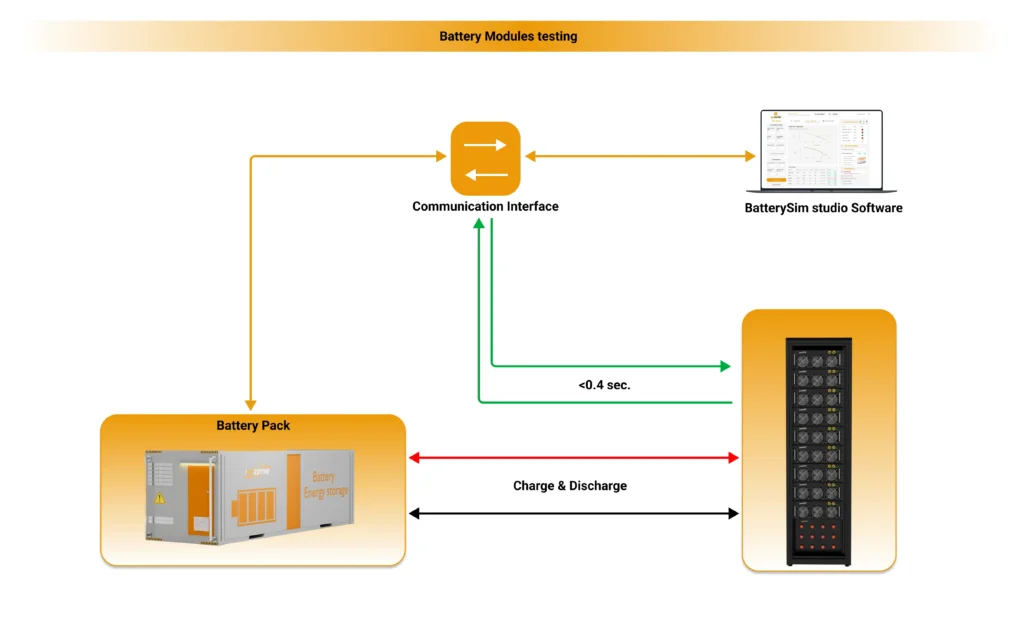
A modern battery management system test bench built for HIL/Power-HIL integrates several coordinated subsystems:

  1. Real-time simulator executing the battery model deterministically (on FPGA and/or CPU).
  2. Cell-voltage emulation providing independently isolated, high-accuracy per-cell voltage outputs that can be series-stacked to reach full pack voltage.
  3. Temperature-sensor emulation (e.g., programmable resistance channels for NTC sensors).
  4. Current-sensor emulation for overcurrent and shunt/Hall-effect signal paths.
  5. A bidirectional DC power stage (for Power-HIL) acting as charger when sourcing and as load when sinking.
  6. Communication interfaces (CAN/CAN FD and others) carrying BMS messages, with fault-injection capability.
  7. Synchronization and I/O: high-speed analog and digital I/O plus deterministic links to keep every channel time-aligned.
  8. Automation and logging: scripting, data capture, scope, and reporting.

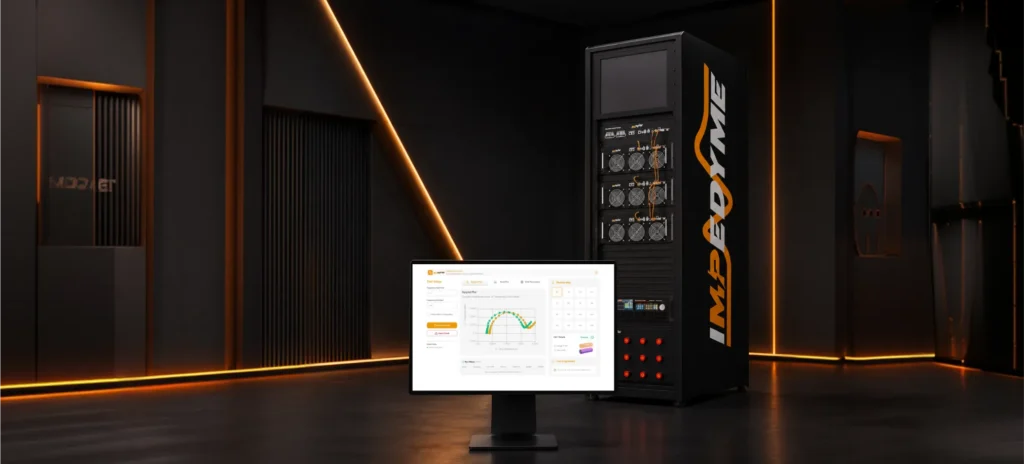
Impedyme’s Power HIL modules are built on embedded FPGA real-time processing units (AMD/Xilinx Zynq UltraScale+) that provide 16 analog input channels and 16 analog output channels at 5 MS/s and 16-bit resolution, 1 MHz waveform data logging accessible through the integrated FPGA Scope, and four SFP+ optical ports per module for deterministic synchronization across multiple units—so a testbed can scale to hundreds of channels while maintaining nanosecond-level timing. Multi-channel signals are directly accessible in MATLAB/Simulink for real-time interaction, parameter tuning, and measurement. The Power HIL Studio environment configures the system, selects FPGA or CPU execution, runs in parallel mode (higher power) or slave mode (synchronized multi-unit testing), and automates entire test sweeps through MATLAB scripting—loops, conditional logic, automated logging, and report generation.

FPGA-Based Real-Time Battery Model Execution: Why Low Latency Matters

The fidelity of any HIL or Power-HIL test depends on how fast and how deterministically the battery model executes. Traditional CPU-based real-time simulators are typically limited to roughly 20–50 kHz update rates by I/O latency, and their timing suffers jitter from scheduling and interrupts. For battery emulation feeding fast protection and balancing loops—and especially for Power-HIL coupled to switching converters—that is often not fast enough or deterministic enough.

This is where FPGAs change the game. Because an FPGA computes the model in massively parallel logic rather than sequential instructions, it achieves extremely small, fixed time steps with sub-microsecond, low-jitter I/O latency. The key benefits for battery management system testing are:

  • Determinism: The controller sees the same fixed delay every run, so a protection trip fires at the same instant every time. That repeatability makes HIL results comparable across builds and teams—essential for regression testing and certification evidence.
  • Fidelity at power: When the emulated battery is coupled through a real converter, microsecond-scale delays change the closed-loop outcome. FPGA execution keeps current feedback and PWM interaction stable.
  • Headroom for complexity: Large series-cell networks and high-order models can run in real time without slowing down.

Impedyme’s FPGA-based HIL integrates processing and I/O on the same chip, achieving simulation steps as fast as 1 µs, and BatterySim Studio runs its battery model on the CHP platform with steps as low as 90 ns, with bandwidth up to 20 kHz and 12.5 Gbps optical links. This nanosecond-class execution is what allows a BMS—or an inverter, charger, or DC-DC converter—to interact with a virtual battery that behaves indistinguishably from the real thing.

Battery Models: Equivalent Circuit vs. Electrochemical

The “battery” the BMS interacts with during testing is a mathematical model. Two families dominate:

Equivalent Circuit Models (ECMs)

ECMs represent the cell as a network of electrical elements—an open-circuit-voltage source that varies with SOC, a series ohmic resistance (R0), and one or more parallel RC pairs capturing charge-transfer and diffusion transients (time constant τ = R1·C1). Variants range from the simple internal-resistance (Rint) and Thevenin models through dual-polarization and higher-order RC networks to Randles and fractional-order models that add Constant Phase Elements and Warburg diffusion. ECMs are computationally efficient, accurate within their calibrated range, and the dominant choice for real-time battery management system testing and HIL emulation. Their parameters depend strongly on SOC, temperature, and aging, so high-quality parameterization is essential.

Electrochemical Models

Electrochemical models describe the underlying physics—lithium-ion diffusion and reaction kinetics—from the inside out. They are more accurate and extrapolate better to extreme conditions, but they are computationally heavy and historically difficult to run in real time. They are most valuable for cell design, degradation studies, and fast-charge optimization.

A powerful complement to time-domain models is Electrochemical Impedance Spectroscopy (EIS), which characterizes a cell’s complex impedance across frequency to reveal aging, internal-resistance growth, and degradation invisible to DC testing. BatterySim Studio integrates EIS directly: it performs measurements from sub-Hz to 20 kHz with micro-ohm accuracy, supports 1,000 V+ full-pack measurements, uses multisine and PRBS excitation to capture a full spectrum in seconds, and then automatically fits an ECM—Rint, Thevenin, RC, Randles, and fractional-order models—parameterized by SOC and temperature, ready for Simulink or a BMS algorithm with no manual data transfer. This collapses what is normally a three-tool chain—one for cell modeling, one for impedance measurement, one for BMS testing—into a single MATLAB/Simulink-native workspace.

Applications: EV, ESS, Drone, and Aerospace

Electric vehicles. The flagship use case: validating BMS firmware, contactor and pre-charge logic, balancing, and fast-charge behavior against emulated 400 V and 800 V packs, including drive-cycle SOC estimation and full fault catalogs—at signal level and at full power through Power-HIL.

Stationary energy storage (ESS/BESS). Utility- and commercial-scale storage adds system-level safety and fire-propagation requirements (IEC 62619, UL 1973, UL 9540/9540A, NFPA 855) and demands testing of grid-tied inverters and energy-management controllers. Megawatt-class Power-HIL emulates full racks so EMS and BMS behavior can be validated without staging a costly battery yard.

Drones and UAVs. Modern unmanned platforms place extreme demands on batteries—high peak currents, power-intensive missions, and accurate SOC estimation under dynamic loads with rapid thermal response. Emulation lets developers validate drone BMS behavior across mission profiles and fault conditions safely.

Aerospace and eVTOL. Electric aircraft energy-storage systems combine large lithium-ion modules with a BMS under the highest reliability and availability requirements; a thermal event with no possibility of emergency landing is catastrophic. HIL and Power-HIL provide the repeatable, documented, safe test coverage these safety cases require.

Best Practices and a BMS Validation Workflow

  1. Shift left. Begin with SIL on the control algorithms and battery model, then move to HIL and Power-HIL. Make real-time HIL the center of the program from day one to cut prototype rebuilds and schedule.
  2. Match model fidelity to the question. Use an ECM whose order captures the electrical and thermal dynamics your controller expects, including cell-to-cell variation and contact resistance; add aging hooks for SOH-threshold testing.
  3. Parameterize from real data. Tie model parameters to measured cell data (EIS-fitted ECMs are ideal) and keep parameter sets under version control, traceable to pack build data.
  4. Honor the interfaces. Ensure emulated signals respect the BMS’s sample rates, quantization, filtering, and accuracy requirements—millivolt-level cell voltages and correct CAN timing.
  5. Automate fault catalogs. Script comprehensive fault sweeps (overvoltage, undervoltage, overcurrent, overtemperature, imbalance, sensor and communication faults) and run them as nightly regressions with automated pass/fail logging.
  6. Validate at power. Use Power-HIL to confirm contactor, pre-charge, charger, and converter interaction under production electrical conditions.
  7. Preserve evidence. Keep models, interfaces, and test records consistent and audit-ready for ISO 26262, UN ECE R100, UL, and ESS standards.

Build a Faster, Safer BMS Validation Program with Impedyme

Battery management system testing is no longer a late-stage checkbox—it is the core engineering discipline that determines whether a battery product is safe, certifiable, and on schedule. Real batteries make thorough BMS validation slow, dangerous, and irreproducible. Battery cell emulation, hardware-in-the-loop and Power-HIL testing, high-fidelity battery models, and FPGA-based real-time execution together solve that problem—turning weeks of risky physical testing into automated, repeatable, fault-rich validation that produces the evidence regulators and OEMs demand.

Impedyme brings all of it into one workspace. BatterySim Studio unifies EIS measurement, automatic ECM fitting, real-time HIL and Power-HIL emulation, and live fault diagnostics in a MATLAB/Simulink-native environment, running on the FPGA-based CHP platform with nanosecond-class time steps and scaling from a benchtop coin cell to a megawatt traction pack. Whether you are validating an EV BMS to ASIL D, characterizing an ESS rack, or qualifying an aerospace battery, Impedyme’s PowerHIL Studio and CHP hardware give your team the speed, fidelity, and safety to ship with confidence.

Frequently Asked Questions

How does battery emulation improve BMS testing?

Battery emulators let engineers test BMS firmware under realistic charge/discharge and fault conditions—overvoltage, overcurrent, temperature limits, imbalance, and communication faults—without risking physical cells, while delivering perfect repeatability across firmware revisions.

What is the difference between HIL and Power-HIL for BMS testing?

HIL delivers signal-level cell voltages, temperatures, and currents to the BMS controller. Power-HIL routes the real-time battery model through a bidirectional converter so the emulated pack delivers real current and voltage, enabling validation of contactors, chargers, converters, and inverters at full power.

Why does FPGA-based execution matter for battery emulation?

FPGAs provide deterministic, sub-microsecond, low-jitter timing and very small time steps (down to nanoseconds), so the emulated battery interacts stably with fast control and protection loops and produces repeatable, certification-grade results.

Can battery emulation completely replace real batteries?

For development and validation phases, emulation can replace real batteries for electrical-behavior testing. Final certification still requires some physical testing, but the overwhelming majority of BMS validation work is faster, safer, and more thorough with emulation.

Which standards drive BMS testing requirements?

ISO 26262 (ASIL D functional safety and fault injection) and UN ECE R100 for road vehicles; UL 2580 for EV battery systems; IEC 61508 as the functional-safety foundation; and IEC 62619, UL 1973, UL 9540/9540A, and NFPA 855 for stationary energy storage.