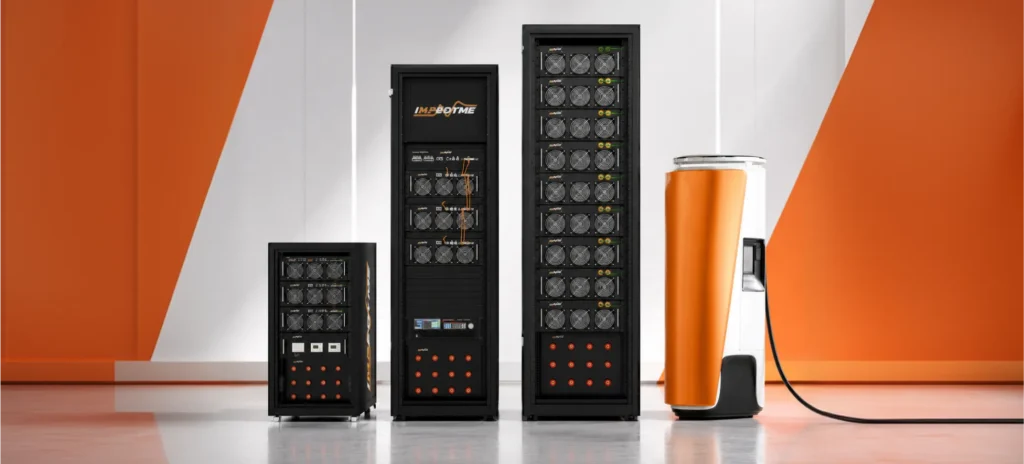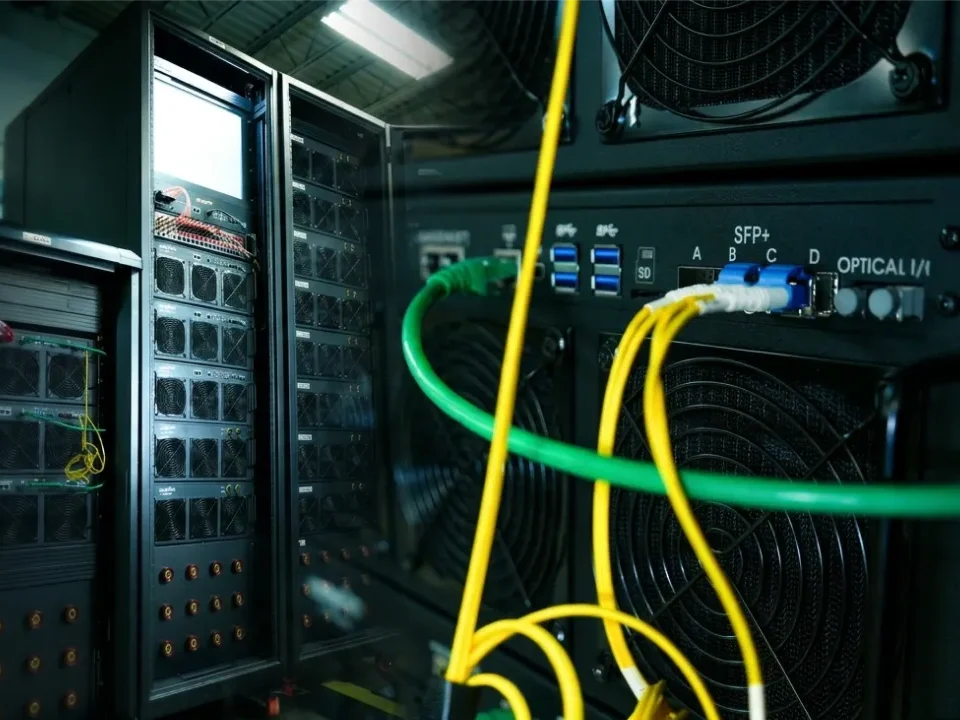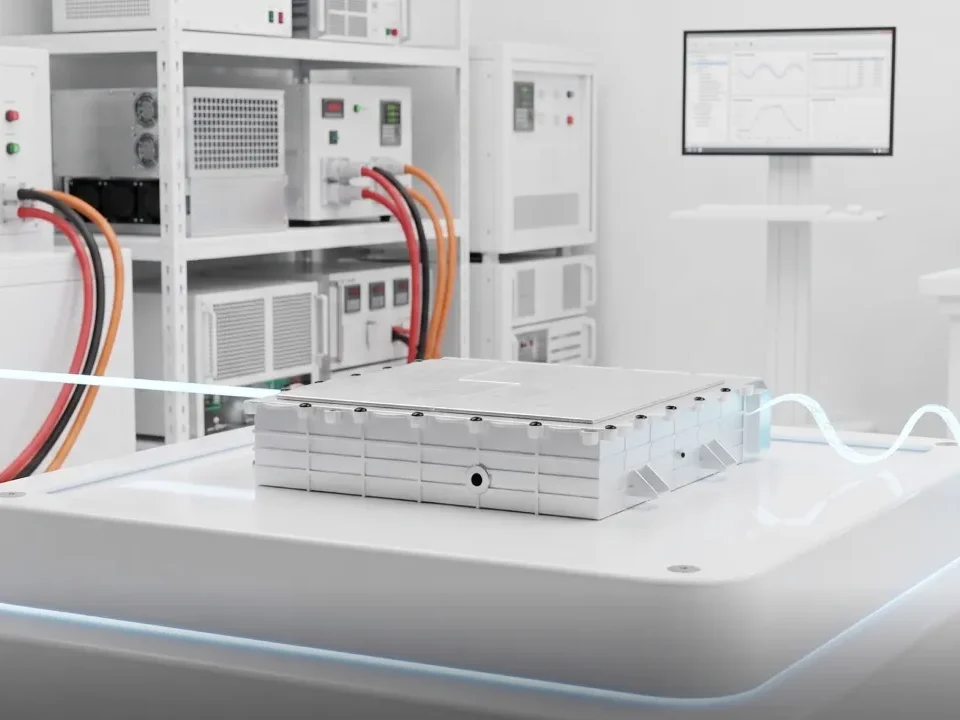

server dc converter testing header card
server dc converter testing header

DC-DC Converter Testing : Ensuring Efficiency and Reliability

DC-DC converter testing is the discipline of proving that a power converter does what its datasheet promises — efficiently, reliably, and safely — across every operating condition it will ever face. A converter that looks perfect at a single bench point can oscillate under a different load, lose half its phase margin when its output capacitor derates at real DC bias, or thermally shut down inside an enclosure it was never characterized in. The job of a rigorous DC converter testing program is to find those failures in the lab, not in the field.

At Impedyme, we build the hardware-in-the-loop and power emulation tools that engineering teams use to validate power electronics faster and with far less risk. This guide walks through the full landscape of DC-to-DC converter testing — the core measurements, how requirements change by topology, the specific demands of server DC converter testing, and how 电力硬件在环(PHIL) is reshaping the way modern converters are validated.

Why DC-DC Converter Testing Matters

Every electronic system that converts one DC voltage to another depends on a converter behaving predictably. In an electric vehicle, a DC-DC stage steps the traction battery down to power the 12 V and auxiliary rails. In an AI server, a cascade of converters takes 48 V down to sub-1 V at thousands of amps to feed a GPU. In a drone, an ESC and its supply rails must survive aggressive transients without browning out the flight controller.

A converter failure rarely stays contained. An unstable control loop injects noise that corrupts a sensitive analog rail. A slow transient response causes a processor to crash under a load step. An undetected protection-threshold error turns a routine fault into a destroyed board. Comprehensive DC-DC converter testing exists to catch these interaction failures before they propagate — and the more power and the higher the stakes, the more thorough that testing has to be.

The Core DC Converter Testing Methods

A complete DC to DC converter test campaign is not a single measurement. It is a battery of complementary tests, each exposing a different aspect of the converter’s behavior. The strongest test programs run every one of these across the full input-voltage and load range, not at a single nominal point.

效率

Efficiency is the headline number, and it is deceptively hard to measure well. Because efficiency is the ratio of output power to input power, the loss is a small difference between two large quantities. To resolve the loss of a 95%-efficient converter to within 5%, voltage and current must be measured to roughly 0.06% accuracy at both ports. That demands four-wire Kelvin sensing to eliminate lead-resistance error, synchronized voltage and current acquisition, and tightly characterized shunts or transducers.

The electrical method — measuring V and I at the input and output simultaneously — covers the vast majority of cases. For converters pushing past 99%, where electrical accuracy runs out of headroom, calorimetric measurement of dissipated heat becomes the more trustworthy approach, immune to the phase and timing errors that plague electrical methods at very high efficiency. Either way, efficiency should be swept across load and line and plotted as a curve, because a converter optimized for peak efficiency can fall apart at light load.

Line and Load Regulation

Load regulation measures how far the output drifts as the load is swept at a fixed input voltage. Line regulation measures output drift as the input voltage is swept at a fixed load. Both are reported as a percentage deviation against spec, and both rely on four-wire sensing so that the regulation of the converter is measured rather than the resistance of the test leads.

Output Ripple and Noise

Output ripple sits at the millivolt level, which means measurement technique dominates the result. Best practice is to limit the oscilloscope bandwidth to 20 MHz, use a tip-and-barrel (“paperclip”) probe connection to minimize the ground loop, and add a small capacitor network at the probe point — a common arrangement pairs a 10 µF tantalum with a 0.1 µF ceramic — to represent realistic local decoupling. Ripple and noise should be captured at full load across the input range, and spectral analysis reveals the switching fundamental and its harmonics.

Load Transient Response

Real loads do not change slowly. A processor can swing from idle to full draw in microseconds, and the converter must hold its output inside the regulation band through that step. Load transient testing applies a fast load step and measures the output voltage deviation (undershoot and overshoot) and the recovery time back to regulation.

The step has to be genuinely fast — its rise time must be much shorter than the converter’s loop response — or it simply will not excite the control loop hard enough to reveal anything. A properly sharp load step is one of the most powerful diagnostic tools in DC-DC converter testing precisely because it stimulates the loop across a wide frequency band at once, exposing marginal stability, input-supply ringing, and layout-parasitic problems that a static measurement would never surface.

Control Loop and Stability Testing

Stability is where many converters quietly fail. The definitive test measures the open-loop transfer function of the closed-loop converter by injecting a small AC signal across a series resistor in the feedback path and sweeping it with a frequency response analyzer to produce a Bode plot. From that plot you read the crossover frequency, the phase margin, the gain margin, and the gain slope through 0 dB. Useful rules of thumb: crossover around one-tenth of the switching frequency, phase margin of at least 45°, and a −20 dB/decade slope through crossover.

Stability is not a fixed property. Margins shift with load and with temperature, and they shift with components you might not suspect — a multilayer ceramic output capacitor can lose well over half its nominal capacitance under real DC bias, dragging the loop bandwidth up and collapsing the phase margin to a fraction of its datasheet value. A converter that passed at room temperature and nominal bias can be marginally stable in the field. There is also a system-level failure mode: when the source impedance feeding the converter is not small compared to the converter’s input impedance, the front end can oscillate even though the converter itself is fine in isolation. That interaction is invisible to any test that uses an ideal bench supply as the source.

Soft-Start, Protection, and Thermal Testing

Three more tests round out a thorough program. Startup and soft-start testing verifies turn-on time, controlled inrush current, monotonic output ramp without overshoot, and correct power sequencing into a range of loads and output capacitances. Protection testing confirms that over-current (OCP), over-voltage (OVP), over-temperature (OTP), short-circuit, and undervoltage-lockout behaviors trip at the right thresholds and recover correctly — tests that flirt with the converter’s destruction limits and therefore reward an energy-limited test interface. Thermal testing places thermocouples at the hottest junctions (switching FETs, transformer, rectifier, PCB), controls airflow and orientation, and builds derating curves, because dissipation changes with input voltage and the converter must stay below its thermal limits everywhere it operates.

DC-DC Converter Testing by Topology

The test plan above is universal, but each topology stresses different parts of it.

  • Buck (step-down): The workhorse. Focus on regulation, efficiency across load, current-mode loop stability and slope compensation, capacitor DC-bias derating, and fast-transient behavior for point-of-load rails.
  • Boost (step-up): The right-half-plane zero fundamentally limits achievable loop bandwidth, so stability characterization and inductor current-stress testing take priority.
  • Buck-boost / SEPIC: Wide input range means testing must cover the full Vin span, with attention to the noise and regulation trade-offs near the transition region.
  • Flyback: Isolated and low-power; test transformer leakage, snubber design, cross-regulation between outputs, and ripple.
  • LLC resonant: Soft-switching delivers high efficiency, but gain and efficiency vary strongly with switching frequency and load, and light-load efficiency suffers from circulating current. Characterize the gain curves, the ZVS boundaries, and frequency control across the full load and line range.
  • Phase-shifted full bridge (PSFB): Test the zero-voltage-switching range, circulating current, duty-cycle loss, and transformer and rectifier stress.
  • Dual Active Bridge (DAB): Bidirectional and isolated, with power transfer set by the phase shift between two full bridges across a high-frequency transformer. Testing a DAB means validating the phase-shift modulation scheme, the ZVS range, soft-start transformer current, efficiency across voltage-gain ratios, minimization of reactive circulating current, and — critically — the dynamics of reversing power flow. Because the control is intricate and the energy levels are high, DAB converters are increasingly validated in real-time simulation before any hardware is energized, which is exactly where Impedyme’s PHIL platform earns its place.

High-Precision Efficiency and Loss Verification Methodologies

As power densities increase, power supply designers target efficiencies exceeding 95% and 98%. Consequently, verifying minor design improvements requires highly precise measurements.

Mathematical Error Propagation in Efficiency and Loss Analysis

When evaluating high-efficiency converters, calculating absolute power loss provides a clearer picture of thermal performance than focusing solely on the efficiency percentage :

$$P_{\text{Loss}} = P_{\text{IN}} – P_{\text{OUT}}$$

For a converter designed to operate at 95% efficiency (η = 0.95), the internal power loss represents 5% of the total input power. If an engineer aims to measure this 5% power loss with a maximum error margin of 5%, the absolute accuracy required for the loss calculation is:

$$\text{Required Accuracy of } P_{\text{Loss}} = 5\% \times 5\% = 0.25\% \text{ of the total power}$$

Standard digital multimeters (DMMs) and electronic loads often exhibit measurement offsets, shunt resistance changes, and thermal drift that exceed these strict limits. For instance, a small 12mA offset in an electronic load’s current readback can introduce severe percentage errors at light loads, distorting the lower end of the efficiency curve.

Implementation of Precision Current Shunts

To achieve the precision required for high-accuracy dc to dc converter test environments, standard electronic load current readbacks should be bypassed in favor of external, high-precision current shunts. Impedyme recommends using two identical current shunts—one on the input rail and one on the output rail. By utilizing identical shunts, any systematic or environmental measurement variations can be balanced out.

These shunts must feature extremely low temperature coefficients (typically 0.02% or less over a 20°C to 70°C operating range) to prevent resistance changes from thermal heating during high-current testing. Designers can perform a quick calibration by linking the converter’s input directly to its output, running a sweep across the current range, and comparing the shunt readbacks to zero out any residual offset or gain errors.

Instrument Consolidation via Source-Measure Units (SMUs)

To reduce the complexity of multi-instrument test racks, Impedyme recommends consolidating separate power supplies, electronic loads, and DMMs into a unified, high-performance system. This is achieved using the Impedyme Series 2600B System SourceMeter SMU or the Impedyme NGM202/NGL202 Power Supplies.

dc dc converter testing impedyme

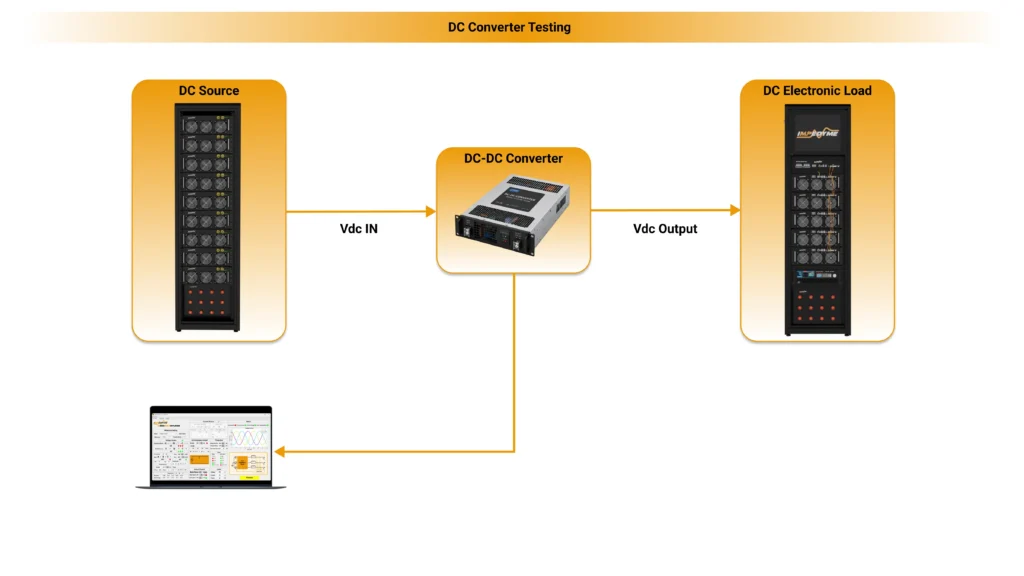
A typical DC-DC converter test setup. Power flows from a programmable DC source into the converter under test (Vdc IN), through the converter, and into a DC electronic load that draws the output (Vdc Output). Rather than relying on an idealized supply and a passive resistor, Impedyme’s platform emulates a realistic source on the input and a dynamic, regenerative load on the output — all configured and orchestrated from GridSim Studio. This lets engineers reproduce the real electrical environment the converter will meet in the field, run efficiency, regulation, transient, and protection sequences automatically, and capture every result for traceability.

Server DC Converter Testing

Server and datacenter power is its own world, and server DC converter testing has become one of the most demanding corners of the field. The architecture has shifted from distributing 12 V to distributing 48 V — and the industry is now beginning to look toward 800 V HVDC distribution — all to cut the resistive losses that dominate at high current.

The efficiency payoff is real and well documented. Hyperscale 48 V rack architectures have demonstrated efficiency improvements on the order of 30% simply by eliminating conversion steps, along with a sharp reduction in distribution losses compared with 12 V. The catch is that conventional two-stage 48 V-to-12 V-to-load conversion has historically peaked around 90% efficiency — which is what drove the development of high-efficiency intermediate bus converters and single-stage 48 V-to-point-of-load designs.

Those intermediate bus converters (IBCs) are typically unregulated 4:1 fixed-ratio stages, and the best of them are remarkable: leading 48 V-to-12 V designs now reach peak efficiencies above 99%, with full-load efficiency in the high-90s. Switched-tank and hybrid switched-capacitor topologies have pushed 48 V-to-12 V conversion firmly into the 98–99% range, and multi-phase coupled-inductor stages routinely deliver close to 98% at full load while supporting fast transient response.

At the bottom of the cascade, the VRM or point-of-load stage steps 12 V (or 48 V directly) down to a sub-1 V core voltage at thousands of amps for a CPU, GPU, or ASIC. Vertical power delivery now pushes current levels toward 100 kA at core voltages in the region of 0.75 V to 0.85 V. Testing here is brutal: millivolt-level deviation tolerances, extreme di/dt transients, current sharing across many phases, and PMBus/AVSBus communication between the converter and the processor it feeds. Industry onboard-power specifications give concrete targets — a load-transient voltage deviation budget around 3% of the output, an output rise time under 10 ms, and a defined current step on the order of 10 A/µs — exactly the kind of spec a server DC converter testing plan must verify.

Looking ahead, emerging 800 VDC datacenter architectures are expected to improve end-to-end efficiency by several percent and to target megawatt-class racks within the next few years, with high-voltage converters already being announced for the transition. These are roadmap targets rather than deployed measured results today, but they signal where high-power DC converter testing is heading — and why test platforms need the bandwidth and power range to follow.

Control Loop Stability and Environmental Robustness Characterization

Ensuring absolute loop stability across a converter’s entire operating envelope requires evaluating its open-loop transfer function within a closed-loop system. This prevents unstable control loop states that can cause catastrophic system failures.

AC Injection Loop Stability Methodology

Because breaking the physical feedback loop of an active converter prevents the controller from regulating the output, loop stability is measured by injecting a small AC disturbance into the closed-loop system. The Impedyme 3225 Frequency Response Analyzer (FRA) injects a swept-frequency AC disturbance voltage across a small-value injection resistor (10Ω to 200Ω) placed in series with the feedback loop path, typically between the output rail and the high-side feedback divider resistor.

The FRA sweeps a small-signal sinusoidal disturbance across a broad frequency band while measuring the input and output response at the injection nodes. From this data, the system plots the open-loop gain (in dB) and phase angle (in degrees) as a function of frequency, producing a Bode plot to evaluate the system’s phase and gain margins.

Alternative Stability Metrics for Closed-Lid Converters

In high-reliability aerospace applications, hybrid space-grade DC/DC converters are hermetically sealed, making physical access to internal feedback nodes impossible. For these “closed-lid” modules, Impedyme utilizes two alternative non-invasive stability evaluation methodologies :

  1. Input Impedance Measurement : By measuring the converter’s input impedance across frequency, engineers can map negative input resistance characteristics. At low frequencies, a switching regulator behaves as a negative resistance : as input voltage increases, input current drops to maintain a constant power output. If this negative input resistance mismatches with the output impedance of the upstream power supply filter, low-frequency front-end oscillations (typically ranging from 600 Hz to 2 kHz) can occur, which can damage the module.
  2. Channel Power Spectral Density Analysis: This non-invasive method acts as a feedback-loop instability indicator. By evaluating the converter’s input voltage noise spectrum with a high-performance spectrum analyzer, engineers measure the total Channel Power magnitude (in dBm) at the phase-crossover frequency (where the loop phase reaches). This method can identify micro-oscillations and low-level loop instabilities that are otherwise invisible on a standard oscilloscope.

Extreme Thermal Environmental Profiling

For aerospace and defense applications, converters must remain stable across military-grade temperature envelopes, typically from −55°C to 125°C. In cryogenic or deep-space missions, this envelope is extended down to −140°C, a region where many commercial and industrial-grade silicon semiconductors fail.

Extreme temperature fluctuations alter internal semiconductor parameters, switching characteristics, and passive component values. These shifts can degrade control loop stability and drift the converter’s switching frequency.

From the Bench to Power Hardware-in-the-Loop

Everything above can be done on a traditional bench: a precision source, an electronic load, a frequency response analyzer, an oscilloscope, and a lot of manual reconfiguration. That approach works, but it has hard limits. The source is an idealized supply, not the real battery or grid the converter will actually see. The load is a passive sink, not a living system that pushes back. Dangerous fault conditions are risky to stage on a full prototype. And every test condition is set up by hand.

Power Hardware-in-the-Loop changes the economics of DC-DC converter testing. In a PHIL setup, a real-time simulation runs a high-fidelity model of the converter’s environment, and a bidirectional power amplifier sources and sinks real current and voltage to the device under test — preserving the natural electrical coupling that signal-level HIL cannot reproduce. The converter does not know it is being tested against a model; it sees real power.

This unlocks tests that are impractical or unsafe otherwise:

  • Source emulation instead of an ideal supply. Rather than feeding the converter from a stiff bench supply, Impedyme’s BatterySim StudioGridSim Studio emulate a real battery, grid, or PV source — with its actual impedance, state of charge, sag, ripple, and fault behavior. This is the only way to reproduce the front-end interaction instabilities that emerge when source impedance is not negligible, the failure mode that no ideal-supply DC converter testing can ever reveal.
  • Realistic, regenerative loads. A motor, a grid tie, or another converter on the output can be emulated as a closed-loop model rather than a passive resistor, so the converter is exercised against the dynamics it will really meet.
  • Safe fault injection. Short circuits, voltage sags, ground faults, and protection-threshold edge cases can be injected through an energy-limited interface and repeated identically, scripted run after run — turning protection testing from a destructive gamble into a repeatable measurement.
  • Closed-loop fidelity at power. For intricate, high-power topologies like DAB and resonant converters, the control scheme can be validated against a faithful real-time plant before the full hardware is ever energized.

Getting PHIL right is an engineering problem in itself, and it is one Impedyme’s platform is built around. The real-time simulator’s time step must be roughly an order of magnitude smaller than the fastest signal it has to represent — for a 100 kHz converter, that means a step on the order of half a microsecond to a microsecond. Impedyme’s FPGA-based CHP platform combines controller-HIL and Power-HIL with update rates fast enough to keep that loop accurate and stable, and the power amplifier characteristics — response time, gain flatness, and phase delay — are specified to keep the PHIL interface from introducing its own instabilities.

Automated Characterization and Reporting

The final differentiator between a good test program and a great one is automation. Manually stepping through every combination of input voltage, output current, and temperature, then capturing efficiency, regulation, ripple, transient, and stability data at each point, is slow and error-prone. A modern DC to DC converter test campaign scripts the entire matrix — multi-dimensional sweeps, drive cycles, ramps, and fault sequences — with automated pass/fail criteria and generated reports.

Impedyme’s PowerHIL Studio drives exactly this kind of campaign. Tests are defined once, run unattended across the full operating envelope, and scored against KPIs automatically, with results captured for traceability. Models and sequences integrate with MATLAB/Simulink, so the same plant model used during control design carries through into validation. The result is a characterization process that is faster, more repeatable, and far broader in coverage than any manual bench routine — and one that scales from a single converter on an engineer’s desk to a full validation rig.

Validate with Confidence Using Impedyme

DC-DC converter testing has outgrown the single-bench-point mindset. Efficiency curves, loop stability across real operating bias, fast transient response, protection behavior under genuine fault conditions, and the increasingly punishing demands of server and EV power all have to be proven across the full envelope — and increasingly against a realistic, emulated environment rather than an idealized supply and a passive load.

That is what Impedyme is built for. From source and battery emulation that reproduces what your converter will actually be connected to, to the FPGA-based CHP platform that exchanges real power with your device in real time, to PowerHIL Studio’s automated, scripted characterization, Impedyme gives power electronics teams a faster, safer, and more thorough path from design to deployment. PHIL doesn’t replace final system-level testing — it de-risks everything that comes before it, so the hardware you build is the hardware that works.

Ready to accelerate your DC converter testing? Talk to the Impedyme team about a PHIL-based validation workflow tailored to your topology, power level, and application.

Advanced Thermal and Mechanical Evaluation Methods

Validating a converter’s electrical performance must be paired with rigorous thermal and mechanical evaluations, as operating temperatures directly impact reliability and lifespan.

To achieve repeatable results during free convection and forced airflow thermal testing, Impedyme recommends several standard setup procedures :

  • Vertical Orientation: For free convection (still air) testing, the converter under test must be oriented vertically. This ensures that natural thermal buoyancy currents can flow unimpeded across the heat-generating components, preventing localized heat pooling.
  • Complete Pin Soldering: The effectiveness of heat transfer from the internal substrate through the connection pins into the system board is highly dependent on copper board area, layer count, and trace thickness. To maximize heat transfer and simulate real-world conditions, all mechanical and electrical pins—including non-functional, NC (no-connect), or duplicate ground pins—must be fully soldered to the test board.
  • Dynamic Efficiency Tracking: Power dissipation varies with input voltage, typically peaking near the minimum and maximum input voltage limits where switching and conduction losses are highest. Consequently, thermal testing must be executed across the entire input voltage range, rather than relying solely on nominal input voltage levels.
  • Critical Component Thermocouple Placement: Standard infrared thermal imaging cannot always capture temperatures beneath components or inside high-aspect-ratio inductors. To monitor internal temperatures accurately, fine-gauge thermocouples should be physically attached to key component “hot spots,” including :
    1. The power switching MOSFET junctions.
    2. The primary and secondary transformer winding cores.
    3. The secondary rectifier output diodes.
    4. The local PCB substrate directly adjacent to the power stage.

These thermocouple points allow engineers to track component temperatures under varying load profiles, verifying that the converter maintains safe operating margins before triggering its over-temperature protection (OTP) circuit.

conclusion

DC/DC converter testing is essential for ensuring that modern power converters deliver the efficiency, stability, reliability, and protection performance required in real-world applications. From evaluating efficiency, regulation, ripple, and transient response to verifying thermal behavior and control-loop stability, a comprehensive test strategy helps engineers identify issues early in development and prevent costly failures in the field. As power systems become more demanding—particularly in data centers, electric vehicles, renewable energy systems, and industrial applications—the need for accurate and repeatable DC-to-DC converter testing continues to grow.

Impedyme helps engineering teams move beyond traditional bench testing by combining advanced source emulation, battery emulation, real-time simulation, and 电力硬件在环(PHIL) technology. This approach enables more realistic and automated dc dc converter testing, allowing converters to be validated against dynamic operating conditions that closely resemble actual deployment environments. Whether your focus is general dc converter testing, a complex DC to DC converter test campaign, or high-performance server dc converter testing, Impedyme provides the tools and expertise needed to accelerate development, reduce risk, and validate power electronics with greater confidence.


Frequently Asked Questions

How do you measure DC-DC converter efficiency accurately?

Efficiency is a small difference between two large numbers, so measuring the loss of a 95%-efficient converter to within a few percent needs roughly 0.06% accuracy at both ports. That requires four-wire Kelvin sensing, synchronized acquisition, and external precision shunts rather than an electronic load’s readback. Above ~99%, calorimetric measurement of dissipated heat becomes more trustworthy than the electrical method.

Why does a converter that passes on the bench become unstable in the field?

Stability isn’t fixed — phase and gain margins shift with load, temperature, and components. A ceramic output capacitor can lose more than half its capacitance under DC bias, collapsing phase margin. There’s also a system-level failure: when source impedance isn’t small relative to the converter’s input impedance, the front end can oscillate even though the converter is fine alone. An ideal bench supply hides this, which is why source emulation with realistic impedance — like Impedyme’s BatterySim Studio and GridSim Studio — is needed to reveal it.

What makes server DC converter testing so demanding?

Server power has moved from 12 V to 48 V distribution, with 800 V HVDC on the roadmap, to cut resistive losses. The point-of-load stage steps down to sub-1 V at thousands of amps, with current pushing toward 100 kA. That means millivolt deviation tolerances, extreme di/dt transients, multi-phase current sharing, and PMBus/AVSBus communication — with specs targeting ~3% transient deviation, sub-10 ms rise time, and 10 A/µs current steps.

How do you test a Dual Active Bridge (DAB) converter?

Testing a DAB means validating its phase-shift modulation, ZVS range, soft-start transformer current, efficiency across voltage-gain ratios, reactive circulating current, and — most critically — the dynamics of reversing power flow. Because the control is intricate and the energy high, DAB converters are increasingly validated in real-time simulation before hardware is energized, which is where a PHIL platform earns its place.

Can you test converter protection features without destroying the board?

Yes. Protection testing — OCP, OVP, OTP, short-circuit, and UVLO — inherently approaches the converter’s destruction limits, which is why an energy-limited interface matters. In a PHIL setup, short circuits, sags, ground faults, and threshold edge cases are injected through a controlled interface and repeated identically, turning protection testing from a destructive gamble into a repeatable measurement.