
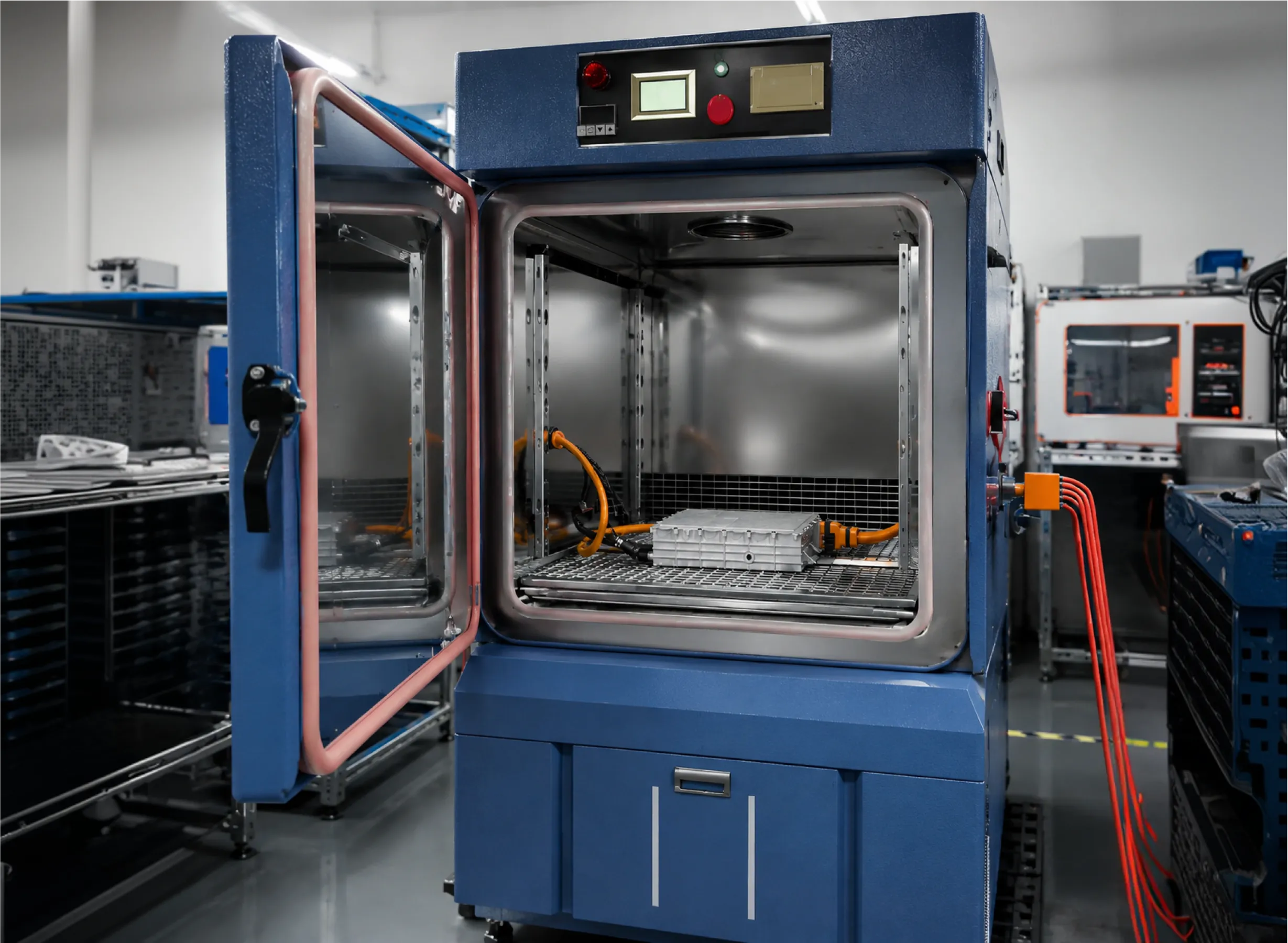
Traction inverters represent the critical junction within modern electrified powertrains, serving as the primary bridge between high-voltage direct current (DC) energy storage systems and multi-phase alternating current (AC) traction motors. Consequently, comprehensive electric vehicle inverter testing is paramount to ensure operational efficiency, electromagnetic compatibility (EMC), functional safety, and long-term mechanical reliability under harsh automotive conditions. As vehicle architectures transition to higher voltages and faster switching speeds, traditional testing methods face significant technical limitations. This report provides an in-depth examination of inverter testing fundamentals, high-frequency motor terminal dynamics, parasitic bearing degradation, global regulatory frameworks, and how advanced 电力硬件在环(PHIL) emulation systems are revolutionizing modern validation workflows.
An inverter converts DC power into controlled AC power, and in most modern systems it manages power flow bidirectionally between the DC and AC domains. Inverter testing is the structured process of confirming that this conversion happens to specification across the full range of input conditions, output demands, environmental stresses, and fault scenarios the device will encounter.
Inverter testing isn’t a single step. It applies throughout the product lifecycle — from early control-algorithm development, through design verification and certification, all the way to high-volume end-of-line production testing. A control bug caught during algorithm development costs almost nothing to fix; the same bug discovered after thousands of units ship can be catastrophic.
Although applications differ, virtually every inverter testing program is built from the same core categories:
A credible inverter testing program addresses all of these, because each one catches a different class of failure. No single measurement proves an inverter is ready.
Evaluating inverter performance requires precise electrical measurements on both the primary-side (DC input) and secondary-side (AC motor terminal) interfaces. Because traction inverters utilize high-frequency Pulse Width Modulation (PWM) to synthesize three-phase sinusoidal currents, the resulting voltage and current waveforms are highly distorted and rich in harmonic content.
On the primary side, measurements focus on input DC voltage, current ripples, and energy consumption under dynamic load shifts. On the secondary side, evaluating true operational parameters requires isolating the fundamental AC wave from the high-frequency switching carrier. Because the secondary-side frequency varies continuously with motor speed, testing instruments must utilize sophisticated, hardware-implemented low-pass filters to extract the fundamental wave values. Utilizing standard true RMS meters without adaptive filtering introduces massive measurement discrepancies, as high-frequency switching harmonics skew power calculations.
Traditional benchtop electrical instruments suffer from extreme limitations when validating modern high-speed inverters. Legacy power analyzers are largely unable to capture high-frequency transients, as they are calibrated primarily for standard grid frequencies and operate by averaging power calculations over fixed cycles. If an inverter operates at a switching frequency of twenty kilohertz or higher, capturing just ten harmonics of that carrier frequency requires an analog bandwidth of at least two-hundred kilohertz and a continuous sampling rate exceeding five-hundred kilohertz.
Furthermore, cycle-averaged metrics fail to record raw, high-resolution waveforms. Capturing and storing raw time-domain data is critical for post-test analysis, enabling engineers to identify transient overvoltage spikes, localized phase shifts, and high-speed switching losses that occur within sub-cycle intervals. Without high-bandwidth, multi-channel transient recording, these destructive microsecond-scale phenomena remain undetected, leading to unexpected field failures.
| Measurement Interface | Primary Evaluation Parameters | Mandatory Instrument Specifications | Key Challenges Addressed |
|---|---|---|---|
| Primary-Side (DC Bus) | Input voltage, DC current ripple, dynamic energy consumption, and bus voltage stability. | High-voltage DC probes, high-precision current sensors, and continuous transient logging. | Capturing DC-link voltage sags and high-frequency ripples induced by dynamic load shifts. |
| Secondary-Side (AC Terminals) | Active power, phase-to-phase voltage, fundamental frequency, current harmonics, and power factor. | True RMS meters, adaptive hardware-implemented low-pass filters, and high-bandwidth current clamps. | Isolating the fundamental AC wave from high-frequency switching carriers to prevent measurement skew. |
| Dynamic Electromechanical | Continuous torque-per-ampere tracking, transient speed changes, and cycle-by-cycle efficiency mapping. | Integrated torque/speed sensor interfaces and multi-channel high-speed synchronization. | Correlating fast electrical transients directly with mechanical outputs to reduce measurement uncertainty. |
EV inverters are critical for vehicle motion and efficiency, so testing aims to validate every crucial parameter. Typical performance tests measure output voltage/current waveforms, switching frequencies and timing, conversion efficiency at various loads, and dynamic response to control commands. For instance, one industry source notes that inverter testing focuses on “output voltage and current waveform quality, switching frequency, efficiency, thermal performance, electromagnetic interference (EMI), and response to various load conditions.”. Accurate waveform measurement (with true-RMS meters and oscilloscopes) is vital because inverter PWM outputs contain high-frequency components. Testing also examines electrical losses and efficiency across the operating range: manufacturers sweep motor speed and torque (or emulate it) and record power in/out to map efficiency. Thermal tests record junction or case temperature under load to verify cooling design.
Other key checks include insulation and leakage testing (to ground) at specified voltages, and protection function tests (over-current, over-voltage, short-circuit response). For example, insulation resistance is typically measured by applying ~500 V DC and ensuring resistance stays above several megaohms (e.g. >5 MΩ). Control algorithms are validated by stepping through speed/torque commands and ensuring smooth, accurate tracking. All these parameters help identify inefficiencies, hidden losses, or design flaws before inverters are deployed. As one guide explains, correlating mechanical output (torque, speed) with electrical input allows engineers to pinpoint drive losses and performance bottlenecks.
Key performance metrics include power conversion efficiency vs. load, output waveform distortion/THD, switching transition losses, control accuracy, and safe operation limits (max current/voltage).
Test result uses: R&D validation (optimizing design), production QA (end-of-line checks), warranty failure analysis, and field diagnostics.
The EV traction inverter is arguably the most demanding inverter to validate. It converts DC from the high-voltage battery into the three-phase AC that drives the traction motor, and it controls motor speed, torque, and direction while also handling regenerative braking, where energy flows back from the motor to the battery. Electric vehicle inverter testing therefore has to reproduce a tightly coupled, fast-moving system rather than a static load — and that is what sets it apart from almost every other kind of inverter testing.
Several factors make EV inverter testing uniquely challenging:
The market context raises the stakes. The traction inverter market is on a steep growth curve, with broad industry estimates placing it on a trajectory from roughly the low-teens of billions of dollars today toward the mid-forties of billions within the next decade — a compound annual growth rate close to 17%. That growth is driven by the shift to 800 V SiC-based platforms that enable faster charging and longer range, and by automakers bringing inverter development in-house. As power levels climb past 100 kW and beyond, the gap between what bench instruments alone can reveal and what the inverter actually needs to survive widens — which is precisely where emulation-based validation earns its place.
Inverters that connect to the electrical grid — solar PV inverters, energy-storage converters, and other inverter-based resources — face a different but equally rigorous battery of tests, focused on how they interact with the utility:
A common thread runs through PV/grid and EV inverter testing alike: the most valuable and most difficult conditions to create are the abnormal ones — weak grids, faults, resonances, and transients. These are exactly what a programmable emulator can produce on demand, and exactly what physical test setups struggle to reproduce safely and repeatably.
To mitigate these electrical, thermal, and mechanical risks, traction inverters must undergo rigorous testing to comply with international automotive standards. The compliance landscape is divided between EV-specific standards and utility-scale renewable standards.
The three primary pillars of electric vehicle inverter testing and validation are UN ECE R100, LV 123, and ISO 26262.
UN ECE R100 is a binding United Nations regulation governing the safety requirements of high-voltage powertrains (defined as components operating above sixty volts DC or thirty volts AC) in Category M and N motor vehicles. For traction inverters, compliance with Annex 9 is a non-negotiable prerequisite for European type approval.
The regulation mandates rigorous validation of the inverter’s electrical protection barriers. Specifically, a test voltage of five-hundred volts is applied between all high-voltage active terminals and the electrical chassis ground, requiring the measured isolation resistance to be at least five megohms.
Furthermore, the inverter must demonstrate structural and operational resilience under extreme physical abuse. It is subjected to thermal shock and cycling tests, heavy mechanical vibration profiles designed to simulate life-of-vehicle road vibrations, and high-intensity mechanical shock tests. Electrical abuse tests mandate that the inverter’s internal control interlocks actively prevent overtemperature conditions, short circuits, and overcurrent events without presenting a risk of electrical shock or thermal propagation.
| Annex 9 Test Module | Test Name | Specific Technical Requirement | Core Safety Objective |
|---|---|---|---|
| Annex 9A | Vibration Testing | Swept sine and random vibration profiles mapped to life-of-vehicle road vibrations. | Ensures mechanical stability of internal busbars and solder joints under continuous driving stress. |
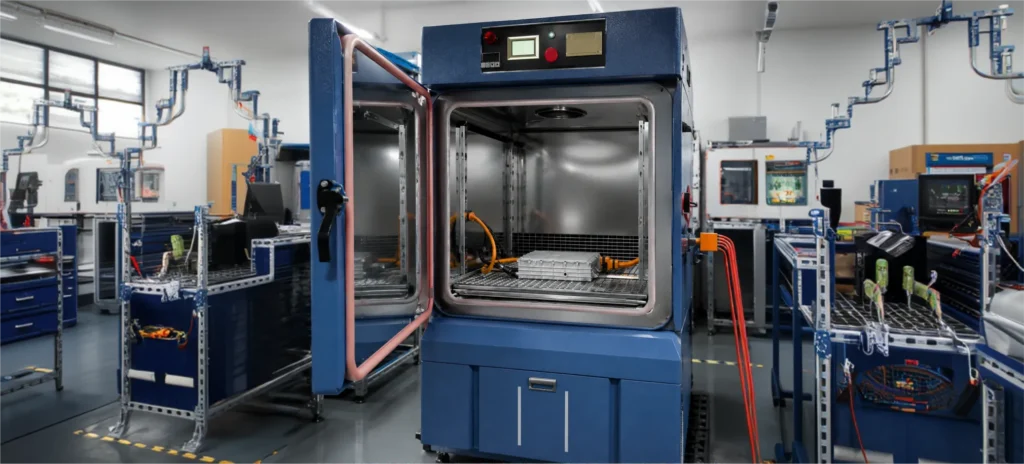
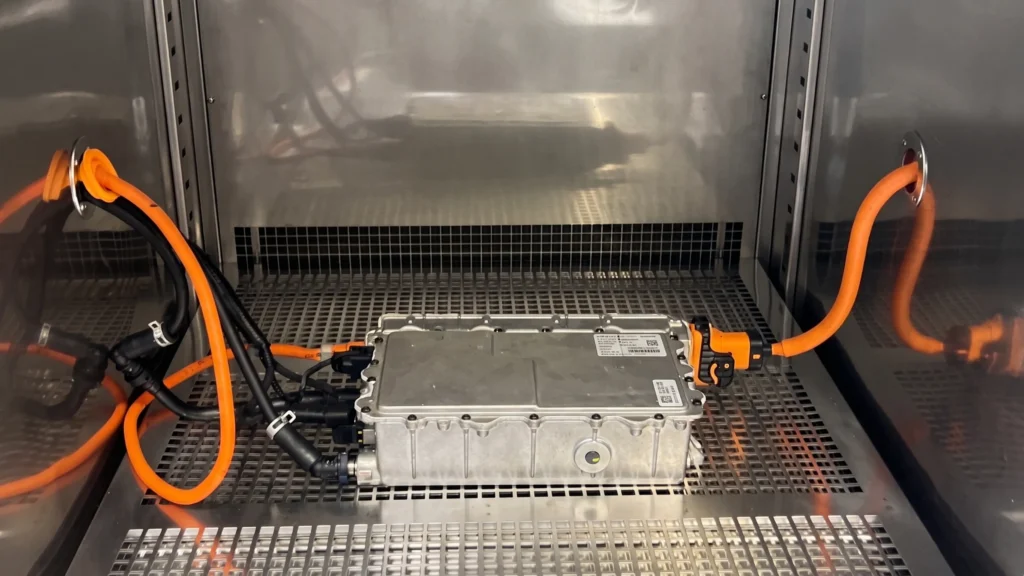
| Annex 9B | Thermal Shock & Cycling | Rapid thermal transitions between extreme temperature limits (-40°C to +85°C). | Verifies structural integrity of internal seals, thermal paste, and multi-layer board layouts. |
| Annex 9C & 9D | Mechanical Shock & Integrity | Severe physical impact deceleration profiles and crushing force applications. | Guarantees the high-voltage enclosure does not rupture or short-circuit during a severe crash. |
| Annex 9E | Fire Resistance | Direct external flame exposure requiring the assembly to withstand fire without rupturing for at least one minute. | Provides critical egress time for occupants to safely evacuate the vehicle during a thermal event. |
| Annex 9F to 9J | Electrical & Functional Safety | Overcharge, over-discharge, external short circuit, overtemperature, and overcurrent protections. | Validates that the inverter’s control software and active interlocks safely disconnect power during faults. |
Originally drafted by German automotive OEMs, LV 123 has become the globally recognized standard for verifying the electrical safety, operational limits, and EMC of high-voltage components in electric and hybrid vehicles. The standard defines precise, standardized test procedures to evaluate inverter behavior during severe electrical transients, including dynamic voltage changes, rapid load shedding (load dumps), high-frequency voltage ripples on the DC bus, and offset voltage variations.
A core mechanism of LV 123 testing is the categorization of the Device Under Test (DUT) into specific High-Voltage (HV) status levels (B0 to B4) based on its operational capability during voltage deviations.
These status levels represent the following operational states:
LV 123 requires the inverter to withstand steep transient interferences and load dumps. For instance, a load dump pulse—simulating the sudden disconnection of a high-current load—requires the test system to generate high-speed voltage rises, with rise times as fast as one microsecond and voltage gradients reaching three-thousand volts per millisecond. These tests verify that the inverter’s input DC-link capacitor, busbars, and semiconductor switches can survive severe overvoltage spikes without dielectric breakdown or thermal failure.
ISO 26262 is the overarching international standard for functional safety in road vehicles, focusing on mitigating risks caused by systematic faults or random hardware failures in electrical and electronic systems. For the traction inverter—the sole controller of vehicle acceleration and deceleration—functional safety is of paramount importance, typically requiring compliance with the most stringent level, Automotive Safety Integrity Level D (ASIL D).
The ISO 26262 implementation lifecycle for traction inverters begins with a Hazard Analysis and Risk Assessment (HARA), which identifies potential hazards resulting from system malfunctions under various operating conditions. For instance, an unintended torque production event (such as un-demanded acceleration from a standstill) is assigned an ASIL D rating because its severity is extremely high (fatal or life-threatening injuries), exposure is high (common driving situations), and controllability is extremely difficult.
To mitigate these risks, engineers establish clear Safety Goals and systematically cascade them into Functional Safety Requirements (FSRs) and Technical Safety Requirements (TSRs). These requirements dictate the integration of robust electronic and software-based safety mechanisms :
Traditional inverter testing depends on assembling the real physical environment around the device under test: a real battery or DC supply on the input, a real motor on a dynamometer (or a passive load bank) on the output, and a real or simulated grid connection. This works, but it carries deep, structural limitations.
Real components may not yet exist when the inverter is ready to test. Dynamometer testing is costly, limited in coverage, and introduces safety risk to expensive equipment. Faults cannot be injected freely because they damage hardware. And no two physical test runs start from exactly the same state, which erodes repeatability and makes regression testing painful.
真硬件在环(Hardware-in-the-Loop, HIL) testing addresses the first layer of this problem. In HIL, a real-time simulator runs a high-fidelity model of the surrounding system and exchanges low-level signals with the inverter’s embedded controller. Engineers can validate control algorithms, protection logic, and fault handling in closed loop — safely, repeatably, and before any full prototype exists. The catch with conventional processor-based HIL platforms is that they are typically limited to update rates around 50 kHz, because a communication bus separates the processor from the input/output and that latency can consume much of each simulation period. This restricts how faithfully they can reproduce the high-frequency switching of a modern inverter.
电力硬件在环(PHIL) extends HIL into the power domain. Instead of exchanging only signals, a PHIL setup uses a bidirectional power amplifier or emulator to exchange real voltage and current between the real-time simulation and the actual inverter power stage. This is the breakthrough for inverter validation: the inverter’s real switches, gate drivers, DC-link, and thermal path all operate under genuine power, while the “motor,” “battery,” or “grid” they interact with is a programmable model that can be reconfigured in software and pushed safely into faults and edge cases no physical load could survive.
The advantages of a PHIL/HIL validation workflow for inverter testing are substantial:
It’s worth being clear-eyed about scope: PHIL is not meant to fully replace final system-level testing in every case. Rather, it complements traditional approaches by reducing prototype iterations, enabling early integration validation, and supporting edge-case analysis in a controlled environment. The strongest programs use PHIL to do the vast majority of envelope and fault coverage, then confirm the remainder on the real system.
The accuracy of any HIL or PHIL test hinges on how fast and how deterministically the real-time model runs. Inverters switch fast, and if the simulation time step is too coarse relative to the switching period, the emulated waveforms drift away from reality. A useful rule of thumb is that the simulation time step should be at least ten times smaller than the period of the fastest signal you need to resolve. As a widely cited industry example, a 25 µs simulation loop reproducing an 8 kHz PWM can introduce up to 20% error, whereas sub-microsecond steps cut that error to under 1%.
This is where FPGA-based real-time simulation changes the game. By integrating processing and input/output on the same chip, FPGA platforms eliminate the latency bottlenecks of processor-based systems and achieve simulation steps as fast as 1 µs — and, in advanced motor-emulation architectures, model updates on the order of 90 nanoseconds. That temporal resolution is what makes it possible to faithfully represent PWM ripple, switching transients, torque ripple, harmonic-rich back-EMF, and the nonlinear, rotor-position-dependent behavior of real machines at high electrical frequency. It’s also what keeps the closed-loop PHIL interface stable, because the power stage’s response can be matched tightly to the simulation step.
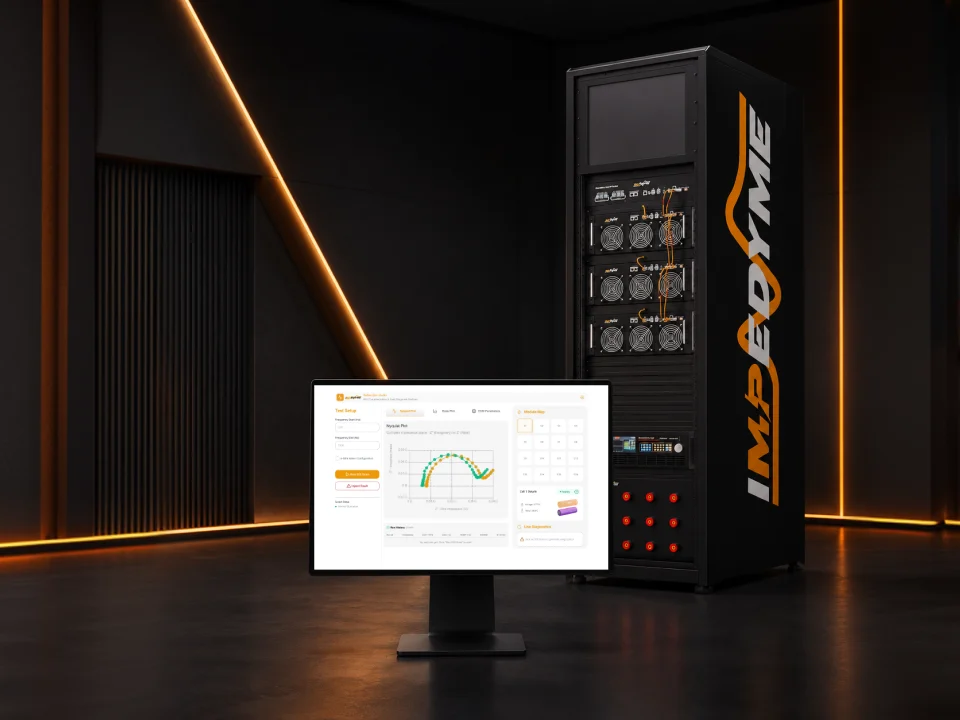
Impedyme’s platforms are built specifically around FPGA-based real-time emulation for power electronics, and they map cleanly onto a staged inverter testing workflow that moves from signal to power:
Several Impedyme products combine to make this workflow concrete for inverter testing:
PowerHIL Studio, is the test-automation and orchestration layer for the whole PHIL bench. It provides a scenario and sequence editor for drive cycles, ramps, step changes, and fault scenarios; synchronized control of motor, battery, and grid emulation; automated pass/fail criteria and reporting of key metrics such as current ripple, torque ripple, efficiency, and protection response; and built-in PHIL safety and limit management with configurable current, voltage, and power limits plus controlled shutdown.
MotorSim Studio is the high-fidelity motor-modeling and parameterization environment — essential for EV traction inverter testing, because the inverter’s whole job is to drive a motor. It offers model libraries for PMSM, induction, BLDC, and IPM machines; parameterization from datasheets, design data, or experimental characterization; angle-dependent flux, torque, and saliency maps; and what-if studies that let engineers change machine parameters and immediately see the impact on currents, torque, losses, and inverter stress.
The Impedyme Motor Emulator provides ultra-high-fidelity, real-time emulation of electric machines, so a traction inverter can be tested with no physical motor or dynamometer at all. It interfaces directly with high-performance traction inverters, supporting DC-link voltages up to 1000 V and phase currents up to 800 Arms, with switching frequencies into the hundreds of kilohertz and fundamental phase-current frequencies in the 10–20 kHz range for very high-speed drives. Its FPGA machine model updates roughly every 90 nanoseconds, performing hundreds to over a thousand updates per electrical period to capture saturation, cross-coupling, torque ripple, and back-EMF harmonics. In a typical bench, the motor emulator and a battery emulator are galvanically isolated to mirror a real vehicle, in which the pack and motor float relative to earth, and power is circulated internally so the AC mains only cover losses — making it possible to test high-power inverters from a modest grid connection rather than a megawatt-scale service.
BatterySim Studio and battery emulation reproduce the high-voltage pack feeding the inverter. A battery emulator sources and sinks power like a real battery, reproducing state-of-charge-dependent voltage and internal resistance, and supporting safe testing of over-voltage, under-voltage, over-current, and over-temperature scenarios without the hazards of real cells. This matters because EV inverters are fed by battery packs whose dynamics shape inverter behavior during hard acceleration and regenerative braking.
GridSim Studio and grid emulation address PV and grid-tied inverter testing, with drag-and-drop grid-profile creation, programmable voltage and frequency profiles, fault and disturbance waveforms, and real-time grid-impedance modeling for weak-grid, fault-ride-through, and islanded scenarios — enabling fully automated ride-through and compliance sequences.
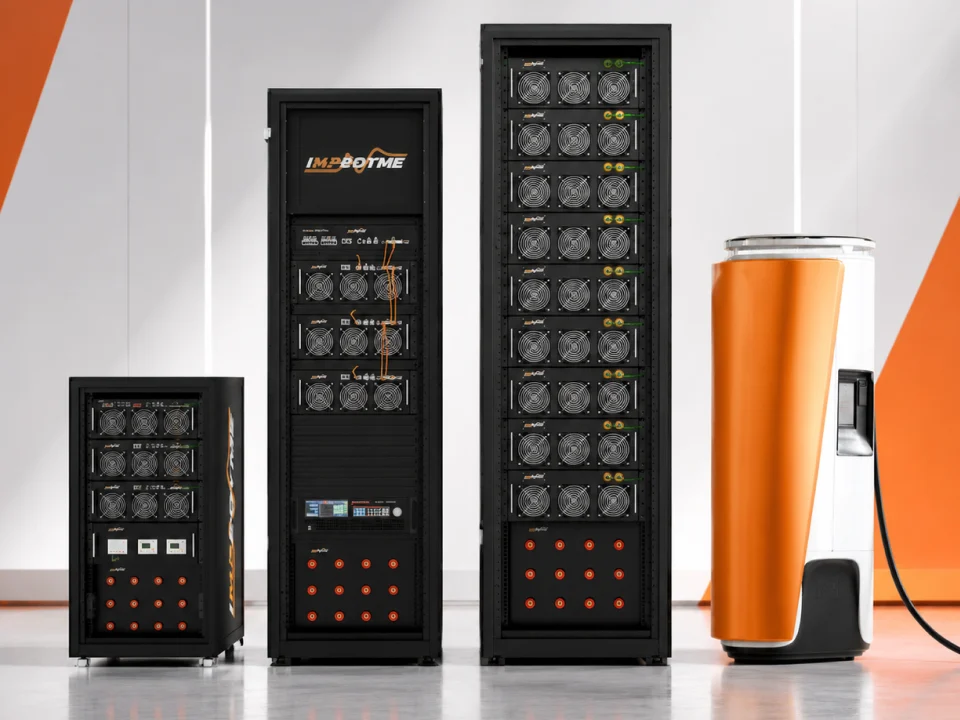
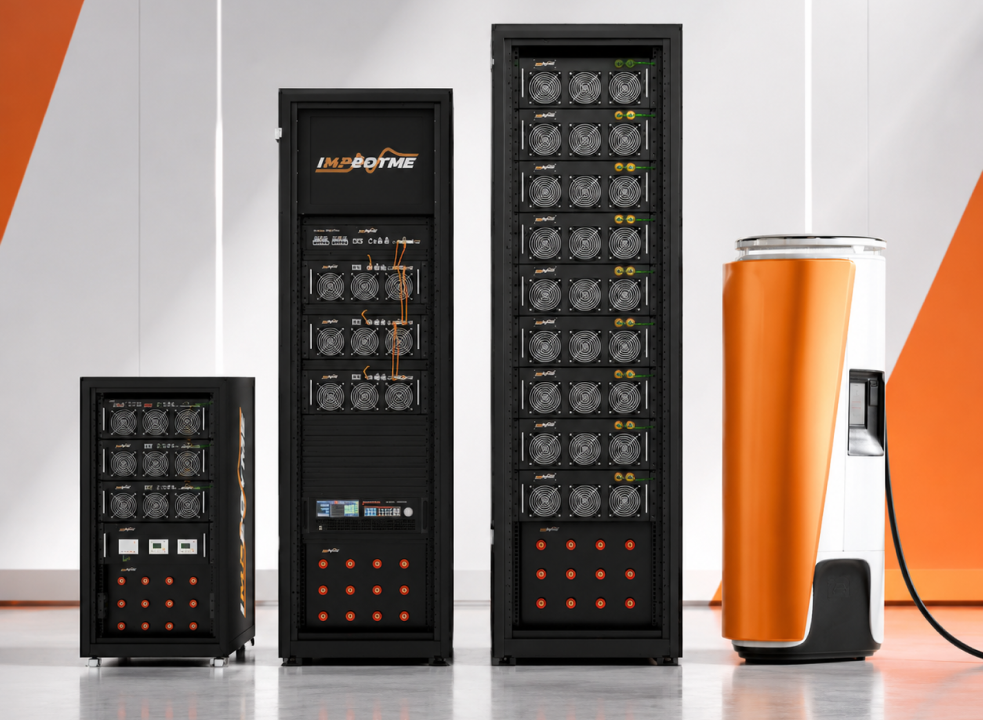
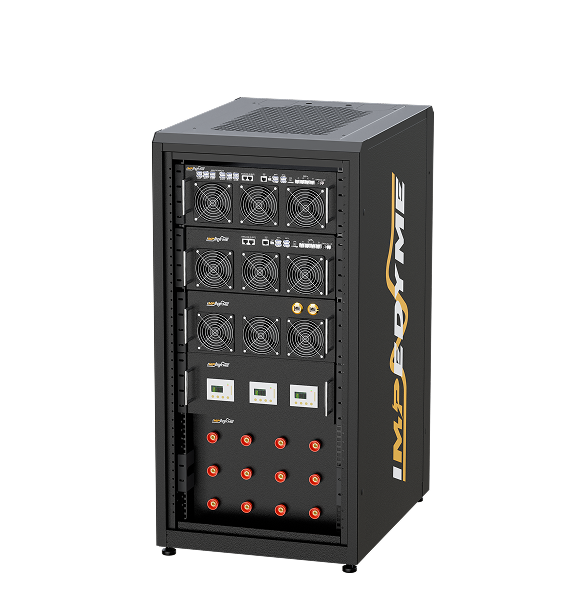
The CHP Testbench platform (Combined HIL and Power) unifies controller HIL and PHIL in a single architecture, with a tightly integrated FPGA real-time engine and a regenerative power interface, simulation time steps as low as 90 nanoseconds, and synchronized operation that eliminates timing mismatches between the signal and power domains. The CHP-150 与 CHP 300 hardware are high-voltage HIL/PHIL test and emulation systems with modular architecture and advanced thermal management, designed for real-time validation of inverters, motors, drives, batteries, and grid-connected systems. The power stage is fully regenerative — able to source and sink up to 100% of rated power — supports single, split, and three-phase AC as well as DC testing, and scales from tens of kilowatts upward.
A complete inverter testing capability draws on several categories of equipment — most of which the PHIL approach delivers as programmable emulation rather than physical hardware:
Because measurement uncertainty compounds when computing losses from large input and output power values, accuracy matters more than it first appears. At high power, a measurement-chain error of a fraction of a percent can be the difference between a meaningful efficiency figure and a useless one. An integrated PHIL platform with synchronized, high-resolution acquisition keeps that uncertainty in check.
For teams building or upgrading an inverter testing capability, the evidence points to a staged, emulation-first strategy:
A few benchmarks should actively change your plan. If your real-time simulation step is coarser than roughly one-tenth of your fastest switching period, treat your results as suspect and move to a faster FPGA-based platform. If your measurement-chain accuracy sits around 1% at high power, your efficiency-loss figures will carry large uncertainty — tighten to a fraction of a percent before making design decisions. And if you find you can’t inject the faults you most worry about because they’d destroy hardware, that is the clearest possible signal that you need an emulation-based PHIL workflow rather than a purely physical bench. As inverters move to 800 V SiC and GaN designs, rising dv/dt and common-mode noise mean your validation method — not just your instruments — has to keep pace.
Why is Hardware-in-the-Loop (HIL) used for inverter testing?
HIL lets engineers test an inverter’s control firmware and protection logic in closed loop against a real-time model of the surrounding system — before any full prototype exists. It’s safe, repeatable, and catches the cheapest-to-fix defects early. The main limitation of conventional processor-based HIL is update rate: many platforms top out around 50 kHz, which struggles to faithfully reproduce a modern inverter’s high-frequency switching. FPGA-based platforms remove that bottleneck with simulation steps down to roughly a microsecond or faster.
Can you test an EV traction inverter without a real motor or dynamometer?
Yes. A motor emulator electronically reproduces the machine’s behavior — back-EMF, inductance, saturation, torque ripple, and rotor-position effects — so the inverter “sees” a realistic motor that doesn’t physically exist. Impedyme’s Motor Emulator does this in real time with FPGA model updates on the order of 90 nanoseconds, interfacing directly with high-power traction inverters. This removes the dynamometer, the physical motor, and much of the safety risk, while making it possible to sweep the entire torque-speed map and inject faults that would destroy real hardware.
How do you test regenerative braking on an EV inverter?
Regenerative braking requires power to flow back from the motor toward the battery, so the test equipment must both source and sink power. In a PHIL setup, a bidirectional motor emulator and battery emulator handle this naturally: the emulated motor drives current back through the inverter, and the emulated pack absorbs it. The validation confirms the inverter manages current reversal and bidirectional energy cleanly, without nuisance trips or instability — all without circulating that energy through a physical dynamometer.
What equipment do I need for a complete inverter testing setup?
A full capability typically draws on a real-time simulator, a battery emulator on the DC side, a motor or load emulator on the AC side (for traction inverters), a grid emulator (for grid-tied and PV inverters), a bidirectional power interface, and high-accuracy measurement and protection instrumentation. The advantage of a PHIL approach is that most of these are delivered as programmable emulation rather than physical hardware. Impedyme’s CHP Testbench platform, with the CHP-150 and PHIL 300 systems, integrates the real-time engine and a fully regenerative power interface in one architecture, orchestrated through PowerHIL Studio.
How is grid-tied or PV inverter testing different from EV inverter testing?
Grid-tied and solar inverter testing focuses on how the inverter interacts with the utility rather than how it drives a motor. Key tests include fault ride-through (staying online through voltage sags and swells), anti-islanding (disconnecting quickly when the grid goes dead), power quality and harmonics, and — for solar — maximum power point tracking under changing irradiance. A grid emulator reproduces nominal and abnormal grid conditions on demand, including weak grids and programmable faults, so these scenarios can be run automatically and repeatably.