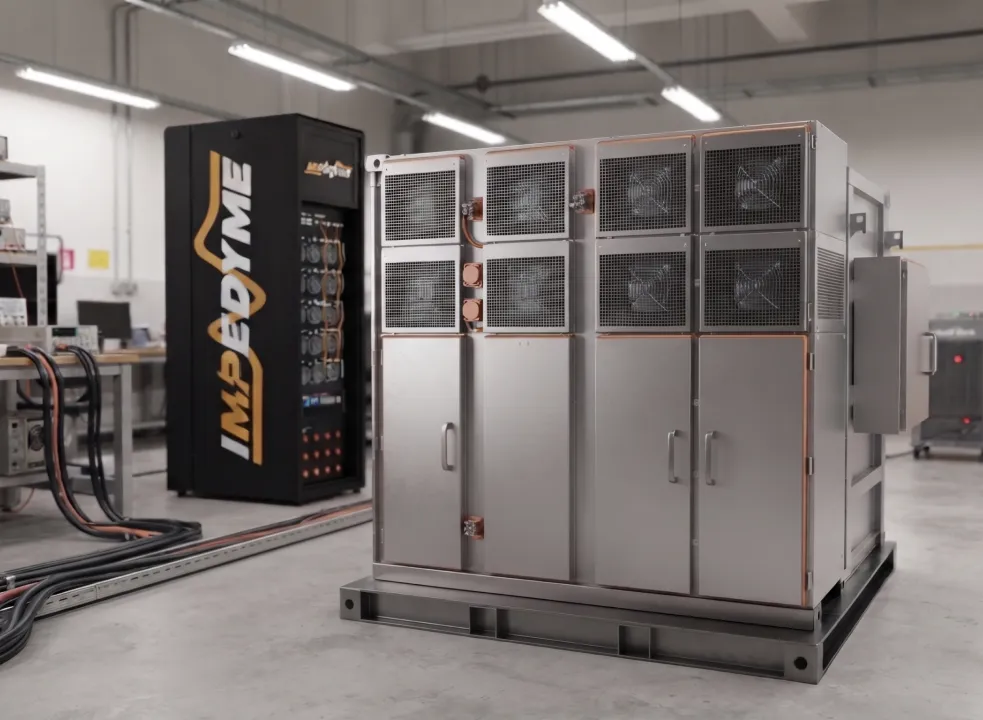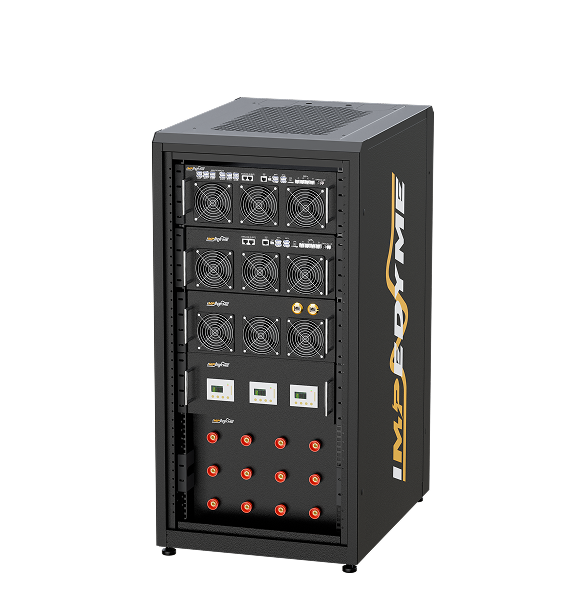

dc fast charger for electric vehicle card
dc fast charger for ev header

DC Fast Charger for EV Battery

What Is a DC Fast Charger for EV Applications?

A DC fast charger for EV applications is a high-power charging station that converts grid alternating current into regulated direct current right inside the station, then sends that DC straight to the vehicle’s battery. The reason this matters is simple but important: a battery can only store DC, so the conversion from AC to DC has to happen somewhere. In ordinary AC charging at home or at the office, that conversion happens inside the car itself, using a small onboard charger limited by space, weight, and cooling. A dc fast charger moves the conversion job out of the car and into a much larger cabinet on the ground, where there is room for serious power electronics, copper, and cooling. The result is a dramatic jump in charging speed — from 3 to 22 kilowatts at home up to 50, 150, 350 kilowatts, and even into the megawatt range for heavy-duty vehicles.

That jump is what makes long-distance electric driving practical. A modern dc fast charger for electric vehicle use can bring a typical passenger EV from 20 percent to 80 percent state of charge in roughly fifteen to thirty minutes, depending on the vehicle and the station. But behind that simple promise sits a genuinely sophisticated piece of engineering: three-phase active rectifiers, isolated DC-DC converters, high-frequency transformers, cascaded control loops, and strict grid-compliance standards. In the sections that follow, this guide walks through how a DC fast charger actually works, which standards govern it, how engineers design and tune it, and how Impedyme’s CHP testbench Power Hardware-in-the-Loop platform are used to validate it safely — at full power, but without putting an actual lithium-ion battery on the lab floor.

Why DC Fast Charging Is in a Class of Its Own

When people start researching electric vehicle charging, one of the first sources of confusion is the terminology. You will hear many different words used as if they all mean different things:

  • Level 1, Level 2, Level 3
  • AC charging vs DC charging
  • Slow charging, rapid charging, ultra-fast charging
  • DCFC, fast charging, Supercharging

They are not really different concepts. They are different lenses on the same underlying question: how much power can be delivered to the battery, and where does the AC-to-DC conversion take place? Understanding this distinction is the easiest way to see why a dc fast charger for ev use is in a completely different league from the charger most people have at home.

The Core Idea: Where Does AC-to-DC Conversion Happen?

Every EV charging method works on two simple facts:

  • EV batteries store energy as direct current (DC).
  • The electrical grid delivers alternating current (AC).

Somewhere between the wall socket and the battery, that AC has to be converted into DC. The only real question is where that conversion happens — and that answer determines everything else: the charging speed, the cost, the size of the equipment, and even which engineering standards apply.

Level 1 Charging — The Trickle

Level 1 is the slowest option, designed for ordinary household outlets:

  • Voltage: 120 V (North America) or 230 V (Europe)
  • Power: 1.4 – 1.9 kW in the US, up to ~2.3 kW in Europe
  • Where AC-to-DC happens: Inside the car, using the small onboard charger
  • Best for: Plug-in hybrids or drivers adding 50–60 km of range overnight
  • Limitation: Charging a fully depleted long-range EV can take 30+ hours — essentially a trickle

This is why almost no one uses Level 1 as their main charging method.

Level 2 Charging — The Everyday Standard

Level 2 is what most EV owners actually use at home or at work:

  • Voltage: 240 V (single-phase) or 400 V (three-phase in Europe)
  • Power: 3.7 – 22 kW
  • Where AC-to-DC happens: Still inside the car, using the onboard charger
  • Typical charging time: 4 – 12 hours for a full charge on a modern EV
  • Best for: Overnight home charging, workplace charging, hotels, parking lots

The key limitation of Level 2 is the size of the onboard charger inside the vehicle. Automakers cannot fit unlimited conversion hardware into a car because every kilogram and cubic centimeter has to be justified against:

  • Vehicle weight and crash safety
  • Cooling requirements
  • Manufacturing cost
  • Available space inside the chassis

This is the fundamental ceiling on AC charging speed — and it is the exact bottleneck that DC fast charging is designed to break.

Level 3 / DC Fast Charging — A Different Architecture Entirely

A dc fast charger solves the bottleneck by moving the AC-to-DC conversion out of the car and into the station.

Here is what changes when you do that:

  • The station is no longer constrained by what fits inside a car.
  • It can be the size of a large refrigerator or larger.
  • It can be packed with industrial-grade power electronics and liquid cooling.
  • It can connect directly to a three-phase or medium-voltage grid feed.
  • The energy that reaches the vehicle is already DC, so it can go straight to the battery at very high power.

These are all names for the same thing:

  • Level 3 charging
  • DCFC
  • DC fast charging
  • Rapid charging
  • Ultra-fast charging
  • Supercharging 

Typical performance numbers for today’s passenger DC fast chargers:

  • Power: 50 – 350 kW (10× to 100× more than home Level 2)
  • Charge time (20 → 80% SOC): about 15 – 30 minutes
  • Range added: roughly 100 – 300+ km in a single 20-minute session, depending on the vehicle

This is the difference between an overnight commitment and a coffee break.

The Next Tier: Megawatt Charging for Heavy-Duty Vehicles

Beyond the passenger-car space, an even higher tier is emerging for trucks and buses:

  • Standard: Megawatt Charging System (MCS)
  • Peak power: up to 3.75 MW (more than 10× the fastest passenger chargers)
  • Voltage and current: up to 1,250 V DC and 3,000 A
  • Status: First MCS corridors are already operating in Europe
  • 重要性: A long-haul truck cannot afford to sit at a charger for hours — MCS is the technology that makes electric trucking practical

The Big Takeaway

The difference between AC charging and DC fast charging is not just a matter of “more kilowatts” — it is a matter of architecture.

A quick comparison:

  • AC charging is constrained by what fits inside a car.
    • The car has to do the AC-to-DC conversion itself.
    • That hardware has to be small, light, and cheap.
    • The result is a hard speed ceiling around 22 kW.
  • DC fast charging is constrained by the grid connection and the cabinet.
    • Both can be made arbitrarily large.
    • That is why a dc fast charger for electric vehicle use can deliver hundreds of kilowatts.
    • That is also why DC fast charging introduces a whole new set of engineering challenges.

Those new engineering challenges include:

  • Strict standards for harmonics and power factor (so the charger does not pollute the grid)
  • Galvanic isolation between the grid and the vehicle (for user safety)
  • High-frequency power electronics (to keep the equipment compact)
  • Digital communication standards like ISO 15118 (so the charger and car can negotiate the session)

How a DC Fast Charger Works: From Grid to Battery

To understand how a dc fast charger works, it helps to follow the energy on its journey — from the utility line all the way to your EV battery. The whole system is really a chain of four stages, and each one solves a problem that the previous stage created.

The journey starts at the three-phase grid input, usually 400 to 600 volts AC. Power enters through a circuit breaker and a small filter that keeps electrical “noise” from leaking back onto the public grid. Think of this stage as a polite handshake between the charger and the utility, making sure the energy flows in cleanly.

Next comes the active rectifier, where AC is converted into DC. Instead of a simple diode bridge (which would dump messy, distorted current onto the grid), a modern dc fast charger for ev use relies on a smart rectifier built from fast electronic switches. It actively shapes the incoming grid current so that it is clean, sinusoidal, and in step with the voltage. The result is a near-perfect power factor, which is the technical way of saying the charger behaves as a well-mannered guest on the electrical grid.

The rectifier’s output feeds the DC link, a large capacitor bank typically held at 800 to 1000 volts. The DC link acts like a shock absorber. Whenever the power coming from the grid does not exactly match the power demanded by the battery, this capacitor absorbs the difference. Sized correctly, it keeps the voltage stable; sized poorly, the whole charger becomes either unstable or unnecessarily expensive.

From the DC link, energy moves into the isolated DC-DC converter, the second major conversion stage. It exists for two reasons. First, safety: since users physically touch the cable and connector, there must be no direct electrical path between the grid and the vehicle. A high-frequency transformer (running at 20 to 100 kHz) provides that isolation while staying compact. Second, flexibility: this stage adjusts the output voltage to match whatever battery is plugged in — anywhere from 150 to 1000 volts. That is how the same charger can serve both an older 400-volt EV and a modern 800-volt platform without any rewiring.

Finally, the regulated DC current passes through an output filter, safety monitoring, and contactors before reaching the connector — CCS, NACS, or MCS — that plugs into the car. Once connected, the charger and the vehicle’s battery management system (BMS) negotiate the charging profile through a digital protocol like ISO 15118. The current and voltage you see on the screen are the result of this whole chain working together in real time.

In short, a dc fast charger for electric vehicle use is more than just a “big plug.” It is a sophisticated power-electronics system that transforms raw grid energy into precisely controlled DC power — safely, efficiently, and in a way that respects both the vehicle and the electrical grid.

EV Charging Standards

DC Fast Charging Standards and Connectors: CCS, NACS, CHAdeMO, and MCS

A dc fast charger is only useful if it can speak the same physical and digital language as the vehicle plugged into it, and that language is defined by a handful of regional and global standards. Understanding them matters because the choice of connector affects three things at once:

  • Which vehicles the station can serve
  • Which markets the equipment can be sold into
  • Which communication protocol the charger has to implement internally

There are four main standards in use today: CCS, NACS, CHAdeMO, and the newer Megawatt Charging System (MCS). Each one is explained below.

Combined Charging System (CCS)

CCS is the most widely deployed DC fast charging standard outside of Tesla’s network. It comes in two regional variants:

  • CCS1 — used across North America; combines the Type 1 (J1772) AC connector with two extra DC pins underneath.
  • CCS2 — used across Europe and Oceania; built on the Type 2 AC connector with the same two DC pins added.

Key technical points:

  • Supports DC fast charging up to roughly 350 kW in current commercial deployments.
  • 通过 HomePlug Green PHY power-line communication to carry the digital handshake.
  • Communication is defined by ISO 15118 (and the older DIN 70121).
  • For any dc fast charger for ev programs targeting Europe or North America, CCS is the baseline that must be supported.

North American Charging Standard (NACS / SAE J3400)

NACS began as Tesla’s proprietary connector and has now been adopted by virtually every major automaker selling in North America from model year 2025 onward.

What makes NACS notable:

  • Mechanically much smaller than CCS — easier to handle and lighter on the cable.
  • Carries both AC and DC in a single unified plug (CCS uses two stacked sections).
  • Uses the same ISO 15118 communication layer as CCS, which makes dual-standard chargers relatively straightforward to build.
  • The May 2025 extension (SAE J3400/2) raised the supported voltage toward 1000 V, aligning NACS with modern 800-volt vehicle architectures.

CHAdeMO and ChaoJi

CHAdeMO is the Japanese standard, historically used on vehicles like the Nissan Leaf and still widely deployed in Japan and as a legacy installation across Europe.

How it differs from CCS:

  • Carries communication over a high-speed CAN bus rather than power-line communication.
  • A CCS-to-CHAdeMO adapter must therefore actively translate one protocol into the other — passive cables do not work.
  • The newer CHAdeMO 3.0 specification, harmonized with China’s GB/T standard under the name ChaoJi:
    • Raises the power ceiling above 500 kW.
    • Addresses the protocol differences that have complicated the older standard.
    • Aims to become a unified Asian-global standard for high-power DC charging.

Megawatt Charging System (MCS)

At the top of the power scale sits MCS, defined under SAE J3271 (issued March 2025) and the complementary IEC 63379 (released early 2026). MCS is built for heavy-duty commercial vehicles where even a 350 kW CCS station would take hours per fueling.

MCS at a glance:

  • Power delivery up to 3.75 MW (3,000 A at 1,250 V DC)
  • Industrial-scale heavy-duty connector designed for repeated high-current cycling
  • High-speed Ethernet communication instead of power-line communication
  • Target users: long-haul trucks, buses, and other heavy-duty commercial fleets
  • First European MCS corridors are operating now, with charger manufacturers shipping units in the 1,000–1,500 kW range
  • Because of the power level, MCS stations typically require medium-voltage grid connections rather than the low-voltage feeds used by passenger DCFC

What This Means for a Charger Designer

Two practical takeaways follow from the standards landscape:

  • The power electronics are largely connector-agnostic. The same active rectifier and isolated DC-DC converter inside the cabinet can serve CCS, NACS, or CHAdeMO — only the cable assembly and the protocol stack change.
  • ISO 15118-20 support is now effectively mandatory for future-proof stations, because:
    • The European AFIR regulation requires Plug & Charge readiness on new public DC chargers.
    • The United States NEVI program requires ISO 15118 support for federally funded stations.
    • ISO 15118-20 is also the protocol layer that unlocks bidirectional vehicle-to-grid (V2G) operation, the next frontier for the dc fast charger for electric vehicle industry.
Standards and Connectors

System Architecture: How Energy Flows from Grid to Battery

The 560 kW dc fast charger reference model is structured as a tightly coupled, multi-stage power conversion chain. Each stage features its own dedicated closed-loop controller, coordinating to ensure grid compliance, high efficiency, and safe battery charging.

STAGE 01: AC Grid Input

  • Electrical Parameters: 415 V RMS, 50 Hz, 3-phase.
  • Role: Utility power is delivered to the charger as a three-phase line voltage. This stage acts as the low-impedance source for the entire power system, establishing the voltage baseline for the downstream front-end converter

STAGE 02: Active Front End (AFE) Rectifier

  • Electrical Parameters: 交流   DC, 10 kHz PWM carrier, 800 V DC-link.
  • Role: A three-phase active rectifier utilizing a cascaded PI controller architecture. The outer loop regulates the intermediate DC-link bus to a constant 800 V, while the inner loop operates in the synchronous  reference frame to keep grid-side current sinusoidal and in-phase with the grid voltage, achieving active Power Factor Correction (PFC).

STAGE 03: Isolated DC-DC Converter

  • Electrical Parameters: 800 V intermediate input, L = 10 μH output filter choke.
  • Role: A high-frequency transformer provides galvanic isolation between the high-voltage grid and the vehicle chassis. Power transfer and constant output current are managed via a fast proportional-integral (PI) loop regulating the inductor current setpoint, matching the specific voltage profile demanded by the battery pack.

STAGE 04: Battery Pack

  • Electrical Parameters: 100S (100 cells in series), single string (1P), 50 Ah cell capacity, initial State of Charge (SOC₀) = 20%.
  • Role: Models a standard high-voltage battery pack (800 V class) under charging loads. Starting at 20% SOC represents the canonical “low battery” condition used in industrial fast-charging benchmarks, testing the controller’s ability to transition smoothly from Constant Current (CC) to Constant Voltage (CV) modes.

Key Performance Indicators (KPIs)

These design targets serve as the tuning objectives for the controller loops. They map directly to the standards a commercial dc fast charger installation must meet for grid integration, billing accuracy, and customer satisfaction.

Key Performance IndicatorTarget ValueEngineering Significance
DC-Link Voltage800 V ± 5% regulation bandEnsures voltage stability for the downstream isolated DC-DC stage, preventing overvoltage trips during grid transients.
Rated Output Power560 kWCalculated as 800 V DC bus output × 700 A current draw, matching modern high-power EV platforms.
Power Factor>0.95 (Unity Power Factor)Minimizes reactive power draw from the grid, reducing utility penalties and system thermal loading.
Total Harmonic Distortion (THD)<5% line current THDMeets strict IEEE 519 grid compliance standards, preventing high-frequency noise injection into the local distribution grid.
Charge Time (20% to 80% SOC)≈20 minutesAchieved using a regulated Constant Current Constant Voltage (CCCV) profile, balancing speed with cell degradation limits.

Inside the Model: Parameter Blocks and Control Design

Rather than organizing the MATLAB setup as a single long file, the model’s parameters are divided into six logical blocks within the script rectifier_params.m. This modular structure allows engineers to easily tune, scale, and compile the model for real-time HIL platforms.

01: Grid Voltage Conversion (RMS Phase   Peak)

This block converts the standard line-to-line RMS grid voltage into peak per-phase values required by the sinusoidal pulse-width modulator (PWM).

				
					% RMS line-to-line voltage of a standard EU 3-phase grid
rectifier.ACVoltagePP   = 415;
% Convert L-L RMS → L-N RMS
rectifier.ACVoltagePN   = rectifier.ACVoltagePP/sqrt(3);
% Convert RMS → peak (used by the PWM modulator)
rectifier.ACVoltagePeak = rectifier.ACVoltagePN * sqrt(2);
				
			
Engineering Explanation:

Standard electrical grids are defined by their RMS line-to-line voltage (VPPV_{PP} ), but the inner control loops and PWM generation require the per-phase peak amplitude (VpeakV_{peak} ). This is derived using the relation:

$$V_{\text{peak}} = \frac{V_{\text{PP}}}{\sqrt{3}} \times \sqrt{2}$$

02: Output Power Definition

This block defines the primary design point for the charger’s power conversion stages.

				
					% DC-side operating point – the entire model scales from here
rectifier.DCCurrent = 700;  % A
rectifier.DCVoltage = 800;  % V

% Implied design power:
% P = V × I = 800 V × 700 A = 560 kW
				
			
Engineering Explanation:

These values define the operating limits of the power converters. An 800 V DC bus matches modern 800 V battery architectures , while a 700 A charging current represents the upper limit for liquid-cooled CCS2 charging connectors. The nominal rated power is calculated as:

$$P_{\text{rated}} = V_{\text{DC}} \times I_{\text{DC}} = 800\ \text{V} \times 700\ \text{A} = 560\ \text{kW}$$

All downstream calculations, including line currents, line filter chokes, and DC capacitor sizing, scale dynamically based on this design point.

03: AC Current Calculation

This block uses instantaneous active power balance to calculate the required line current from the grid.

				
					% Peak line current required to deliver the DC-side power,
% derived from instantaneous power balance.
rectifier.acCurrent =...
    sqrt(2) * rectifier.DCCurrent * rectifier.DCVoltage /...
    (sqrt(3) * rectifier.ACVoltagePP);
				
			
Engineering Explanation:

Assuming a near-unity power factor and neglecting converter losses, the active power balance between the grid AC input and the DC output is defined as:

$$P_{\text{AC}} = P_{\text{DC}}$$
$$I_{\text{AC,peak}} = \frac{\sqrt{2} \times 800\ \text{V} \times 700\ \text{A}}{\sqrt{3} \times 415\ \text{V}} \approx 1102.77\ \text{A}$$
This calculated peak current determines the physical dimensions of the grid-side line filter chokes, copper busbars, and the thermal sizing (I²t limits) of the switching semiconductors.
 

04: Line Inductance & Resistance (Grid-Side Filter)

This block defines the passive impedance of the line filter connected between the grid and the active rectifier.

				
					% Grid-side line impedance (per phase)
rectifier.lineInductance = 0.1e-3;  % H  (100 µH)
rectifier.lineResistance = 20e-3;   % Ω  (20 mΩ)

% Effective electrical time constant
rectifier.lineT = rectifier.lineInductance /...
                  rectifier.lineResistance;
				
			
Engineering Explanation:

The grid-side line inductance (Lₗᵢₙₑ) acts as the physical energy storage element that the active front end controls against. This inductance:

  • Filters out high-frequency switching harmonics generated by the 10 kHz PWM carrier.

  • Establishes the plant pole for the inner current PI controller.

  • Defines the maximum rate of current change (di/dt), which dictates the current loop’s transient response.

The ratio of inductance to resistance defines the natural electrical time constant of the grid filter (t= L/R = 5). To maintain system stability, the inner current control loop’s bandwidth must be designed to be at least five times faster than this time constant.

05: DC-Link Capacitor (Voltage Buffer)

This block sizes the energy storage capacity of the intermediate DC-link bus.

				
					% DC-link energy storage
rectifier.OutputCapacitance = 20e-3;  % F  (20 mF)

% Stores ~6.4 kJ at 800 V:
% E = ½ · C · V² = 0.5 × 0.02 × 800² = 6,400 J
				
			
Engineering Explanation:

The DC-link capacitor (Cₒᵤₜ) serves as an energy buffer, decoupling the AC grid from the battery-charging DC stage. The electrostatic energy stored in the capacitor bank is:

$$E_{DC} = \frac{1}{2} C_{out} V_{DC}^2$$
20 mF800V, the stored energy is:
$$E_{DC} = 0.5 \times 0.02 \text{ F} \times (800 \text{ V})^2 = 6400 \text{ J}$$

This energy buffer absorbs grid voltage perturbations and protects the downstream battery pack from high-frequency ripple.

  • Under-sizing the capacitor results in large voltage ripple on the DC bus, causing control loop oscillations and accelerated battery aging.

  • Over-sizing the capacitor reduces the voltage loop’s response time and increases the physical footprint, cost, and inrush current of the charger cabinet.

06: Auto-Tuned Control Gains

This block dynamically calculates the proportional and integral gains for the cascaded controllers based on the physical parameters of the system.

				
					% Inner current loop – proportional gain
rectifier.controller.CurrentG = rectifier.lineInductance /...
    (2 * rectifier.G * rectifier.CurrentSensorG * rectifier.Tphi);

% Outer voltage loop – proportional gain
rectifier.controller.VoltageG =...
    (rectifier.OutputCapacitance * rectifier.CurrentSensorG) /...
    (rectifier.K * 2 * rectifier.VoltageSensorG * rectifier.Tdel);
				
			
Engineering Explanation:

Rather than using static or manually tuned PI gains, the script calculates control parameters dynamically using the Symmetrical Optimum tuning criterion.

  • Inner Current Loop: Controls line current; its bandwidth is limited by the sensor phase delay Tᵩ. The proportional gain scale is calculated directly from the line inductance (Lₗᵢₙₑ).
  • Outer Voltage Loop: Controls the intermediate 800 V DC bus; its bandwidth is limited by the total loop delay Tᵈᵉˡ. Its gain scales with the output capacitance (Cₒᵤₜ).

This dynamic auto-tuning capability is crucial when deploying the Simulink model onto real-time HIL platforms. If physical components are changed on the testbench, the control loops automatically retune to preserve system stability and transient response.


Complete Parameter Reference and Simulation Settings

The following reference tables detail the remaining sub-systems, sensor characteristics, and simulation settings used within the model.

Isolated DC-DC Stage Parameters

This stage provides galvanic isolation and regulates output power.

Variable数值Role
inverter.SwitchFrequency10 kHzCarrier frequency for the high-frequency switching bridge.
inverter.controller.kp2Proportional gain for the output current loop.
inverter.controller.ki1Integral gain for the output current loop.
inverter.inductance10 µHHigh-frequency output filter choke.
transformer.magnetizingL1 HMagnetizing inductance of the high-frequency isolation transformer.
transformer.windingFactor0.5Transformer turns ratio (N₂/N₁), stepping down the 800 V DC-link.

Battery Pack Parameters

Models the electrochemical load representing an 800 V class EV battery pack.

Variable数值Role
battery.currentReference100 AConstant Current (CC) charging setpoint sent from the virtual BMS.
battery.initialSOC0.20Standard 20% initial State of Charge for charging validation.
battery.AHRating50 AhCell capacity rating defining the charging speed (C-rate}.
battery.inductance5 mHEquivalent series inductance of the battery pack cabling.
battery.cellsInSeries100Series count, establishing a nominal pack voltage of 370 V to 420 V.
battery.batteryStringsInParallel1Single-parallel string configuration.

Simulation Time Settings

Determines the temporal parameters of the simulation.

Variable数值Role
simulation.numberOfCycles10The number of utility grid cycles simulated.
simulation.simTime0.2 sTotal run duration (10 cycles / 50 Hz grid frequency).

Front-End Converter Variants

To balance simulation speed with model fidelity, the front-end active rectifier is implemented using three interchangeable Simulink variants. This allows engineers to swap the power circuit topology without changing the surrounding controllers or the grid-facing test harness.

VARIANT 0: Average Model (powerCircuit = 0)

  • Technical Modeling: Bypasses active switching components, modeling the three-phase rectifier as ideal, controlled AC voltage sources and a DC current source.
  • When to Use: Used during early-stage control design, controller linearization, and frequency-domain stability analyses (such as plotting Bode and Nyquist criteria). This variant runs extremely fast, making it ideal for checking control loop stability.

VARIANT 1: Two-Level Converter (powerCircuit = 1)

  • Technical Modeling: Models a standard six-switch three-phase converter bridge using high-frequency semiconductor models.
  • When to Use: Used to verify PWM gating signals, analyze switching harmonics, examine dead-time effects, and calculate line current Total Harmonic Distortion (THD).

VARIANT 2: Three-Level Inverter (powerCircuit = 1)

  • Technical Modeling: Models a Neutral-Point-Clamped (NPC) three-level converter topology.

  • When to Use: NPC topologies are standard in high-power systems (≥ 800 V) because they halve the voltage stress across each semiconductor switch. This variant is used to design high-voltage systems, verify NPC-specific clamping diode balance, and confirm compliance with strict grid harmonics limits.

The Impedyme CHP Testbench: Real-Time Simulation Meets Real Power

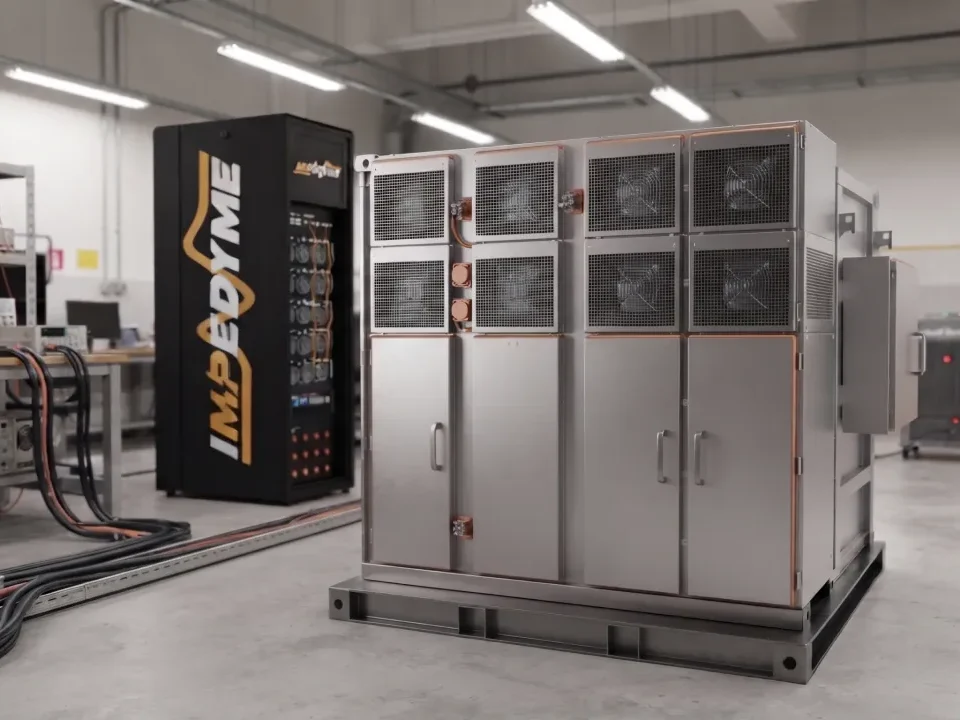
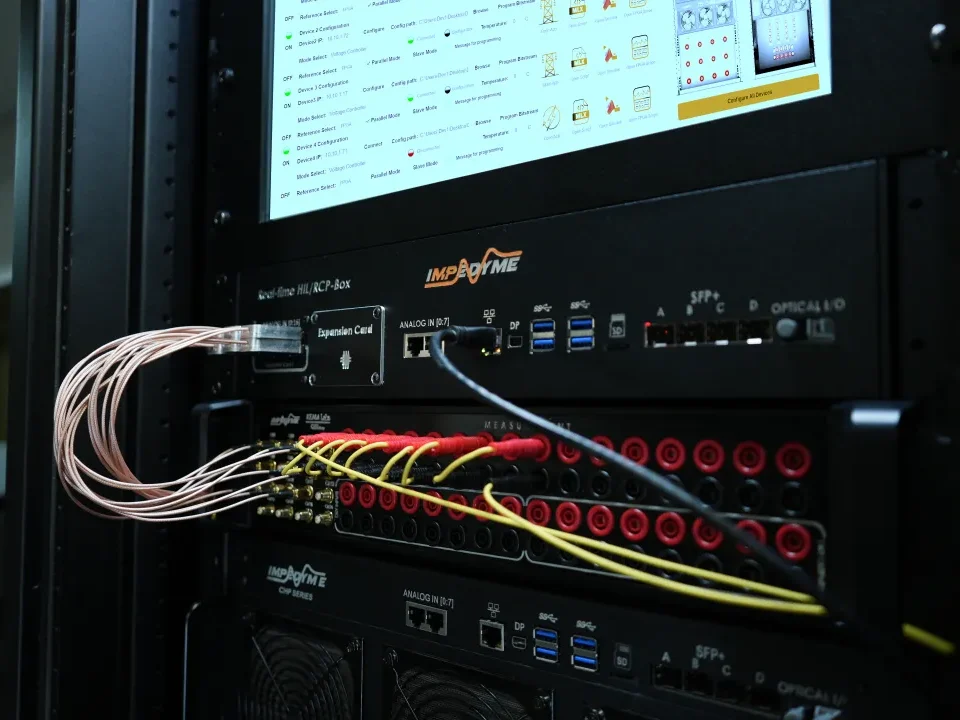
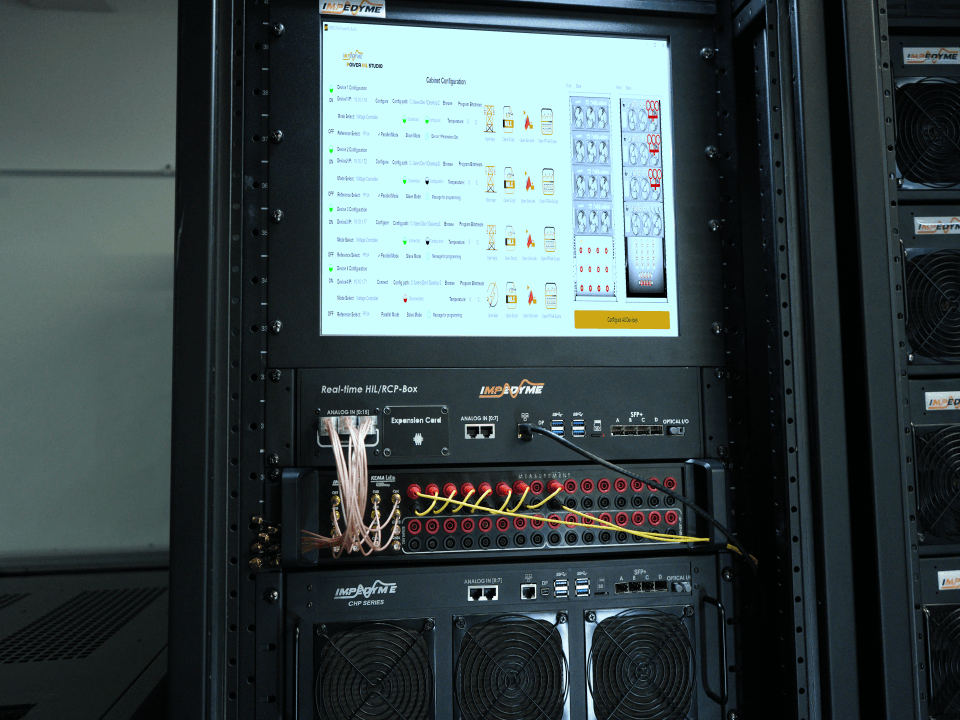
The Combined HIL and Power (CHP) testbench bridges Simulink models and the full-power behavior of a real dc fast charger in the field. Here’s why a simulation-first workflow has become standard for serious dc fast charger for ev programs.

What the CHP Testbench Combines

  • High-speed real-time simulator — FPGA-based, executes digital models of the grid, EV battery, and system under test in nanosecond time steps, fast enough to capture microsecond switching events.
  • Direct MATLAB/Simulink integration — a dedicated blockset lets engineers design in Simulink and deploy to the simulator with no code rewriting.
  • Bidirectional regenerative power hardware — reproduces exact grid voltage and frequency at full charger-rated power, measures the charger’s current draw, and closes the loop in real time.

The charger under test can’t tell the emulated grid from a real utility connection — even during voltage drops, frequency excursions, or phase imbalance no real utility would produce on demand.

Why Regenerative Power Matters

  • Energy flowing into the charger is recovered and recirculated, not dumped as heat or wasted.
  • A megawatt-class test consumes only system losses from the wall — not a full megawatt.
  • Enables long-duration stability sweeps and repeated fault-injection scenarios at low operating cost.

The Practical Workflow

  1. Early control-loop design in Simulink alone, using the average-fidelity rectifier for fast iteration.
  2. Controller-in-the-Loop — move the model to the real-time simulator, connect actual controller hardware, validate firmware.
  3. Power Hardware-in-the-Loop — connect the full power stage; the CHP testbench emulates the grid (and optionally the battery).

Every layer is validated against a realistic, full-power environment — no physical battery, no megawatt utility feed, and no risk of destroying prototype hardware.

The Charger Box and Battery Emulator: Completing the Validation Picture

A complete dc fast charger for electric vehicle validation campaign also addresses the vehicle side — the battery and the digital communication between charger and car.

Bidirectional Battery Emulator

  • Replaces the physical pack with a regenerative power source that reproduces real battery behavior in real time.
  • Eliminates the risk of thermal runaway, toxic gas, and fire from testing against a real lithium-ion pack.
  • No waiting for recharge between runs — what could take a week happens in a day.
  • Simulates dynamic voltage, current, internal resistance, state-of-charge progression, and behavior across temperatures and states of health.
  • Real-time Electrochemical Impedance Spectroscopy (EIS) — wideband measurements with micro-ohm accuracy above 1000 V while the charger operates, using multisine and Pseudo-Random Binary Sequence techniques. Lets engineers watch pack impedance evolve during the fast-charging session itself.

The Charger Box

Emulates the vehicle’s communication interface and handles protocol and compliance testing:

  • ISO 15118 communication over CCS and NACS connectors, including the Plug & Charge handshake required by European AFIR regulation and the US NEVI program.
  • CAN bus communication for CHAdeMO — useful for chargers supporting both standards.
  • Characterizes bidirectional power flow for vehicle-to-grid operation and validates source-to-sink transitions.
  • Simulates the BMS signals the charger expects from a real vehicle.

The charger under test sees a realistic, full-power, fully communicative environment — but no real utility connection, no real battery, and no real vehicle is required. For teams bringing a dc fast charger for ev product to market under tight schedule and cost constraints, this is what separates a successful program from one stuck in the lab.


The Future of DC Fast Charging Runs Through Simulation

The story of the DC fast charger has come a long way from the early days of electric mobility, when a fifty-kilowatt unit at a highway service area felt like science fiction. Today, a modern dc fast charger for ev use is a sophisticated power-electronics system that draws hundreds of kilowatts from the grid, transforms it through multiple conversion stages, and delivers it to the vehicle in a way that is both fast and respectful of the battery, the user, and the utility connection behind the wall. Tomorrow’s chargers, built around megawatt-class architectures, silicon-carbide semiconductors, and bidirectional vehicle-to-grid capability, will push that complexity even further. What ties the whole picture together is the realization that the hardest part of fast charging is no longer moving energy, it is proving that the system can do so reliably under every condition the real world will throw at it. Grid disturbances, battery faults, communication errors, compliance audits, and edge cases that only appear once in a thousand sessions all have to be addressed before a charger can be deployed at scale. This is the reason simulation-based validation has become not just a convenience but a competitive necessity: the teams that learn to design their dc fast charger systems in Simulink, validate them on a real-time Power Hardware-in-the-Loop platform like Impedyme’s CHP testbench, and round out the picture with a bidirectional battery emulator and a Charger Box for protocol testing are the teams that ship faster, with fewer surprises in the field and a clearer path to ISO 15118 compliance, megawatt charging, and the bidirectional grid services coming next.

If you are developing a dc fast charger for electric vehicle application — whether building a new charging product, integrating an existing one into a fleet depot, or qualifying a station for public deployment — Impedyme’s simulation-first ecosystem is built to take you from concept to production-ready hardware in the shortest practical path. The CHP testbench provides the real-time grid and the regenerative power interface, the battery emulator replaces the physical pack with a safer and more flexible substitute, and the Charger Box completes the loop with full protocol and compliance testing. Together they form the engineering foundation that the next generation of fast-charging infrastructure will be built on. To see how that foundation can fit into your own development workflow, or to discuss a specific project, the team at Impedyme is ready to help.